
SEATTLE, United States – FIFA has turned a World Cup knockout match into a global argument about power, rules, politics, and trust.
The Royal Belgian Football Association has challenged FIFA’s decision to let United States striker Folarin Balogun face Belgium in Monday’s last-16 clash, even after a red card in the previous round should have triggered an automatic one-match ban. The decision followed direct pressure from U.S. President Donald Trump, who asked FIFA President Gianni Infantino to review the sending-off, according to Reuters.
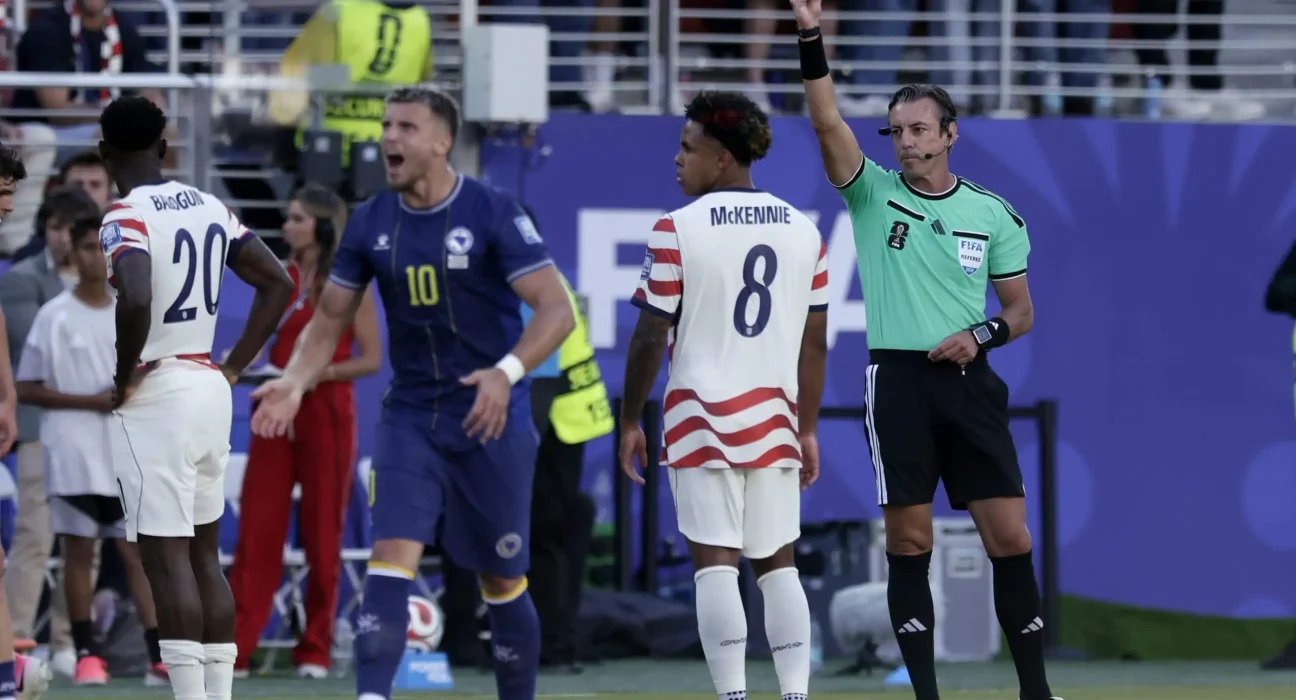
Balogun scored his third goal of the tournament in the United States’ 2-0 win over Bosnia and Herzegovina, then received a red card after a VAR review for a challenge on defender Tarik Muharemovic. FIFA later suspended the implementation of his ban for one year, while leaving the red card on his record.
This is why Belgium is angry. This is why UEFA is furious. This is why the story now matters far beyond one striker, one tackle, or one match in Seattle.
Football rules only work when teams believe the same law applies to everyone. Once a host nation’s president places a call and a suspended player suddenly becomes eligible, suspicion enters the game. FIFA now faces a question deeper than Balogun’s studs, VAR angles, or disciplinary wording. Who gets mercy from FIFA, and who gets the rule book?
UEFA did not hide its anger. It accused FIFA of crossing “a red line” and called the decision “unprecedented, incomprehensible and unjustifiable.” UEFA also warned that when the guardians of rules fail to guarantee certainty, “the integrity of the game is at stake.”
Those words carry weight. UEFA rarely attacks FIFA this openly during a World Cup. Its reaction shows how dangerous this ruling looks inside football’s own power structure. Europe sees a precedent. Belgium sees an unfair match advantage. Other teams see a warning. Political access might now matter as much as disciplinary evidence.
FIFA has defended its decision by pointing to Article 27 of its Disciplinary Code. The article allows a judicial body to fully or partly suspend the implementation of a disciplinary measure. It also places the sanctioned person under probation for one to four years. If Balogun commits another offence of similar gravity during the probation period, FIFA says the suspended punishment will return.
That explanation does not answer the core problem. The rule exists. The timing still stinks. The United States plays Belgium in a knockout match. The American president calls FIFA’s president. FIFA then applies a rarely used disciplinary escape hatch and clears America’s leading scorer to play. That chain of events demands sharper scrutiny.
Trump celebrated the decision on Truth Social, thanking FIFA for “reversing a great injustice.” Reuters also reported a White House post celebrating Balogun’s reinstatement with “USA-USA-USA.”
The optics are terrible for FIFA. Football’s world body has spent years telling fans it protects fairness, neutrality, and sporting integrity. Yet this case now links discipline to presidential influence. FIFA did not rescind the red card. It did not say the referee made a formal error. It did not erase the offence. It only delayed the punishment long enough for Balogun to face Belgium.
That is exactly why Belgium has moved. The RBFA said it was “astonished” by FIFA’s decision and argued that the move contradicted World Cup regulations on automatic suspensions. Reuters reported that Belgium has been investigating its options, while The Athletic reported the federation had written to FIFA to lodge an appeal.
Belgium’s point is simple. A red card in one World Cup match should mean suspension in the next World Cup match. If FIFA wants exceptions, it must define them clearly before the tournament, not during a crisis involving the host nation.
This case also exposes an old FIFA weakness. The organisation often hides behind legal language when public trust needs plain answers. Article 27 gives discretion. It does not explain why discretion appeared here, now, for this player, before this match, after this political call.
Pochettino, the United States coach, welcomed the ruling. He said most football people saw the red card as unfair punishment and argued that past cases showed punishments could be suspended and served later.
That defence helps the United States, but it does not close the argument. Many controversial red cards happen in major tournaments. Many players miss decisive matches because a referee, VAR official, or disciplinary panel makes a harsh call. That pain forms part of tournament football. The law often feels cruel. The law still has to look equal.
England manager Thomas Tuchel asked the question many coaches now share after his own player Jarell Quansah was sent off against Mexico. “Who overturns this decision then and when? And on what grounds?” he asked.
That is the question FIFA must answer before this storm grows larger.
The Balogun case also lands in a politically sensitive World Cup. The United States is a co-host. Trump sits at the centre of American politics and has a public relationship with Infantino. The tournament already carries commercial, diplomatic, and security pressure. FIFA now looks exposed to the charge that power bends procedure.
Balogun himself should not carry the full weight of this scandal. He did not write Article 27. He did not run FIFA’s disciplinary committee. He did not design the appeal pathway. He scored goals, received a red card, and benefited from a decision made above him.
The responsibility sits with FIFA.
If FIFA believes Balogun’s red card was wrong, it should explain the evidence. If FIFA believes Article 27 applies to automatic red-card suspensions, it should publish a clear standard. If FIFA wants probation to replace match bans in rare cases, it should say which cases qualify. Silence feeds distrust.
For Belgium, this controversy changes the emotional temperature of the match. The players now enter Seattle believing their opponent has gained a political advantage. For the United States, Balogun’s return strengthens the attack but places the team inside a legitimacy debate. Every touch from him will now draw noise.
For world football, the danger is bigger. A World Cup knockout match should be decided by players, tactics, courage, mistakes, and pressure. It should not become a test of who has the strongest politician on speed dial.
FIFA wanted a legal solution. It has created a credibility crisis.