
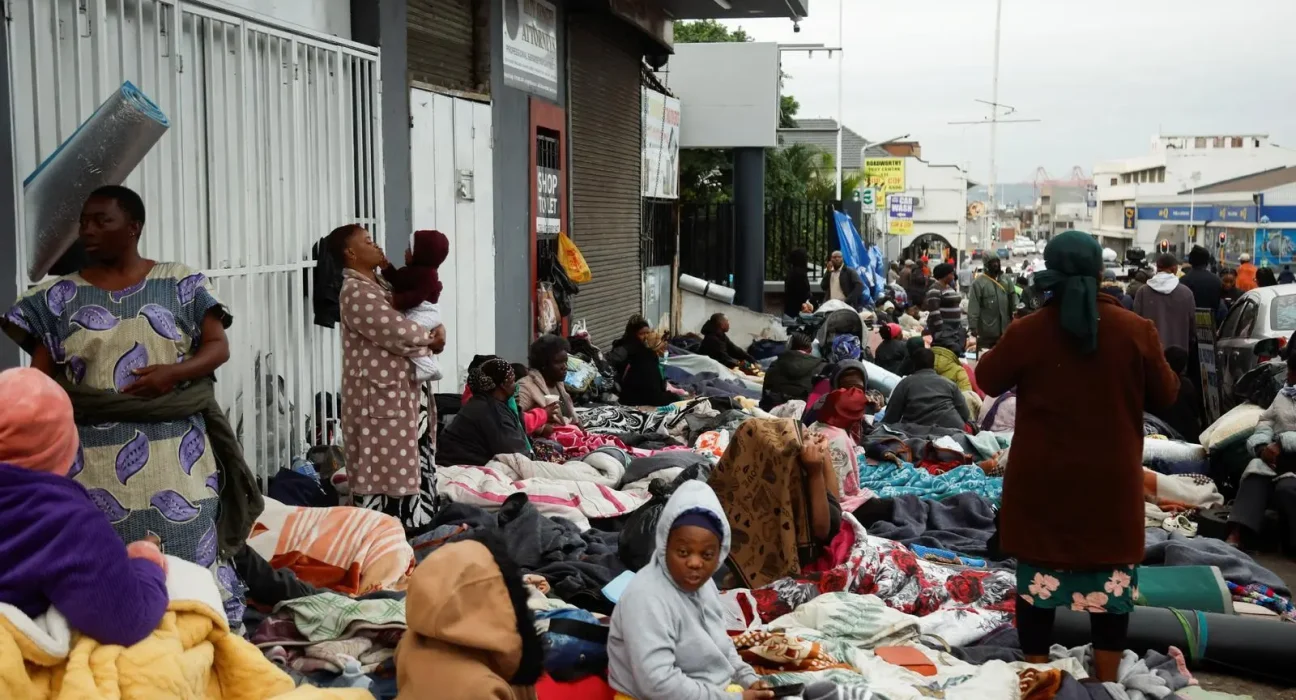
JOHANNESBURG, South Africa – Africans are not rushing to South Africa because they hate their countries. They are fleeing policy failure, collapsing currencies, weak property rights, corrupt tender systems, broken hospitals, missing jobs, and ruling parties which treat the state as a liberation inheritance.
The hard truth is this. South Africa has unemployment, crime, inequality, load-shedding scars, Afrophobia, and political decay. Yet millions of Africans still see it as a better bet than home. Statistics in South Africa’s Census 2022 migration report says Zimbabwe, Mozambique, and Lesotho were the top three source countries for immigrants in South Africa, with Zimbabwean men and women forming the largest share among the top ten immigrant groups.
That fact should not lead to street hatred. It should lead to policy comparison.
Ask the right question. What are Africans fleeing?
They are fleeing currencies that destroy wages. Zimbabwe launched the ZiG in 2024 to replace a collapsing local currency, then battled public mistrust, devaluation history, and the continued dominance of the US dollar. Reuters reported that Zimbabwe’s ZiG was sharply devalued in September 2024 and later traded far weaker than its launch rate. By 2026, inflation had cooled, but confidence still needed tight policy, transparency, reserves, and creditor progress.
A worker follows the currency. A trader follows the currency. A nurse, teacher, builder, security guard, and mechanic follows the currency. The rand has problems, but it still moves through banks, shops, salaries, rentals, remittances, savings, and cross-border trade with more credibility than many regional currencies.
They are fleeing property insecurity. Investors do not build factories where tomorrow’s politician might seize the asset, reverse the permit, punish the owner, or give land to a connected comrade. Zimbabwe’s land history damaged agricultural confidence and still shadows investment. South Africa also faces serious land reform disputes, especially after its 2025 Expropriation Act, but the fight still runs through courts, Parliament, legal challenges, banks, and public argument. That matters. Reuters reported that South Africa’s law triggered fierce debate over property rights and investment, while the government said it created a legal framework for public-interest expropriation.
That is the difference. A flawed system with courts still attracts money faster than a revolutionary system where party power sits above law.
They are fleeing tenderpreneurship. Across many African states, public contracts enrich political insiders before they build anything useful. Roads cost too much. Hospitals get no medicine. Schools get no desks. Water projects stall. Connected companies receive money, fail to deliver, and return at the next tender under another name.
Zimbabwe offers a warning. Transparency International’s 2025 Corruption Perceptions Index gives Zimbabwe a score of 22 out of 100 and ranks it 157 out of 182 countries. That score reflects a public sector where corruption perception remains severe.
The disease is not only Zimbabwean. South Africa knows the same sickness through state capture, cadre deployment, municipal collapse, and politically connected contracts. Yet South Africa still has stronger courts, louder media, deeper capital markets, tougher civil society, and a private sector with enough weight to resist total party control.
That brings the uncomfortable point. South Africa still has a substantial white, Indian, black, and foreign investor class with factories, farms, logistics firms, banks, mines, supermarkets, law firms, hospitals, schools, and pension capital. Many white South Africans still own major productive assets because apartheid left a brutal economic inheritance. But after 1994, South Africa did not completely destroy that productive base. It taxed it, regulated it, fought over it, transformed parts of it, and sometimes punished it. But it did not fully burn it down.
Many revolutionary parties elsewhere made a fatal mistake. They replaced white supremacy with party supremacy. They did not free the state. They captured it.
Look at the pattern. ZANU-PF in Zimbabwe, FRELIMO in Mozambique, MPLA in Angola, SWAPO in Namibia, CCM in Tanzania, and the ANC in South Africa all carry liberation history. Some governed better than others. Some built more stable systems than others. But the danger repeats. The party that fought for liberation started to treat the army, police, courts, parastatals, tenders, land, and public jobs as revolutionary property.
Once the army marries the ruling party, corruption gains bodyguards.
That is why comrades rarely arrest comrades. They investigate each other in public, then protect each other in private. They suspend, redeploy, rehabilitate, and recycle. South Africa saw this language again when ANC secretary-general Fikile Mbalula defended Dina Pule’s return to Cabinet, saying she had been rehabilitated and deserved another chance after past misconduct linked to the ICT Indaba scandal.
That word, rehabilitated, tells the continent everything. In many African ruling parties, corruption becomes a moral mistake, not a crime against the poor. A minister falls. A minister waits. A minister returns.
China takes a harsher road. No African democracy should copy China’s lack of open political freedoms or use anti-corruption as a weapon against rivals. But China shows one lesson about fear of consequence. AP reported on July 7, 2026, that a former Nanjing economic development official, Yang Youlin, received a death sentence after a court found he took about $325 million in bribes over three decades. Reuters also reported in 2025 that Zhao Weiguo, former chairman of Tsinghua Unigroup, received a suspended death sentence over corruption and embezzlement.
Africa does not need firing squads. Africa needs certainty. Steal public money, lose office. Steal public money, lose assets. Steal public money, go to prison. Steal public money, lose party protection.
The migration answer also sits in factories. South Africa remains one of Africa’s most industrialised economies, with a large formal retail system, major banks, mines, ports, universities, private hospitals, public hospitals, courts, highways, and digital infrastructure. Its economy grew only 1.1 percent in 2025, but it still held the continent’s largest economy status by official output reporting.
That scale pulls people.
Hospitals pull people too. South African public hospitals face overload and poor management, but many migrants still compare them with hospitals at home and choose South Africa. A 2024 study on undocumented Zimbabwean migrants said they rely on South African public healthcare for treatment of communicable and non-communicable diseases, surgery, and other care.
This does not mean South Africa has Africa’s best standard of living in every measure. Seychelles, Mauritius, Botswana, and some North African states outrank South Africa on some human development or income indicators. UNDP’s 2025 table places South Africa at HDI rank 106, with an HDI of 0.741.
But South Africa still beats many countries sending migrants there. That is the honest comparison.
So African leaders must stop insulting South Africans and migrants alike. South Africans must not hunt Africans in the streets. African governments must not export citizens, then hide behind Pan-African slogans. Zimbabwe, Mozambique, Malawi, DRC, Lesotho, Nigeria, and others must ask why their citizens risk humiliation, violence, police raids, and death for South African survival.
The answer is not hatred. The answer is reform.
Fix currency trust. Protect property. Arrest corrupt comrades. End tender cartels. Separate army from party. Build maternity wards. Stock clinics. Industrialisation. Pay workers in money that keeps value. Let courts punish elites. Let business operate without party permission. Let citizens see a future at home.
No African would beg to be tolerated and harassed in Johannesburg if Harare, Maputo, Lilongwe, Kinshasa, Maseru, and Lagos worked for ordinary people.
South Africa attracts Africans because many African states repel them by poor governance. That is the policy truth behind the migration crisis.