

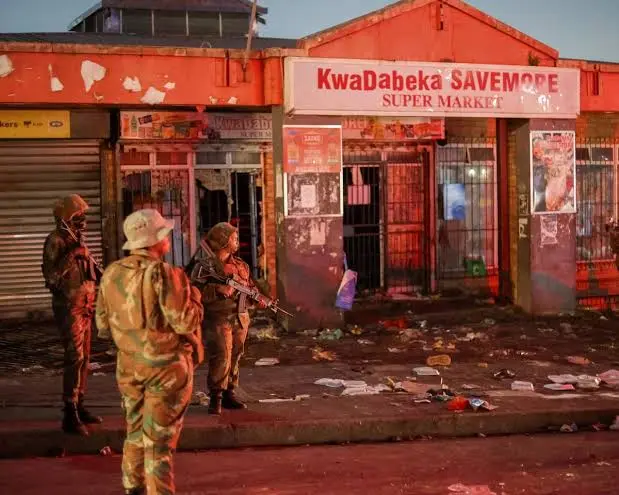
JOHANNESBURG, South Africa – President Cyril Ramaphosa has sent soldiers into South Africa’s streets because the government allowed an immigration crisis to leave state offices and enter mobs, marches, threats, looting, fear, and regional diplomacy.
This deployment marks a grave moment. A democracy sends soldiers to support police when ordinary law enforcement no longer carries enough authority. Ramaphosa authorised 3,405 members of the South African National Defence Force to assist police during countrywide marches against undocumented immigrants. The deployment began on June 28 and runs until July 31. News24 reported the soldiers would assist SAPS in maintaining law and order during planned marches, while Reuters placed the cost at about 54.6 million rand, roughly $3.37 million.
This is not strength. This is a state failure wearing boots.
South Africans have every right to demand border control. They have every right to demand clinics, jobs, schools, housing, identity systems, lawful business permits, clean policing, and fair service delivery. No elected government has the right to dismiss those concerns with slogans. But no citizen, movement, party, or street committee has the right to demand identity documents from strangers, raid homes, close shops, or decide who belongs in a neighbourhood.
Ramaphosa said exactly this in June when he warned groups exploiting public concern over illegal immigration for political, personal, and criminal agendas. He said immigration enforcement belongs to the state alone and warned against groups using legitimate concerns to incite lawlessness and violence.
The tragedy is clear. Government waited until vigilante politics had grown muscles, slogans, routes, leaders, deadlines, and fear. Now the same government needs soldiers to contain what weak governance helped feed.
The anti-immigrant mobilisation has been led by groups including March and March, which set an unofficial June 30 deadline for undocumented foreign nationals to leave South Africa. Organisers said their demonstrations would remain peaceful, but foreign nationals with documentation also reported harassment. The Guardian reported police units across towns and cities before the marches, while troops and assets appeared in Johannesburg’s central business district.
The message to migrants was not subtle. Leave, or face the street.
Across Johannesburg, Durban, Cape Town, and other centres, marches drew South African flags, sticks, angry chants, and deep frustration. Reuters reported thousands of demonstrators took to streets, with many marches mostly peaceful, while some descended into looting and violence. Police arrested more than 900 people for offences including immigration violations, public violence, robbery, and harbouring undocumented migrants.
That mixture shows why this crisis has become dangerous. A protest over immigration becomes a net for criminals. A demand for law becomes an excuse for lawlessness. A complaint about state absence becomes a street occupation of state power.
The human cost has already crossed borders. Reuters reported Ghana, Nigeria, Malawi, and Mozambique were repatriating some citizens caught in the unrest. Mozambique said five of its nationals had been killed. Ghana petitioned the African Union over treatment of its nationals and began compiling lost assets for possible litigation.
This is no longer only a South African matter. This is a continental wound.
Nigeria then reported two citizens killed amid the surge in anti-migrant violence. One was shot near his shop in eMalahleni, while another died in police custody during interrogation in Pretoria, according to Reuters. South Africa’s Independent Police Investigative Directorate is probing the police custody case. Nigeria warned of possible action if Pretoria fails to address the situation.
South Africa risks becoming a country where African foreigners fear both mobs and uniforms. That image damages Pretoria in the African Union, SADC, ECOWAS, and every bilateral corridor where South African companies still seek business.
The anger on South African streets has roots. Unemployment remains punishing. Public services strain under corruption, poor planning, and weak local government. Informal settlements grow. Hospitals overflow. Spaza shop wars create resentment. Fake documents, bribed officials, porous borders, and criminal syndicates make citizens feel abandoned.
But blaming every foreign national for South Africa’s collapse gives corrupt officials a gift. It shifts the spotlight from stolen budgets, broken municipalities, failed policing, ghost borders, tender fraud, and political patronage. A Zimbabwean vendor did not collapse Eskom. A Malawian gardener did not loot municipalities. A Congolese refugee did not design Home Affairs backlogs. An Ethiopian shopkeeper did not create youth unemployment.
Social scientists dispute claims linking migrants to job scarcity and crime. Reuters noted immigrants account for about 3 million people, around 4 percent of South Africa’s population, a low share by global standards. The Guardian also reported crime statistics show foreigners commit only a small fraction of crimes, undermining claims repeated by protest organisers.
Yet statistics do not comfort a hungry citizen watching local services fail. That is why the state must act with two hands. One hand must enforce immigration law firmly. The other must crush vigilantism without apology.
South Africa needs fast immigration courts, clean deportation procedures, secure biometric identity systems, protected asylum processes, audited work permits, and prosecution of officials who sell documents. Ramaphosa has promised dedicated courts for immigration cases and replacement of paper green book identity documents with secure biometric digital identity cards.
Those steps matter only if they move from speeches to desks, border posts, courts, and police dockets.
The army deployment buys time. It does not solve the crisis. Soldiers cannot repair Home Affairs. Soldiers cannot audit work permits. Soldiers cannot rebuild trust in police. Soldiers cannot provide jobs. Soldiers cannot erase Afrophobia from township politics. Soldiers cannot rebuild businesses destroyed by mobs.
The hard lesson is simple. When the government allows street groups to take law into their hands, disorder returns with force. A state that trains citizens to accept mob enforcement should expect mob power to grow beyond control.
Ramaphosa now faces a test larger than June 30. He must prove South Africa belongs to law, not mobs. He must protect citizens and migrants at the same time. He must enforce borders without feeding Afrophobia. He must stop illegal migration without turning poverty into ethnic cleansing. He must punish looters, document sellers, corrupt police, violent organisers, and employers who exploit undocumented labour.
South Africa has reached a point where silence no longer counts as caution. Silence now counts as permission.