
JOHANNESBURG, South Africa – The United States has walked into South Africa’s most dangerous domestic fracture at the worst possible time.
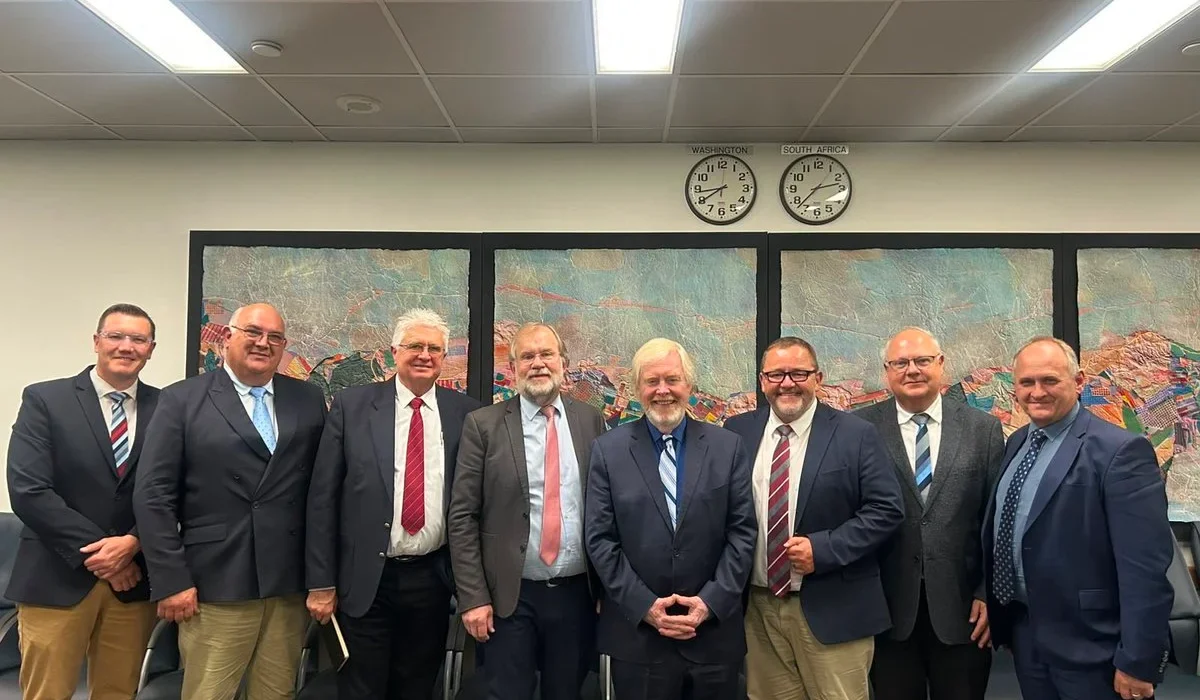
US Ambassador to South Africa L. Brent Bozell III has met Afrikaner leaders in Pretoria while South Africa faces a fierce anti-immigrant wave, army deployments, African diplomatic anger, and renewed questions over whether Washington now treats South Africa as a hostile state rather than a partner.
The meeting included leaders from the Solidarity Movement, AfriForum, Solidarity, the Southern African Agri Initiative, NEASA, and the Freedom Front Plus. The US Embassy said it was “great to see Afrikaner leaders” and said discussions focused on how the US government’s focus on the community could help make South Africa “safer and more prosperous.”
That sentence carries a heavy political charge. A foreign ambassador did not meet a broad national civic delegation. He met organisations rooted in Afrikaner identity politics, minority rights campaigns, property rights battles, farm safety campaigns, and opposition to parts of South Africa’s post-apartheid transformation agenda. Some present themselves as civil rights bodies. Their critics describe them as part of a white-right ecosystem that international conservatives have used to frame South Africa as a country persecuting white citizens.
This meeting took place while South Africa’s streets were under pressure from anti-migrant protests led by groups including March and March. Reuters reported that President Cyril Ramaphosa deployed 3,405 soldiers from June 28 to July 31 to support police during the unrest, at a cost of about R54.6 million. More than 900 people were arrested for offences linked to the protests, including public violence, robbery, immigration violations, and harbouring undocumented migrants.
The timing should alarm Pretoria. South Africa is already struggling to prevent anti-immigrant anger from becoming Afrophobic violence. Reuters reported that protesters marched across cities on June 30 after demanding that undocumented migrants leave the country, with some areas seeing looting, clashes, and deaths. Migrants from Zimbabwe, Malawi, Nigeria, Ghana, and Mozambique fled or sought help from their embassies.
Now add Washington’s racial diplomacy to the same fire.
The Trump administration has spent more than a year advancing the claim that white South Africans, especially Afrikaners, face racial persecution. In February 2025, Trump signed an executive order cutting US assistance to South Africa, citing Pretoria’s land policy and its genocide case against Israel at the International Court of Justice. Reuters reported that the order also provided for resettlement in the United States of Afrikaners who were described as victims of unjust racial discrimination.
In May 2026, Reuters reported that Trump raised the US refugee admissions ceiling by 10,000 to bring in more white South Africans. The presidential determination said white South Africans of Afrikaner ethnicity faced an emergency situation because of “incitement of racially motivated violence” by the government and political parties in South Africa. Pretoria rejects that premise.
That is why Bozell’s meeting lands like a diplomatic provocation. It does not stand alone. It follows aid cuts, refugee preference for white South Africans, public US attacks on South Africa’s land reform debate, criticism of Pretoria’s Palestine policy, and the expulsion of South Africa’s ambassador to Washington, Ebrahim Rasool, in 2025. Reuters reported that the US declared Rasool persona non grata after accusing him of race-baiting and hostility toward Trump.
Diplomats have a right to meet civil society. That point matters. A meeting with AfriForum or Solidarity does not automatically breach the Vienna Convention. Diplomacy includes listening to political parties, unions, business groups, churches, farmers, activists, and minority organisations.
The problem begins when a foreign mission appears to privilege one racial constituency inside a country already battling racial wounds, migration panic, and street violence. Article 41 of the Vienna Convention on Diplomatic Relations says diplomats must respect the laws and regulations of the receiving state and must not interfere in its internal affairs.
Pretoria must now ask a direct question. Was this routine engagement, or part of a wider US political project aimed at pressuring South Africa through race, sanctions, refugee policy, and elite networks?
That question grows sharper because the anti-immigrant movement itself now carries a US soft-power controversy. News24 reported in an opinion column that March and March leader Jacinta Ngobese-Zuma participated in the US State Department’s International Visitor Leadership Program in 2023. The State Department describes that programme as a professional exchange which advances US national security priorities and builds long-term relationships with international leaders.
That fact does not prove US control of March and March. It does not prove funding. It does not prove intelligence direction. But it creates a legitimate political question in a country where anti-migrant mobilisation now threatens African lives, regional relations, and public order.
South Africans should not fall into lazy conspiracy. They should demand evidence. Who funds these marches? Who prints material? Who provides logistics? Who trains organisers? Who protects leaders politically? Who benefits when South Africa fights African migrants in the street while Washington courts white minority organisations in Pretoria?
The answer might be domestic opportunism. It might be foreign influence. It might be both. The state must investigate without fear.
Ramaphosa also cannot hide behind Washington. South Africa created the gap. Home Affairs failures, porous borders, corruption, fake documents, police weakness, unemployment, collapsed municipalities, and poor service delivery prepared the ground for vigilantes. The US did not create South Africa’s immigration chaos. But foreign actors can exploit a house already full of cracks.
The proverb fits the moment. When you train or allow demonstrators to take the law into their own hands, you bring into the home a log full of ants. The lizard will visit you in your sleep.
South Africa now hears the lizard.
The government must do three things. First, enforce immigration law through the state, not mobs. Second, protect every African migrant from street terror, whether documented or undocumented. Third, demand diplomatic clarity from the US Embassy over meetings which appear to racialise Washington’s South Africa policy.
Bozell’s meeting was legal on paper unless proven otherwise. But politics is not only paper. In a wounded country, symbols carry weight. A US ambassador meeting Afrikaner organisations while African migrants flee anti-immigrant violence sends a message many South Africans and Africans will read with suspicion.
If Washington wants a safer and more prosperous South Africa, it should engage the whole country. Workers. migrants, black farmers, white farmers, township traders, women’s groups, churches, universities, unions, business, and government.
A foreign mission that appears to choose one racial lane in South Africa is not building trust. It is stepping into history with muddy boots.