
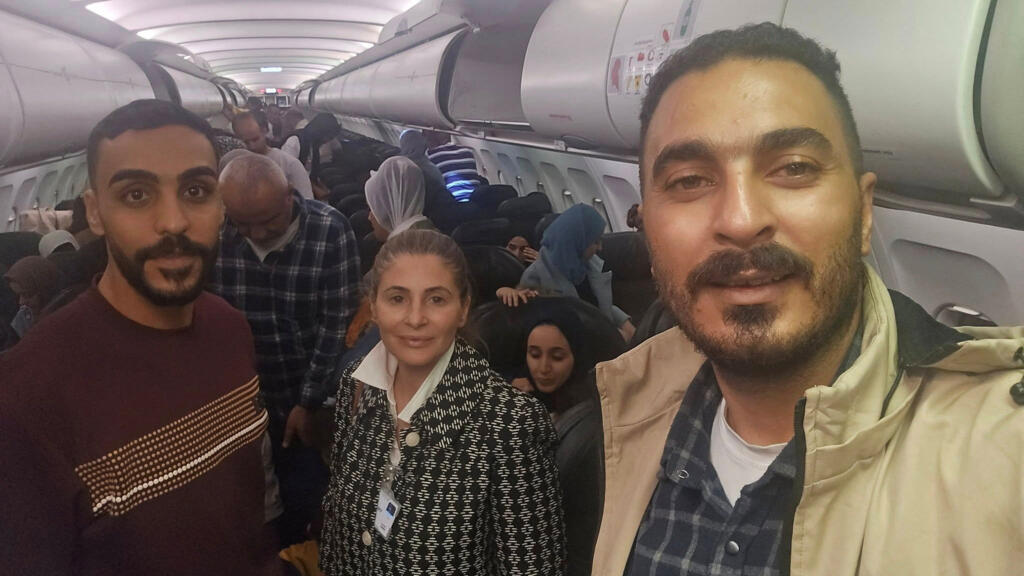
JOHANNESBURG, South Africa – Mid November 2025: A chartered aircraft from a war zone does not slip through the sky by accident. A flight carrying 153 Palestinians from Gaza did not leave through Israeli-controlled territory, pass through Ramon Airport, stop in Nairobi, and land at OR Tambo International Airport as a normal act of mercy. Someone planned the route. Someone cleared the buses. Someone approved the airport. Someone took the money. Someone expected South Africa to carry the political burden.
Now South Africans must ask the questions many diplomats prefer to bury.
Who were the people on that flight, really? Why was Israel involved? Why did the passengers pass through an Israeli-controlled crossing and an Israeli airport, yet arrive without normal Israeli exit documentation? Why were they sent to South Africa, the same country dragging Israel before the International Court of Justice over Gaza? Were these desperate families escaping death, or were they also pawns in a bigger political operation? And if Arab states keep warning against mass displacement from Gaza, what do they know about this project that Africa is now being asked to absorb?
These are not xenophobic questions. They are sovereign questions. A serious country asks them before a crisis enters through its airport.
South Africa’s Home Affairs Ministry confirmed the central facts. Border officials found missing departure stamps in some passports. Several travellers had no return tickets. Some had no clear accommodation addresses. Palestinian ordinary passport holders qualify for 90-day visa-exempt entry into South Africa, but only after security and verification procedures. That means the passengers were not illegal by identity. The operation around them was irregular by design.
The passengers were reportedly moved by bus from Gaza through the Kerem Shalom crossing, then flown from Israel’s Ramon Airport. Reuters reported that Gazans said they paid around $2,000 per seat to an outfit called Al-Majd Europe. Two passengers said they saw online adverts, applied months earlier, received WhatsApp messages saying security clearance had been granted, then left Gaza by bus before flying through Israel and Kenya to Johannesburg.
That is where the story stops being humanitarian theatre and becomes geopolitical smoke.
If Israel controlled the exit route, why no proper exit stamps? If COGAT, the Israeli military body overseeing civilian affairs in Gaza, said approval had been received from a third country, why did South African officials say the required approvals and permits were missing? If the journey was lawful and transparent, why did President Cyril Ramaphosa describe the arrival as “mysterious” and order intelligence services to investigate? AP reported that passengers could not clearly say where or how long they would stay in South Africa, while Israeli authorities said the movement fell under a policy allowing Gaza residents to leave.
This is the dangerous contradiction at the heart of the scandal. Israel says Palestinians must be free to leave Gaza. South Africa says the flight looked like part of a wider plan to remove Palestinians from their land. Foreign Minister Ronald Lamola went further. He said Pretoria did not want more flights because the pattern showed “a clear agenda” to clear Palestinians out of Gaza and the West Bank. AP also reported that a similar flight had landed in South Africa on October 28 with more than 170 Palestinians on board.
One flight is an incident. Two flights are a channel. Several flights are a system.
Al-Majd Europe sits at the centre of this fog. The group presented itself as a humanitarian organisation. Al Jazeera, citing Haaretz, reported that the organisation was linked to Tomer Janar Lind, a dual Israeli-Estonian national, and alleged coordination with Israeli authorities. The same report said an Israeli Defence Ministry unit tied to “voluntary emigration” from Gaza had been created in early 2025.
South Africa must now treat this as more than an immigration file. It is an intelligence file. It is a foreign policy file. It is a national security file.
The passengers themselves must not be turned into suspects by nationality. Public evidence so far does not prove they were militants, criminals, or a threat. Reuters interviewed Gazans who described destroyed homes, dead relatives, cancer treatment needs, and life under bombardment. Those are human facts. A country with a conscience does not ignore them.
But compassion without control is not policy. It is exposure.
South Africans have every right to ask why their country was selected. Why not Egypt, Jordan, Saudi Arabia, Qatar, Turkey, Malaysia, Indonesia, or another state with deeper religious, regional, or logistical ties? The answer is uncomfortable. Many Arab and Muslim-majority governments reject mass relocation because they see it as forced displacement. They fear Gaza will be emptied under the language of rescue, then the right of return will die quietly in foreign hostels, temporary visas, and scattered communities.
That does not mean Palestinians are bad people. It means permanent removal from Palestine serves the occupier more than the occupied.
This is where South Africa’s role becomes explosive. Pretoria took Israel to the ICJ. Pretoria positioned itself as the loudest state voice for Palestinian rights. Then a secretive route suddenly brought Gazans to Johannesburg through Israel and Kenya, without the paperwork South African border officials expected. The symbolism is too loud to ignore. The country accusing Israel of destroying Palestinian life is now being asked to receive Palestinians leaving under Israeli-controlled channels.
South Africa was not chosen by accident.
Was this a humanitarian evacuation? Was it a profit scheme exploiting desperate families? Was it a population-transfer experiment dressed as rescue? Was it a diplomatic trap designed to force South Africa to choose between border law and moral identity? The honest answer is this. It may be all of them at once.
Ramaphosa allowed entry out of compassion. That was human. But a president’s empathy must not replace state preparedness. No government should learn about a mass arrival from a tarmac crisis. No charter operator should land vulnerable war survivors without verified sponsors, accommodation, medical plans, return options, or clear legal status. No foreign-linked entity should decide South Africa’s migration burden through WhatsApp groups and paid seats.
The people on the plane deserved dignity. South Africa deserved honesty.
This scandal should force Pretoria to act fast. Parliament must demand the full passenger manifest, the charter contract, the payer records, the route approvals, the Kenyan transit details, and all communications between Al-Majd Europe, Global Airways, Israeli authorities, and any South African officials. Intelligence services must establish whether South Africa was used as a dumping ground, a transit point, a propaganda stage, or a pressure valve for a foreign war.
The lesson is brutal. Africa must not become the emergency exit for conflicts it did not create and cannot control.
South Africa is not ending today. But the old South Africa, the one that believed moral slogans were enough to manage global power games, is finished. This flight exposed a border blind spot, a diplomatic trap, and a dangerous truth. In the new world, wars arrive by charter plane. They come with humanitarian language, missing stamps, silent organisers, and desperate people caught in the middle.
South Africa must protect the innocent. It must also protect itself or else it will be the African centre of either terrorism or playground of force which are opposed to a united Africa. Lest we forget Libya.