
JOHANNESBURG, South Africa – South Africa is facing a hard question. When does a protest about immigration become a campaign against Africans?
The March and March movement says it wants immigration law enforced. Many South Africans agree the state has failed to manage borders, documents, labour abuse, crime, and informal trade fairly. Those concerns are real. President Cyril Ramaphosa has also admitted weaknesses in migration management, corruption, poor enforcement, and pressure on public services. But he has warned private groups not to stop people in the streets and demand proof of nationality. He said immigration enforcement belongs to the state alone.
That is where the story becomes bigger than one march.
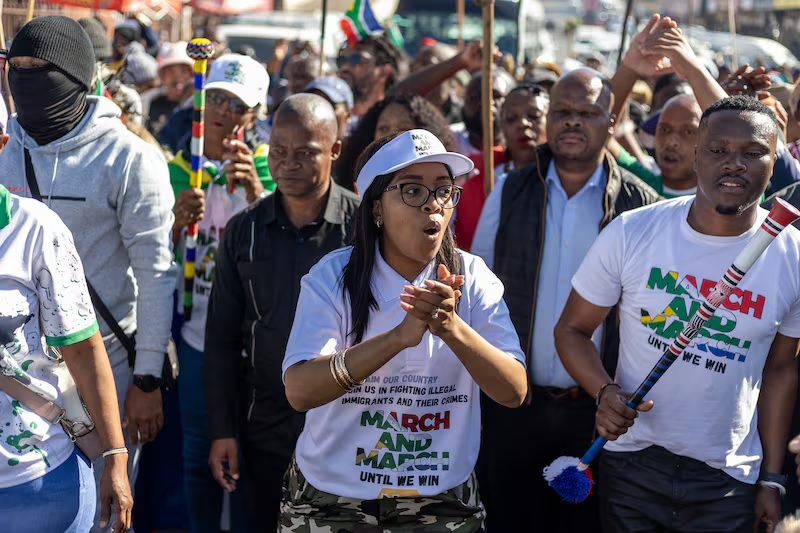
March and March has placed itself at the centre of a national argument over who belongs in South Africa. Its leader, Jacinta Ngobese-Zuma, has become one of the loudest public voices calling for undocumented foreign nationals to leave. Reuters reported that she told supporters in Durban the movement would hold weekly marches for six months until its demands were met. “From building to building, they must go,” she said, according to the report.
The June 30 protests drew thousands across South Africa. Some marches stayed peaceful. Others took place in a climate already shaped by fear. Reuters reported that at least four people had been killed in months of anti-migrant violence, while thousands of foreign nationals had fled their homes or shut their shops before the deadline set by activists. The report also said foreign nationals make up about 4 percent of South Africa’s population, far below the figures often shared online by anti-migrant campaigners.
The danger is not only in the numbers. The danger is in the language. Once a Congolese shopkeeper, a Malawian worker, a Zimbabwean mother, or a Nigerian student becomes a symbol of every failed clinic, every stolen job, every drug corner, every broken border, the crowd no longer sees a person. It sees an enemy.
That is why March and March has become a Pan-African issue. South Africa was not built in isolation from the continent. Its liberation struggle drew support from African states that hosted exiles, trained activists, raised funds, and gave diplomatic backing when apartheid tried to crush Black political life. The same country now has citizens singing liberation songs while other Africans sleep outside consulates, board buses home, or hide behind locked shop doors.
This contradiction has pulled old wounds into the open. In 2008, anti-migrant violence killed 62 people. In 2021, South Africa saw deadly unrest after Jacob Zuma was jailed for contempt of court. The Guardian reported that authorities deployed police before the June 30 demonstrations because officials feared looting and mob violence. The paper also linked the moment to memories of 2008 and 2021.
Zuma’s name now sits near the centre of the storm.
The uMkhonto weSizwe Party, led by Zuma, publicly backed March and March earlier in June. The Mail & Guardian reported that MK Party secretary-general Sibonelo Nomvalo said the party was fully behind the movement and its call for undocumented foreigners to leave South Africa. The same report said critics, including the EFF, accused the movement of xenophobia, while others praised it for raising illegal immigration concerns.
Zuma’s own shadow has deepened for another reason. This week, South African and Indian media reported that the former president was seen at a Hindu temple in Haridwar, India, alongside Ajay Gupta. Gupta is linked to South Africa’s state capture scandal and has been described in reports as a fugitive from South African authorities. IOL reported that Zuma was also accompanied by South Africa’s High Commissioner to India, Professor Anil Sooklal. The MK Party defended Zuma, saying he is a private citizen and free to attend religious gatherings.
That image is politically explosive. While Zuma’s party backs pressure against undocumented Africans inside South Africa, Zuma himself is reported to have appeared beside a Gupta brother accused in a scandal that South Africans associate with the looting of public power. The poor are told to direct their anger at migrants in townships, while a former head of state is photographed abroad with a man tied to one of the deepest corruption traumas in democratic South Africa.
This is why the March and March story deserves more than slogans. It asks who pays the price when political elites turn public anger downward.
The movement also carries another irony. AmaBhungane reported that Ngobese-Zuma attended the US Department of State’s invitation-only International Visitor Leadership Program in 2023. The programme, according to the report, focused on “Media Responsibility in an Age of Disinformation.” AmaBhungane also reported that she had earlier been invited to the US consulate-general’s residence in 2021 for a panel involving women in media and entertainment.
No public evidence proves that March and March is directed or funded by the United States. Serious journalism must not turn suspicion into fact. But the optics raise fair questions. A leader who benefited from US-linked soft power programmes now leads a movement accused by critics of spreading fear around African migrants. A programme on disinformation is now part of the biography of a figure whose movement operates in an information space full of inflated claims, viral clips, and broad accusations against foreign nationals.
This does not make her a foreign agent. It does make her story a warning about influence, political education, media power, and public anger. Soft power works by identifying rising voices before they become national forces. Sometimes those voices serve democracy. Sometimes they ride public pain into dangerous places.
South Africa’s government has no right to ignore illegal immigration. Borders matter. Labour laws matter. Documentation matters. Employers who exploit undocumented migrants must face the law. Corrupt Home Affairs officials must face the law. Criminal syndicates must face the law. Communities have a right to safety and fair trade.
But no movement has a right to turn African migrants into targets. No party has a right to harvest votes from fear. No former president has a right to pose as a defender of South Africans while remaining politically tied to networks and figures that many citizens associate with state capture and unrest.
March and March has forced South Africa to look in the mirror. The reflection is uncomfortable. It shows a weak state, angry citizens, frightened migrants, opportunistic politicians, and a continent watching one of its most influential nations struggle with the meaning of Ubuntu.
The question now is not whether South Africa must fix immigration. It must.
The question is whether it will fix it through law, dignity, and regional cooperation, or through intimidation, street power, and the old habit of blaming the vulnerable while the powerful walk free.