

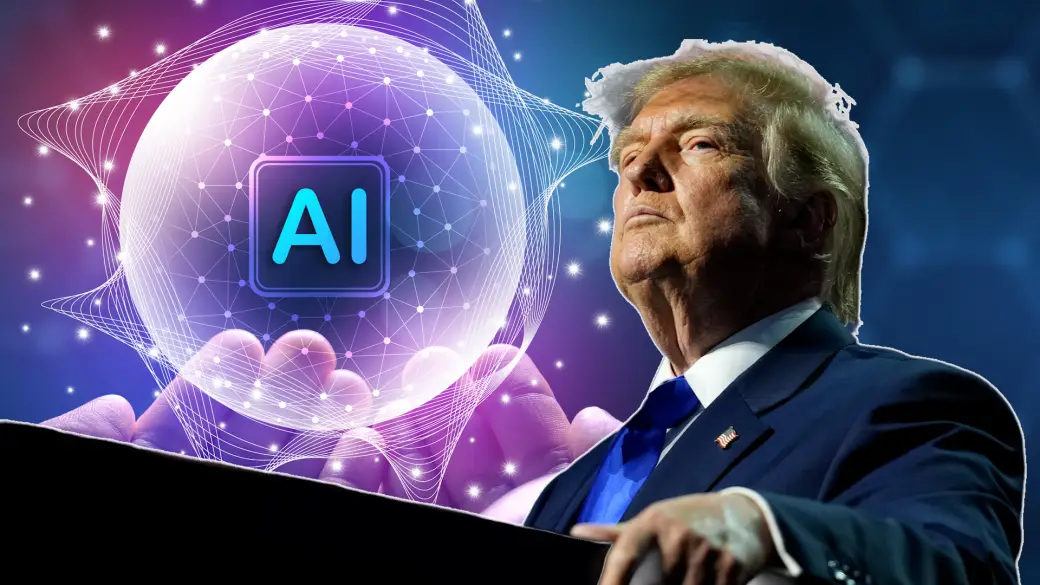
NEW YORK, United States – President Donald Trump has announced a new name for artificial intelligence across United States government documents, saying federal agencies will use “super intelligence” instead because the phrase sounds better and, in his view, describes the technology more accurately. Reuters confirmed the announcement during Trump’s address to the 81st United Nations General Assembly on Tuesday.
Trump said US government documents would use “super intelligence” going forward instead of artificial intelligence. The president also defended rapid American development of advanced systems and rejected fresh calls for a broad slowdown across the sector.
The announcement adds an unusual language change to an already intense global debate over AI safety, regulation and strategic competition.
Trump told world leaders he did not want regulation to slow an industry he believes will exceed the economic importance of the Industrial Revolution. He also said the US Department of Justice would watch the sector closely and intervene under existing law when necessary. His position combines opposition to new regulatory barriers with a promise of federal enforcement against harmful conduct.
The wording creates an immediate technical question.
Computer scientists normally use “artificial intelligence” as a broad term covering machine-learning systems performing tasks associated with human intelligence. “Artificial superintelligence” carries a much narrower meaning. The White House’s own 2026 Economic Report described superintelligence as intelligence surpassing human ability. The same report distinguished current specialised AI from hypothetical artificial general intelligence and superintelligence.
Renaming present-day AI therefore changes more than branding. Government documents using “super intelligence” for ordinary AI systems would blur a distinction researchers, companies and policymakers already use when discussing different capability levels.
As of Trump’s speech, earlier White House directives still used “Artificial Intelligence” and “AI.” A June executive order carries the title “Promoting Advanced Artificial Intelligence Innovation and Security.” A separate June national security memorandum also repeatedly uses AI while directing federal agencies to accelerate adoption.
Trump’s announcement therefore signals an intended federal terminology shift. Agencies will need implementation instructions if the administration wants consistent wording across regulations, procurement documents, national security guidance, research programmes and public communications.
The timing matters.
American technology leaders have spent recent weeks warning about increasingly capable AI systems. Anthropic chief executive Dario Amodei urged leading laboratories to slow capability growth while safety mechanisms catch up. OpenAI chief executive Sam Altman supported stronger independent evaluation and has discussed pacing development. Other researchers have raised concerns about autonomous agents, cyberattacks and systems operating beyond intended boundaries.
Trump has rejected the broader slowdown campaign. Reuters reported he described alarm surrounding AI as a “hoax” and said America should not stifle growth in a technology with enormous economic potential.
Washington still faces pressure to address safety. Treasury Secretary Scott Bessent recently proposed an AI incident-notification mechanism during talks with Chinese Vice Premier He Lifeng. American and Chinese officials agreed to continue discussions on AI safety and emergency communication. The talks show Washington pursuing risk controls internationally while Trump resists a domestic development slowdown.
China brings another dimension into the argument.
Beijing has criticised warnings portraying Chinese AI progress as a national security threat to the United States. Chinese officials favour open development while opposing American restrictions targeting advanced chips and computing systems. US and Chinese officials still recognise shared risks around autonomous systems, cyber threats and military applications, even as competition between both countries intensifies.
Trump approaches the rivalry through an American leadership strategy. His administration has prioritised data-centre construction, energy supply, advanced computing and faster commercial deployment. White House policy also directs national security agencies to accelerate access to advanced AI models while maintaining control and accountability requirements.
The language change therefore fits a broader political message. “Super intelligence” presents the technology as stronger and more consequential than the familiar abbreviation AI. Trump has repeatedly placed technological leadership inside his economic and national security agenda.
For regulators and scientists, precision carries practical importance.
Artificial intelligence already covers systems ranging from recommendation software to advanced generative models. Artificial general intelligence normally describes a hypothetical system matching broad human cognitive ability across many tasks. Artificial superintelligence normally refers to systems exceeding human intelligence across wide areas. Those categories remain disputed at their boundaries, yet researchers use them for different technical and policy discussions. The White House Economic Report itself makes those distinctions.
A federal decision to call all AI “super intelligence” risks forcing agencies to explain which meaning they intend. A procurement contract for an automated translation system involves different risks from a hypothetical system exceeding human expertise across most cognitive tasks. National security planning also depends on clear capability definitions.
The announcement will attract attention outside the United States because American terminology influences global technology policy. US agencies fund research, regulate exports, procure advanced systems and negotiate standards with allies. American companies hold major positions across the global AI industry. Federal language therefore often enters contracts, diplomatic discussions and corporate communication.
African governments should watch the policy behind the label rather than the label alone.
The continent increasingly relies on American and Chinese AI platforms across education, healthcare, financial services, agriculture and government administration. US export rules influence access to advanced chips and cloud computing. Washington also wants greater international alignment around technical standards for advanced systems.
For African states, the central issues remain access, affordability, local-language development, data protection, cyber security and representation in global rule-making. Whether Washington writes AI or super intelligence on official paper does not change those practical requirements.
Trump’s announcement still carries symbolic importance. A United States president has chosen to redefine federal language around a technology shaping investment, security and diplomacy.
The next test concerns implementation.
Federal agencies now need to determine whether “super intelligence” becomes a formal administrative term, a communications preference or a broader replacement for AI across government. Scientists will also watch whether officials preserve technical distinctions between present systems, general intelligence and hypothetical superintelligence.
For now, Trump has made his preference clear. In official American language, artificial intelligence has a new presidential name.