

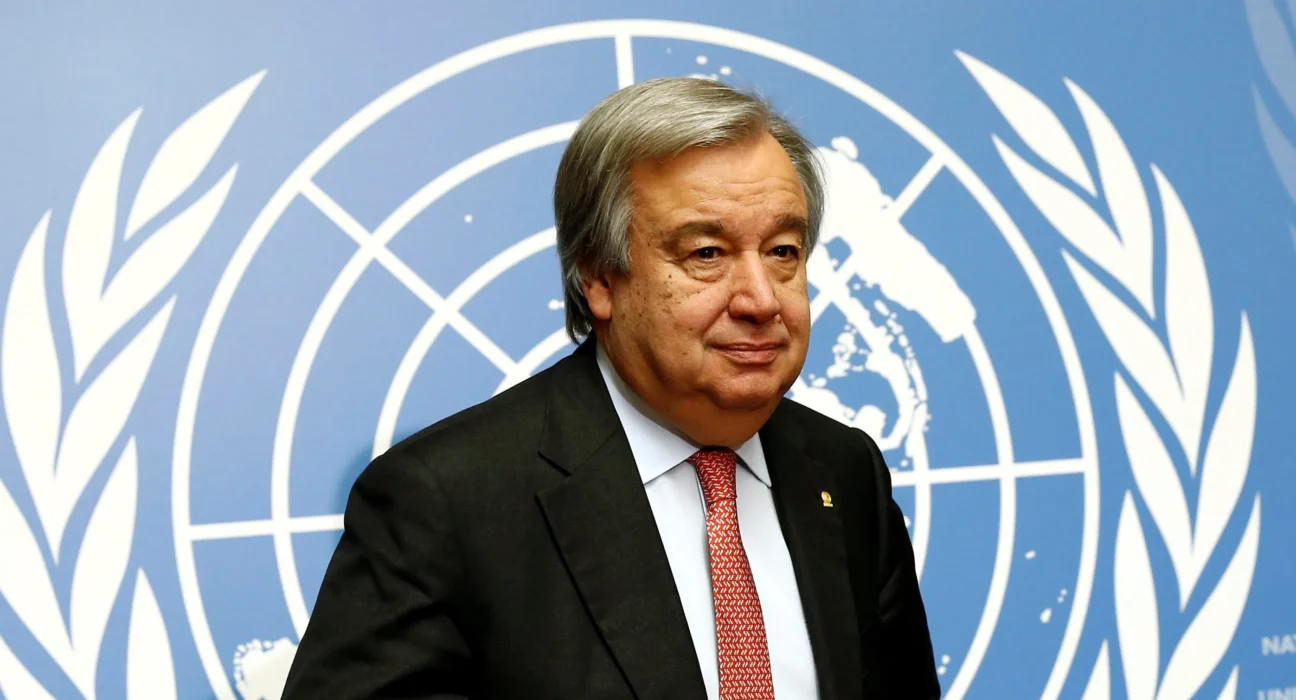
NEW YORK, United States – United Nations Secretary-General António Guterres used his final address to the UN General Assembly to demand Security Council reform, declaring Africa’s continued exclusion from permanent membership unjust and indefensible.
Guterres delivered the message on Tuesday as world leaders gathered for the 81st General Assembly in New York. He argued global institutions still reflect political structures created after the Second World War rather than modern demographic, economic and geopolitical realities. “A 21st century Security Council without permanent African representation is unjust and indefensible,” Guterres told delegates.
The statement strengthens a campaign African governments have pursued for decades.
The Security Council holds 15 seats. China, France, Russia, Britain and the United States occupy five permanent positions and each holds veto authority. Ten other countries serve elected two-year terms. Africa currently has three elected members, Somalia, the Democratic Republic of Congo and Liberia. None holds permanent membership or a veto.
Guterres argues such an arrangement no longer reflects global political reality.
During February’s African Union Summit in Addis Ababa, he went further. “This is 2026, not 1946,” he told African leaders. He backed two permanent African seats and said Africa should participate in global decisions rather than live mainly with their consequences.
The historical imbalance sits at the heart of Africa’s case.
When the United Nations emerged in 1945, much of Africa remained under European colonial rule. Dozens of present-day African states had no independent governments able to negotiate the structure of the organisation. The victorious powers of World War Two secured permanent Security Council membership and special veto rights.
Eight decades later, those arrangements still govern international peace and security.
The Council approves sanctions, establishes peace operations and authorises military force under defined circumstances. Decisions involving wars and security crises across Africa therefore often pass through an institution where African countries lack permanent representation.
Africa has developed a common proposal rather than asking outsiders to design one.
Under the Ezulwini Consensus and Sirte Declaration, the African Union demands at least two permanent seats with all existing privileges, including veto rights for as long as the veto survives. Africa also seeks five non-permanent seats in an expanded Council. African Union Commission Chairperson Mahmoud Ali Youssouf repeated the position in May, describing permanent exclusion as a historical injustice.
The veto creates one of the hardest obstacles.
Washington announced support in 2024 for two permanent African seats. The United States stopped short of supporting new veto rights. Then-US Ambassador Linda Thomas-Greenfield said Washington opposed expanding veto authority because additional veto holders would make an already divided Council harder to operate.
Africa’s position rejects a permanent seat carrying fewer rights than existing permanent members.
Such a compromise would create two classes of permanent membership. One group would possess veto authority. African members would sit permanently without equal decision-making privileges.
The argument therefore concerns more than adding chairs around a table. The dispute concerns power.
Guterres has repeatedly linked representation with legitimacy and effectiveness. He told journalists earlier this year the Council still reflects the settlement produced after World War Two. He also pointed toward repeated vetoes which have blocked collective action during major conflicts.
Recent wars have intensified scrutiny.
Security Council divisions have constrained action over Ukraine, Gaza and other conflicts. Africa faces wars in Sudan and the Democratic Republic of Congo, instability across parts of the Sahel and continuing security pressures in Somalia. African governments argue permanent representation would give the continent sustained influence over decisions involving peace operations, sanctions and conflict diplomacy.
Permanent membership would still raise difficult questions inside Africa.
Which countries should occupy the seats?
Nigeria holds Africa’s largest population. South Africa carries considerable diplomatic and economic weight. Egypt occupies a strategic position linking Africa and the Middle East. Algeria, Ethiopia and Kenya also hold significant regional influence. Smaller states reject any assumption that size alone should determine representation.
Guterres has avoided choosing candidates. He told reporters in Addis Ababa African governments themselves must decide which states represent the continent permanently.
African Union unity therefore becomes essential.
A fight among major African states over permanent seats would strengthen opponents of reform. The AU has instead concentrated first on securing agreement around the African model, leaving selection mechanisms for African governments to settle.
Changing the Council also requires far more than speeches.
Any alteration to Security Council membership requires an amendment to the UN Charter. Two-thirds of the General Assembly must approve and ratify reform. Crucially, all five current permanent members must also ratify the amendment. Every existing veto power therefore possesses an effective route to stop structural change.
This requirement explains why reform discussions have lasted for years without producing new permanent members.
Political support has still widened.
The United States supports two permanent African seats. France has expressed support for stronger African representation. Russia says the Council should add permanent members while retaining the existing veto system. Developing states across Asia and Latin America also seek wider representation, while India, Brazil, Germany and Japan have long pursued permanent membership through the G4 grouping.
Every expansion proposal creates another negotiation over numbers, regional balance and veto rights.
For Africa, patience is wearing thin.
The continent participates heavily in UN peace and security discussions while lacking permanent authority inside the organisation’s most influential body. Africa also represents a major bloc within the General Assembly. African governments increasingly argue institutional legitimacy suffers when structures inherited from 1945 determine decisions in 2026.
Guterres leaves office on December 31 after ten years as Secretary-General. His final General Assembly speech therefore carries the weight of a departing UN chief placing institutional reform among unfinished priorities. Reuters reported he warned global institutions still represent the interests and power structures of a “largely bygone age.”
His departure will not settle Africa’s campaign.
The next Secretary-General will inherit the same pressure. African governments will continue pushing the Ezulwini position. Existing permanent members will face growing demands to translate verbal support into Charter negotiations.
For African citizens, the debate should matter beyond diplomatic symbolism.
Permanent representation means influence over sanctions, peacekeeping, military authorisations and international responses to conflicts affecting millions of Africans. A permanent seat also means continuity. Elected African members rotate after two years. Permanent members retain institutional memory, diplomatic networks and lasting influence across every major Council file.
Africa has spent eight decades outside that circle.
Guterres now leaves world leaders with a direct challenge. If the United Nations claims to represent today’s international community, its strongest security institution must eventually reflect today’s world.