

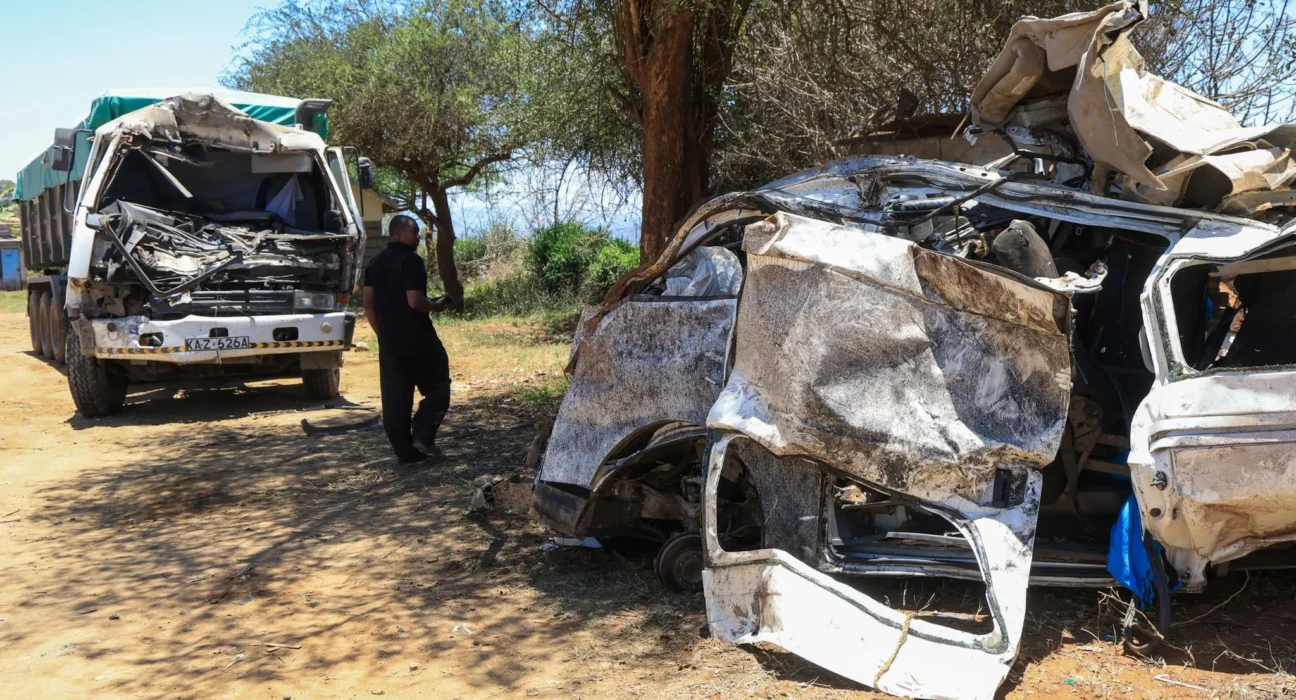
NAIROBI, Kenya – Kenyan authorities intensified investigations on Sunday into a deadly multi-vehicle crash at Salama along the Nairobi-Mombasa Highway, as the Catholic Archdiocese of Mombasa released the names of 17 pilgrims killed while travelling to the National Shrine in Subukia for National Prayer Day.
This development came hours after families reached Sultan Hamud Hospital ahead of postmortem examinations. Hospital administrator Dr Stephen Mwangangi said relatives had arrived for the process, after which authorities expect to transfer the bodies to Mombasa County. One person with serious head injuries continued receiving treatment at Makueni County Referral Hospital.
The Catholic Archdiocese identified the dead as Janet Miito, Florence Atieno, Jane Mwakamba, Josephat Mekonge, Hilkah Orina, Linah Akinyi, Veronicah Musyimi, Martha Nzyoki, Ann Mwanthi, Sarapia Mwarimbo, Scholastica Ochieng, Catherine Joseph, Beatrice Oluoch, Veronica Ngandi, Regina Mwai, Samuel Muigai and Samuel Mwanyasi.
Coadjutor Archbishop of Mombasa Dominic Kimengich expressed grief as parishes prepared special prayers during Sunday Masses.
“We are saddened with great grief to announce the untimely passing on of seventeen pilgrims from St. Mathias Mulumba, Mikindani, in an accident at Salama,” Kimengich said.
The pilgrims belonged to St. Mathias Mulumba Catholic Church in Mikindani, Mombasa. Their journey toward Subukia ended shortly after midnight on Saturday near Mlima Kiu. Kenya’s National Transport and Safety Authority already classifies the highway section as a black spot.
The crash involved several vehicles. Early police accounts said a heavy commercial truck moved out of its lane while overtaking before striking other vehicles. Police reported subsequent collisions involving a Hino truck, a Peugeot, a Toyota Noah, a Toyota Hiace public service vehicle and a Nissan UD truck.
Investigators have not issued final findings on the precise sequence or mechanical condition of each vehicle. Reports have included references to overtaking and possible brake failure. The new multidisciplinary inquiry is therefore responsible for establishing vehicle roadworthiness, driver actions, lane discipline, mechanical condition and road factors.
Roads and Transport Cabinet Secretary Davis Chirchir confirmed the investigation and said officials would inspect vehicles for roadworthiness and compliance.
“The investigation will include examination of the vehicles involved, their roadworthiness and compliance, as well as other factors which contributed to the crash,” Chirchir said.
The National Transport and Safety Authority deployed investigators to support the National Police Service. Authorities also urged motorists to avoid dangerous overtaking, maintain safe speeds and remain inside proper lanes.
Chirchir framed the tragedy as a wider road safety warning.
“Every life lost on our roads is a painful reminder of our collective responsibility to make road safety a priority,” he said.
The location raises difficult questions for road managers. NTSA has already classified the Mlima Kiu-Salama stretch as a black spot and has acknowledged previous safety recommendations for the route. A fresh fatal collision therefore places attention on enforcement, engineering controls and implementation of earlier risk-reduction proposals.
For road safety engineers, black-spot management usually requires more than warning signs. Authorities need collision data, sight-distance assessments, lane-marking reviews, speed studies, lighting checks, shoulder inspections and enforcement analysis. Where overtaking repeatedly causes fatal crashes, road design and traffic control require targeted intervention.
Kenya’s Nairobi-Mombasa corridor carries heavy passenger, freight and commercial traffic. Long-distance buses, matatus, private vehicles and trucks share the same route across extended sections. Freight movement toward and from Mombasa Port adds large commercial vehicles to an already busy road system.
Driver fatigue, unsafe overtaking, speeding, mechanical defects and mixed traffic create serious exposure when road geometry leaves limited recovery space. Police enforcement addresses one part of the risk. Vehicle inspection, road engineering, rest management and commercial fleet supervision address other parts.
Official figures show Kenya records thousands of road deaths each year. Government road safety planning also acknowledges underreporting, which means official totals do not always capture the full scale of fatalities and serious injuries.
The Salama disaster now gives authorities a direct test of whether investigation findings lead to measurable action.
Families need clear answers on vehicle condition, driver conduct and road factors. Motorists need visible safety improvements on a section already known for serious collision risk. Commercial fleet owners need stronger scrutiny of braking systems, tyres, driver hours and maintenance records. Enforcement agencies need consistent action against dangerous overtaking and defective vehicles.
President William Ruto extended condolences to bereaved families, friends, parishioners and the wider Catholic community. Mombasa church leaders also asked worshippers to dedicate Sunday prayers to the victims and their families.
Kimengich said, “Let us pray for the repose of their souls as we pray for their families, St. Mathias Mulumba Parish and the Archdiocese as a whole.”
The deaths have hit Mikindani parish with particular force. The group left Mombasa for a national religious gathering, making the loss a shared tragedy for families, fellow parishioners and Catholic communities beyond the coast.
Mombasa Governor Abdullswamad Sherriff Nassir urged residents to avoid circulating unverified information while investigators establish facts. Such restraint matters during mass-casualty incidents, where conflicting early reports often spread before authorities complete vehicle inspection, witness interviews and scene reconstruction.
Postmortem examinations now form part of the formal process. Investigators will also rely on damage patterns, tyre marks, vehicle positions, mechanical inspections, driver records and witness statements when reconstructing events.
The inquiry should also examine earlier safety recommendations for the Salama black spot. Officials need to establish which measures engineers proposed, which projects secured funding, which interventions reached completion and whether outstanding work increased road exposure.
Kenya’s road safety challenge reaches beyond one crash. Rapid motorisation, expanding freight movement and growing intercity travel place pressure on enforcement agencies and transport infrastructure. Fatal collisions impose costs on households, hospitals, insurers, employers and emergency services.
A serious response therefore requires accountability after mourning. Authorities should publish investigation findings, identify enforceable failures and set deadlines for corrective work on known black spots.
Seventeen families now face funerals after a journey meant for prayer. The strongest tribute from public authorities would be a road safety response measured through fewer deaths, stronger fleet compliance and safer highway design.