

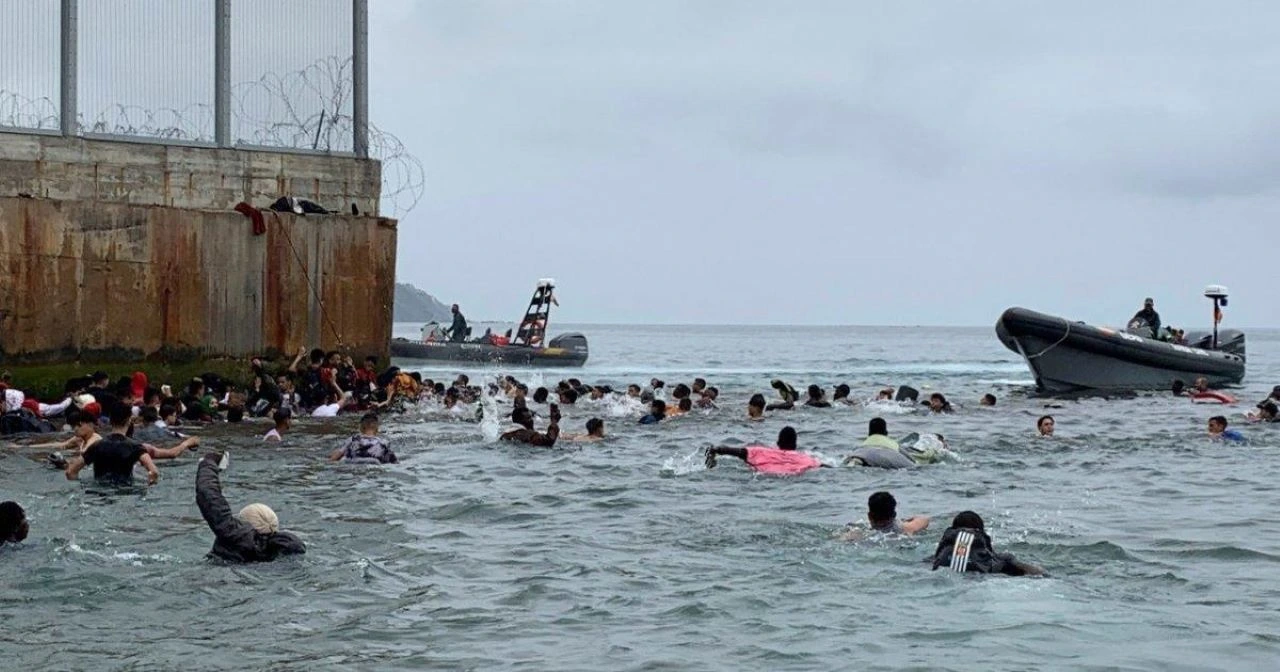
CEUTA, Spain – More than 1,500 migrants reached Spain’s North African enclave of Ceuta by sea within one week, overwhelming reception centres and forcing local leaders to demand a national emergency declaration.
Most arrivals came from Morocco. Some came from Algeria after spending time inside Morocco. Many swam around border barriers at Tarajal and Benzú, risking strong currents, exhaustion and drowning to enter European Union territory. Regional authorities reported an average close to 300 arrivals each day during the latest surge.
Ceuta President Juan Jesús Vivas described the pressure as a humanitarian and security emergency. Facilities for unaccompanied minors reached about 2,400 percent of normal capacity, while adults slept outside overcrowded reception centres. Vivas asked Madrid for a coordinated response involving several ministries rather than another short-term police deployment.
The crisis carries a deadly cost. Local officials recorded about 60 sea deaths during the wider period of pressure around Ceuta. Rescue teams, Civil Guard boats and Red Cross workers have pulled exhausted swimmers from the water. Every crossing turns a narrow strip of sea into a test between desperation and survival.
Spain’s Interior Ministry plans high-level talks in Ceuta. Moroccan security forces have assisted border control, according to Spanish officials, even as questions grow over why such a large movement developed so quickly.
The cause has received no single verified explanation. Seasonal weather, unemployment, social frustration, smuggling networks and changing legal expectations all form part of the debate.
A Spanish Supreme Court ruling issued on July 8 also changed the legal setting. The court blocked immediate returns for people intercepted after swimming around maritime barriers, limiting fast rejection procedures to migrants crossing physical border structures.
Ceuta officials now want immigration law amended to cover sea entries around the fences. Rights groups warn rushed returns would deny migrants individual assessment and access to asylum procedures.
The surge looks dramatic, yet Spain’s national data provides essential context.
Spain recorded 14,479 irregular arrivals between January 1 and July 15, down about 25 percent from the same period in 2025. Sea arrivals fell 36 percent. Ceuta moved in the opposite direction, recording 2,826 land arrivals, a 150 percent increase.
Ceuta therefore faces a concentrated local emergency inside a national picture showing lower overall arrivals. Political leaders should resist presenting every movement as proof of total border collapse.
They should also resist denying the severe pressure faced by a small territory with limited accommodation, schools, social workers and medical services.
President Donald Trump has used Europe’s migration debate to defend his own border policies. In a July 4 social media post, Trump said Europe was learning the consequences of admitting what he called “Third World criminals.”
His language placed crime and migration inside one broad political warning.
Such language attracts attention, but collective labels distort reality. A migrant entering without authorisation has broken an immigration rule. Such conduct does not prove violent criminality.
Governments hold a duty to secure borders, identify entrants, process asylum claims and remove people without lawful grounds. Governments also hold a duty to avoid treating nationality, poverty or skin colour as evidence of criminal intent.
Europe’s security concerns remain legitimate. Uncontrolled arrivals strain local services, weaken public confidence and create opportunities for smugglers.
Ceuta forms one of the European Union’s only land borders with Africa. Spain needs personnel, surveillance, reception space, legal processing capacity and strong cooperation with Morocco.
Africa also needs an honest reckoning.
Young Moroccans do not enter cold water because Europe offers certainty. They leave because many see limited jobs, weak upward mobility and little confidence in their future.
Algeria faces similar youth frustration. Across Africa, unemployment, poor governance, conflict and unequal development continue pushing citizens toward dangerous routes.
European leaders often focus on the final metres of migration while ignoring the years of failure preceding each crossing. African governments focus on remittances and diplomatic disputes while failing to build economies able to retain skilled and ambitious citizens.
Morocco also holds political leverage over Spain.
Migration pressure has appeared during earlier diplomatic disputes, including the 2021 Ceuta crisis when thousands crossed during tensions linked to Western Sahara. Madrid and Rabat now describe cooperation as strong, but geography gives Morocco lasting influence over European border security.
Spain should avoid dependence on informal political bargains. Border cooperation needs written standards, independent oversight and respect for human rights.
Morocco should prevent dangerous departures without using migrants as diplomatic pressure. The European Union should share reception costs rather than leaving Ceuta to manage a continental border alone.
The deeper solution lies on both shores.
Spain needs faster case decisions, lawful returns, safe reception and legal labour routes tied to verified shortages. Morocco and other African states need employment, accountable government, quality education and confidence among young people.
Europe should support productive investment rather than agreements focused mainly on containment.
African leaders must also understand the humiliation hidden inside each crossing. A young person who risks drowning to leave home has delivered a severe judgment on local opportunity, public leadership and economic policy.
The answer does not lie in celebrating departure or condemning every traveller. The answer lies in governments building societies where staying represents a rational choice.
Ceuta’s latest surge represents a border emergency, a humanitarian crisis and evidence of political failure across two continents.
A wall might slow a swimmer. A wall does not remove the reason he entered the sea.