
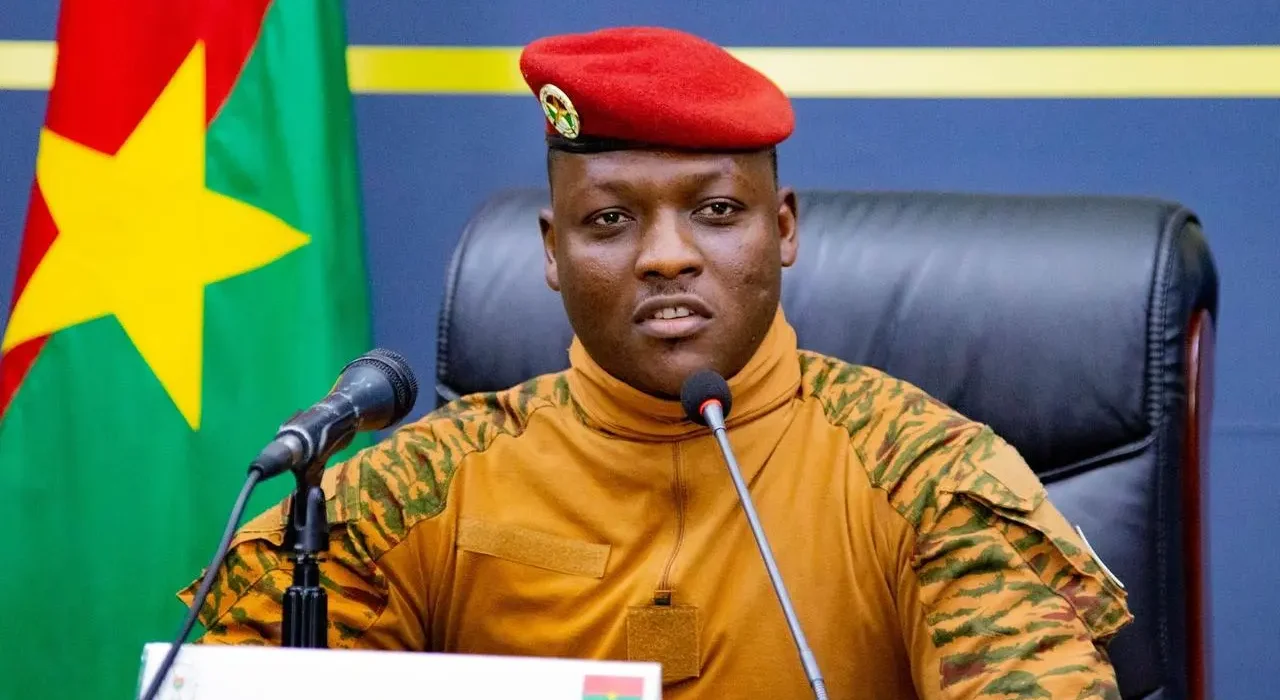
OUAGADOUGOU, Burkina Faso – Burkina Faso’s military leader, Captain Ibrahim Traoré, has declared Sharia law will never govern the country, placing constitutional secularism above religious demands during an intense national debate over faith, security, education, and state authority.
Regional reporting attributes the clearest line to a July 16 address during Traoré’s visit to Ouahigouya. “There will never be Sharia law here,” he said while identifying himself as a Muslim and defending every citizen’s freedom to practise a chosen faith. Official presidential reporting confirms Traoré met regional leaders, religious representatives, customary authorities, security commanders, and civic groups during the visit, though the official summary did not reproduce the Sharia statement.
The message carries unusual force in a Muslim-majority country fighting armed groups linked to extremist movements. Burkina Faso’s legal order defines the state as secular and protects freedom of belief, non-belief, conscience, worship, and religious opinion within limits set by law and public order. No faith holds constitutional authority over another.
Traoré’s statement also follows a new religious freedoms law adopted unanimously by the transitional legislature on June 20. The measure regulates worship, preaching, religious buildings, organisations, public order, and relations between religious institutions and the state. Government says the law protects freedom of conscience while responding to intolerance, radicalisation, violent extremism, and religious interference in state affairs.
For many Burkinabè, the principle is straightforward. Muslims, Christians, followers of traditional religions, and citizens without religious affiliation belong to one republic. Personal faith deserves protection. State law must apply equally across communities. A national court should not deliver one form of justice for a Muslim, another for a Christian, and another for a traditional believer.
Traoré’s intervention therefore defends more than a constitutional phrase. His warning draws a boundary between religious practice and political control. Mosques, churches, temples, customary institutions, and families retain space for belief. Government, criminal justice, taxation, education, and citizenship remain under national law.
Such clarity matters during war. Armed Islamist groups have attacked communities, displaced families, closed schools, damaged health services, and weakened local administration across Burkina Faso. The 2026 humanitarian response estimates 4.5 million people need urgent assistance. International migration agencies report nearly two million internally displaced people, despite large numbers returning to recovered areas.
Extremist movements often seek more than territory. They seek authority over daily life, schooling, dress, taxation, marriage, worship, and punishment. A state fighting such groups needs a firm constitutional answer. Traoré has now supplied one. Burkina Faso will remain a secular republic, even under a leader who openly identifies as Muslim.
The government must still apply the new policy with discipline. Fighting violent extremism should not become a licence to silence peaceful believers, close lawful places of worship, criminalise theological disagreement, or punish entire communities for crimes committed by armed factions. Religious freedom loses meaning when protection depends on political loyalty.
The new law has already generated concern among some Muslim organisations and clerics over regulation of sermons, worship spaces, and religious activity inside public institutions. Government officials say major religious federations, Catholic leaders, traditional authorities, experts, and public bodies participated in consultations. Public confidence now depends on fair enforcement across every faith.
A preacher promoting violence should face lawful investigation. A cleric criticising government policy without inciting violence should retain freedom of expression. A church, mosque, or shrine breaking planning or safety rules should face the same transparent process. Selective enforcement would turn a unity law into a political weapon.
Traoré also linked religious education with national development. Reports from the speech say he questioned why large numbers of young Burkinabè pursue religious studies abroad while the country lacks engineers, technicians, doctors, agricultural specialists, builders, and industrial workers. He argued national reconstruction requires technical knowledge and practical skills.
The argument deserves attention, though religious study and technical education need not become enemies. Burkina Faso needs well-trained imams, pastors, theologians, teachers, counsellors, and community leaders who promote peace. The country also needs electricians, mechanics, programmers, nurses, irrigation specialists, surveyors, chemists, and machine operators. Education policy should expand productive skills without treating faith scholarship as worthless.
Government should create scholarships tied to national shortages, publish labour-market needs, strengthen technical colleges, and support students returning with useful qualifications. Religious institutions should also teach civic duty, entrepreneurship, science, conflict prevention, and respect for other beliefs.
Traoré’s secular position will attract praise across Africa, especially among citizens worried about religious extremism. Yet praise should not remove wider scrutiny of his rule. He seized power during a 2022 coup. His government postponed elections, dissolved political parties, and extended military leadership while arguing security must come first. In April, he told citizens to forget democracy.
A leader who defends constitutional secularism should also defend constitutional limits on state power. Religious domination threatens liberty. Military domination also threatens liberty. Burkina Faso needs protection from armed extremists, sectarian politics, arbitrary detention, censorship, and permanent rule without public consent.
Traoré’s statement still marks an important national line. He has told religious hardliners, foreign sponsors, and armed movements no single creed will control Burkina Faso’s legal system. He has also reassured Christians, traditional believers, moderate Muslims, and secular citizens their place in the republic does not depend on religious conformity.
The strongest response now lies in consistent action. Schools should teach religious tolerance and citizenship. Courts should protect equal rights. Security forces should separate peaceful communities from violent networks. Religious leaders should reject hate speech. Government should publish clear enforcement rules and allow lawful challenges before independent judges.
Burkina Faso faces a brutal security crisis and a difficult political transition. Turning religion into another battlefield would deepen division. Traoré’s refusal of Sharia rule offers a firmer route. One country, one civil legal order, equal protection for every faith, and no religious authority above the republic.
His words will matter only when Muslims, Christians, traditional believers, and non-believers all experience equal freedom under law.