
JOHANNESBURG, South Africa – South Africa faces a hard truth. The danger from Islamist extremist ideology no longer sits at the border, in Mozambique, Somalia, or the Sahel. The documented trail now runs through Johannesburg suburbs, Durban courts, Mpumalanga farms, Limpopo firearm sites, financial networks, and immigration systems.
This story needs discipline. South Africa’s Muslim community is not on trial. Islam is not on trial. Violent Islamist extremism is on trial. State weakness is on trial. Corruption, poor intelligence, broken prosecutions, and border loopholes are on trial.
The latest United States terrorism report says ISIS “continued operating urban cells” in South Africa, with logistical and financial support flowing to ISIS branches elsewhere in Africa. That line should shake Pretoria because it places South Africa inside a continental terror supply chain, not outside it.
Washington has said this for years. In March 2022, the U.S. Treasury sanctioned four South Africa-based ISIS and ISIS-Mozambique financial facilitators. Under Secretary Brian Nelson said the action aimed to “disrupt and expose key ISIS supporters” exploiting South Africa’s financial system. South Africa’s own Justice and Finance ministries then acknowledged the designations and promised cooperation with foreign partners.
Eight months later, the U.S. Treasury sanctioned another alleged ISIS cell in South Africa, including eight companies linked to those individuals. In July 2025, the Terrorist Financing Targeting Center named South Africa-based Zayd Gangat as an ISIS facilitator and trainer, and said ISIS leaders in South Africa had used robbery, extortion, and kidnapping for ransom to raise funds.
That is the core danger. Extremism does not need to seize Pretoria to damage South Africa. It needs bank accounts, front companies, weak paperwork, criminal markets, safe houses, and slow courts. South Africa offers too many of those openings.
The Thulsie twins case showed the ideological side. Tony-Lee and Brandon-Lee Thulsie pleaded guilty in 2022 after a long case linked to attempts to join ISIS and plans to attack targets in South Africa. VOA reported their planned targets included the U.S. Embassy, diplomats, and Jewish institutions. One brother received 11 years, the other eight. Months later, both entered parole after credit for time served.
Then came the Durban pattern. In 2018, attackers killed one person at a Shia mosque near Durban. Prosecutors later linked suspects to the Verulam mosque attack and incendiary devices at Woolworths stores, but the case collapsed after the state failed to proceed. That collapse matters. Failed prosecutions teach extremists, financiers, and copycats one lesson: South Africa’s laws look firm on paper, but weak cases die in court.
The 2018 murder of British botanists Rodney and Rachel Saunders added a brutal criminal dimension. Durban High Court later sentenced Sayefudeen Aslam Del Vecchio, Fatima Patel, and Ahmad Musa to double life terms for murder, with further sentences for kidnapping, robbery, and theft. Reports described the trio as ISIS-linked, although courts convicted them on ordinary criminal charges, not terror charges. That distinction matters. The crime still shows how extremist messaging, robbery, and violence meet in the same dark space.
Then came the camps.
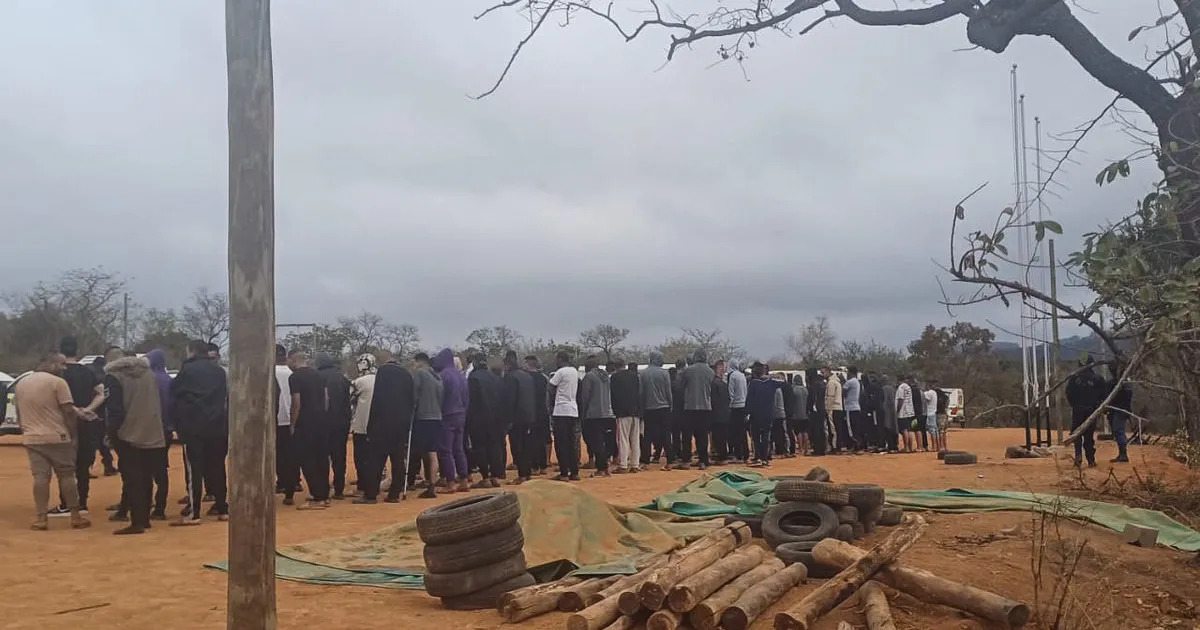
In July 2024, police arrested 95 Libyan nationals at a farm near White River in Mpumalanga. SAPS said the men had entered South Africa on study visas for security training, but detectives found military tents, training equipment, and licensed firearms. Police said they could not rule out an illegal military training camp.
Prosecutors later withdrew immigration charges, and Home Affairs took over deportation. AP reported the charges were withdrawn after police had described the site as an illegal military training camp where firearms and ammunition were recovered.
That outcome should anger every serious South African. Ninety-five foreign men enter on study visas. Police raid a suspected military training site. The public receives no full national security explanation. The case leaves court. The men leave the country. Then the file fades.
Days later, the Hawks raided a suspected firearm training facility in Modimolle, Limpopo. Several licensed firearms, rifles, pistols, and ammunition were seized. No arrests followed at the time, and investigators said they still needed to establish what happened on the farm.
These cases do not prove every camp had an Islamist link. Serious journalism must say that. But they prove a larger national security failure. South Africa has become comfortable discovering alarming sites, issuing statements, and moving on before the public learns who funded them, who approved them, who protected them, and who benefited.
Money sits at the centre. South Africa entered the FATF grey list in February 2023 because of weaknesses in anti-money laundering and counter-terror financing controls. Treasury later said the country exited the grey list in October 2025 after addressing FATF deficiencies. That was progress, but not a cure. FATF compliance reduces risk. It does not erase networks already embedded in crime, cash businesses, charities, front companies, and informal transfer systems.
Pretoria must stop treating terrorism as a foreign relations embarrassment. This is a domestic governance test. A state that loses control of borders, visas, firearms, company registration, charitable flows, local policing, and prosecution timelines creates oxygen for extremists.
Your question as a reader should be simple. Who checks religious charities without targeting religion? Who audits security training firms without crippling legal security businesses? Who investigates visa fraud without scapegoating migrants? Who follows terror money through companies, cash, crypto, property, vehicles, and cross-border couriers?
South Africa also needs moral clarity. Foreign policy slogans cannot substitute for counterterror competence. You can support Palestinian rights and still reject Hamas. You can oppose Islamophobia and still confront ISIS-linked networks. You can defend civil liberties and still jail violent extremists. These positions do not conflict. They protect a constitutional democracy.
The consequences already show. Investors fear dirty-money risk. Border communities fear unknown armed networks. Jewish, Shia Muslim, foreign, and public spaces carry heightened anxiety. Police lose public confidence when major cases collapse. Extremists learn how to use South Africa’s freedoms against its people.
The answer is not panic. The answer is clean intelligence, lawful surveillance, faster courts, audited charities, stricter visa scrutiny, firearms accountability, and public briefings after major security raids. South Africans deserve facts, not silence.
South Africa has enough problems without becoming a logistics hub for violent ideologies. Pretoria still has time to act. But denial is no longer a policy. It is negligence.