

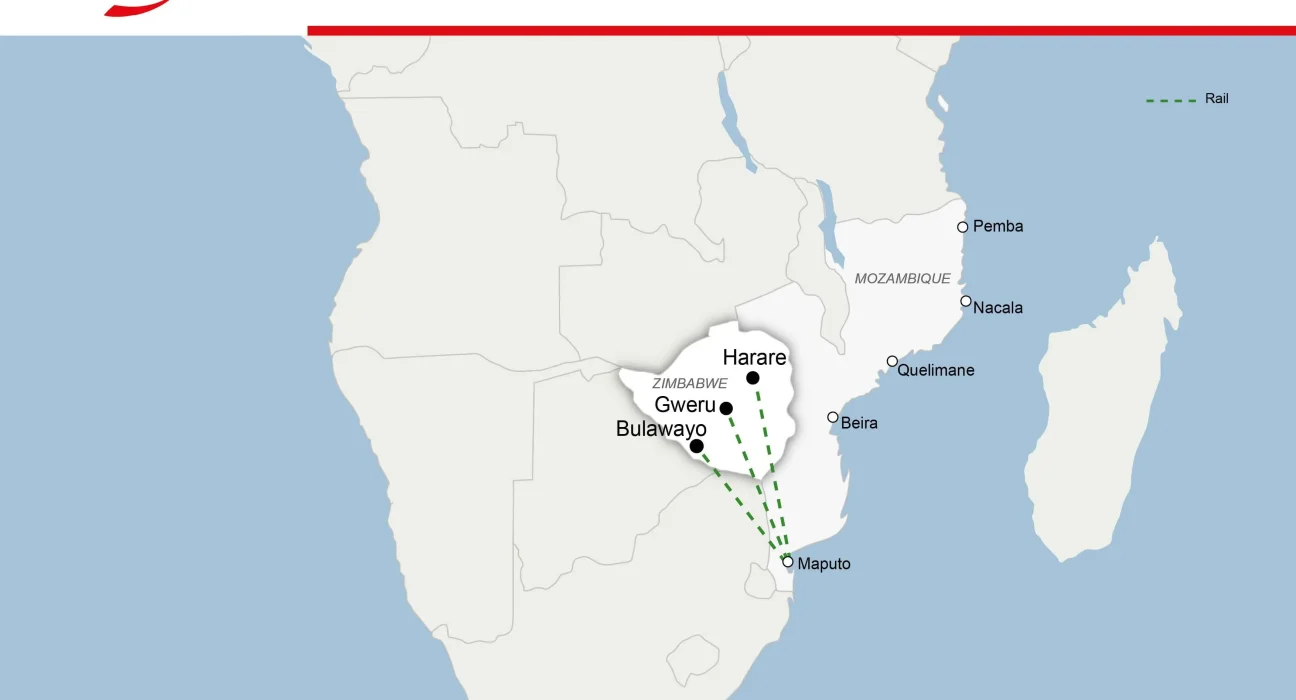
GWANDA, Zimbabwe – Zimbabwe has sent its first 1,000-tonne lithium concentrate consignment from Gwanda to Mozambique’s Port of Maputo by rail, giving miners a freight alternative to long-distance trucking and placing the country inside southern Africa’s growing contest for mineral-export traffic. The train links three operators across almost 1,000 kilometres of track.
The shipment started near Gwanda Lithium Mine in Matabeleland South. Beitbridge Bulawayo Railway moved the cargo about 180 kilometres to Beitbridge. National Railways of Zimbabwe then carried the wagons more than 300 kilometres to Chicualacuala on the Mozambican border. Mozambique’s Limpopo line completed the remaining 522 kilometres to Maputo. Zimbabwean logistics company Silvergill coordinated the movement.
Officials describe the development as a new lithium rail corridor. Precision matters. Zimbabwe and Mozambique did not construct an entirely new cross-border railway for lithium. Existing connected rail systems gained a new mineral customer, a new transshipment facility, and a coordinated operating arrangement. The first cargo therefore marks commercial activation and expanded capacity rather than construction of 1,000 kilometres of fresh track.
BBR commissioned a US$1.5 million transshipment siding at West Nicholson on July 14. The siding will handle lithium concentrate, iron ore, chrome, and other bulk commodities from Matabeleland. BBR general manager Kumbulani Tendai Mabvura said, “We are investing, we are delivering, and we are demanding performance.”
An NRZ official said rail holds “a critical role” in helping mineral exports reach international markets efficiently. Silvergill said efficient logistics remain essential for Zimbabwean minerals to compete abroad. Those claims now face a practical test involving locomotives, wagons, border clearance, loading time, derailment risk, security, and port turnaround.
Rail offers clear advantages for heavy bulk cargo. One train replaces many trucks. Fewer trucks reduce road damage, congestion, diesel use, border queues, and accident exposure. Miners also gain a more predictable system for large volumes. Yet reliability will decide whether producers stay on rail. A cheaper tariff means little when wagons arrive late or locomotives fail.
The deal gives NRZ a needed commercial opening. Zimbabwe’s state railway moved about 12 million tonnes at its 1990s peak. Freight volume fell to roughly two million tonnes during 2025 after years of weak investment, ageing equipment, and declining industrial traffic. Lithium offers dense, regular cargo capable of supporting fleet renewal and track maintenance when contracts remain stable.
Chinese investment drove the mining growth behind this shipment. Tsingshan Holding Group owns Gwanda Lithium Mine. Zhejiang Huayou Cobalt, Sinomine, Sichuan Yahua, Chengxin Lithium, and other Chinese groups dominate Zimbabwe’s producing lithium assets after investing around US$2 billion in mines and processing plants since 2021. The US$2 billion figure relates to the lithium sector, not direct financing for the Maputo rail route.
Zimbabwe exported 1.13 million tonnes of spodumene concentrate to China during 2025, equal to about 15 percent of Chinese concentrate imports. Such volumes explain the urgency surrounding rail. They also expose Zimbabwe’s dependence on one main market and foreign-controlled mines. Faster exports strengthen revenue only when contracts, taxes, wages, local procurement, and community benefits protect national interests.
Maputo now gains a stronger claim on Zimbabwean mineral cargo. The port competes with Beira for Zimbabwean freight and with wider regional gateways seeking copper, cobalt, graphite, lithium, chrome, and agricultural traffic. Geography favours Maputo for southern Zimbabwe, while Beira serves central and eastern production zones. Price, distance, border delays, rail availability, vessel schedules, and storage capacity will shape each exporter’s choice.
Farther north, Tanzania and Zambia are rebuilding TAZARA through a US$1.4 billion programme led by China Civil Engineering Construction Corporation. The 1,860-kilometre railway links Zambia’s mineral belt with Dar es Salaam. A concession agreement signed on September 29, 2025 placed revitalisation, operations, and expansion under a long-term public-private structure.
Tanzania’s Central Corridor also seeks a larger share of strategic-mineral trade from Zambia, the Democratic Republic of Congo, Burundi, Rwanda, Uganda, and inland Tanzania. Corridor officials promote value addition around lithium, copper, cobalt, graphite, silica, and phosphate while modernising rail, dry ports, and Dar es Salaam cargo systems.
These routes do not compete on maps alone. Exporters compare total costs from mine gate to ship, not political speeches. A port wins cargo through dependable trains, quick customs processing, transparent tariffs, safe storage, deep berths, and regular shipping links. Zimbabwe should therefore negotiate service guarantees across BBR, NRZ, Mozambique Railways, Silvergill, and Maputo Port.
The first train also creates a policy contradiction. Harare plans to ban lithium concentrate exports from January 2027 and wants producers to manufacture lithium sulphate or higher-value products locally. Rail planners are moving concentrate while mining policy seeks to end concentrate exports. Both goals align only when the corridor later carries processed chemicals, equipment, reagents, and finished industrial products.
Zimbabwe expects lithium sulphate output to reach 344,000 tonnes annually by 2030. Huayou’s US$400 million Arcadia plant already exports lithium sulphate, but the facility lacks capacity for concentrate from unrelated mines. Other producers still need new plants before the 2027 deadline. A rail corridor will not solve insufficient processing capacity, electricity shortages, water demands, or weak industrial ownership.
You should judge this project through more than train photographs. Ask how much miners save, how much NRZ earns, how many local workers receive skilled posts, how much freight moves monthly, and whether communities near Gwanda gain roads, clinics, water, schools, and environmental protection. Public authorities should publish tonnage, tariffs, delays, derailments, tax receipts, and local procurement.
Zimbabwe has taken a serious logistics step. The first lithium train gives Maputo fresh cargo, gives NRZ a commercial lifeline, and reduces dependence on trucks. The route also joins a continental race where Maputo, Beira, Dar es Salaam, TAZARA, the Central Corridor, and Lobito seek control over mineral flows.
The winning corridor should not belong only to ports, rail companies, foreign miners, or overseas battery manufacturers. Zimbabwe’s real victory will arrive when efficient transport supports African processing, African ownership, skilled work, public revenue, and stronger communities.