
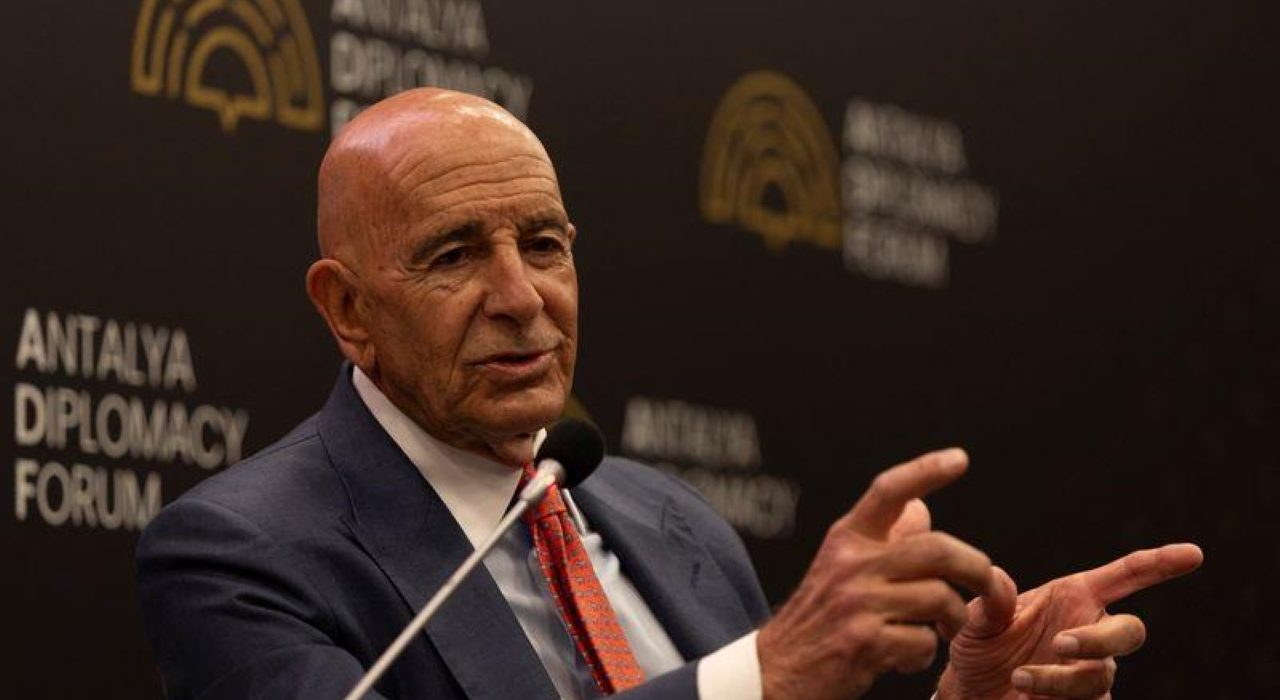
ANKARA, Türkiye – U.S. envoy Tom Barrack has raised an extraordinary warning over the growing confrontation between Israel and Turkey after an Israeli strike on Syria's Abu al-Duhur airbase brought two major American partners close to a possible military encounter.
Barrack, Washington's ambassador to Turkey and special envoy for Syria, said one theory behind the August 18 Israeli attack was an attempt to provoke Ankara. He described the possibility as Israel “baiting the Turks” before Israel's October election. Barrack stressed he was presenting theories rather than an intelligent conclusion.
The warning deserves careful wording. Barrack did not declare an Israel-Turkey war inevitable, nor did he predict World War Three as an established outcome. During an interview with Mario Nawfal, Barrack faced a question about whether an unintended confrontation between Israeli and Turkish forces might expand into World War Three. He replied along broader lines, saying unintended incidents carry escalation risks while stressing neither government seeks such a confrontation.
His central concern focused on how quickly events nearly moved beyond political rhetoric.
Israeli aircraft struck Abu al-Duhur, an inactive military airbase in Idlib province, close to Turkey's border. The attack damaged runways and hangars without reported casualties. Israel later said Syria stood close to allowing Turkish troops and military systems into the site, a development Prime Minister Benjamin Netanyahu's government viewed as a security threat.
Barrack disputed the underlying picture. He said Washington checked Israeli information concerning Turkish military movement and found no Turkish military assets at the site. Syrian officials also denied plans for a permanent Turkish base. Two Syrian officials told Associated Press a Turkish delegation had visited Abu al-Duhur before the strike to inspect reconstruction work.
The distinction matters. A Turkish inspection visit and a permanent military deployment represent different levels of involvement.
Israel argues its security services detected Turkish plans involving forces, drones or radar systems. Israeli Defence Minister Israel Katz also rejected claims Washington received no warning. Katz said Israel transferred intelligence to relevant U.S. authorities while alerting senior Syrian officials.
Barrack gave a different account. He said neither Washington nor Ankara received advance notice of the actual attack. When Israeli jets approached within roughly 80 kilometres of Turkey's border, Turkish commanders started considering whether to scramble fighters.
For Washington, such a moment presents an unusually dangerous problem. Turkey belongs to NATO and hosts major alliance infrastructure. Israel stands among America's closest military partners. An exchange involving their aircraft would force the United States into an immediate diplomatic and security crisis involving allies with competing interests across Syria.
Turkey has also built a close relationship with Syria's government under President Ahmed al-Sharaa since Bashar al-Assad's fall in 2024. Ankara supports training and reconstruction of Syrian institutions. Israel views an expanding Turkish military footprint in Syria with suspicion and wants to preserve freedom of military action across Syrian territory.
Those competing security visions now meet around Syrian airspace.
Barrack has pushed Washington toward a formal deconfliction mechanism linking Turkey, Israel and Syria. The purpose is simple. Military leaders need direct communication before aircraft, drones or troops enter sensitive zones. Reuters reported the United States was working on such a framework after the Abu al-Duhur strike.
Turkey responded sharply. Its Foreign Ministry said Ankara “strongly condemn[s]” the Israeli airstrikes and accused Israel of attacking Syrian infrastructure and violating Syrian territorial integrity. Ankara also called for international accountability.
The political timing adds another layer.
Israel holds national elections on October 27. Reuters reports Netanyahu faces a difficult re-election fight after declining support for Likud and deep divisions over war, military service and the direction of his coalition. Barrack suggested domestic electoral calculations belonged among possible explanations for the strike. He described one theory as a pre-election move designed to draw a forceful Turkish response.
Such an accusation carries weight because Netanyahu has increasingly presented regional security as a central election issue. Yet no public evidence proves Israeli leaders ordered the Abu al-Duhur strike primarily for electoral gain. Israel says military intelligence and national security drove the operation.
Washington also appears eager to contain the dispute. Syrian Foreign Minister Asaad al-Shaibani and Mossad chief Roman Gofman held U.S.-mediated talks in Jordan after the strike, according to Reuters. The discussions focused on easing Israeli-Syrian tensions and stopping the Israel-Turkey rivalry from destabilising Syria further.
Barrack's intervention exposes a larger strategic danger. Syria has become the meeting point for Israeli security operations, Turkish regional ambitions, American diplomacy and the rebuilding programme of a new Syrian government. Each actor has armed forces, intelligence services and separate red lines.
One mistake in such an environment carries consequences far beyond a damaged runway.
Turkey previously shot down a Russian Su-24 near the Syrian border in 2015 after accusing the aircraft of violating Turkish airspace. Russia denied a violation. Relations plunged before Ankara and Moscow later repaired ties. Barrack referred to the history while explaining why unidentified or unannounced military flights near Turkey create severe risks.
The latest episode ended without Turkish jets firing on Israeli aircraft. Diplomats then moved to repair the damage. Barrack said Turkish leaders were concentrating on restraint.
For now, restraint has held.
The next test concerns whether Israel, Turkey and Syria accept a working communication system before another strike. Without one, military commanders will keep making decisions under pressure with incomplete information.
Barrack's World War Three discussion should not become a sensational prediction detached from his fuller remarks. His warning points toward a narrower and more serious fact. Two heavily armed U.S. partners came close enough to confront senior officials to discuss emergency escalation scenarios.
In the Middle East's current security environment, preventing the first exchange of fire matters more than explaining one afterward.