

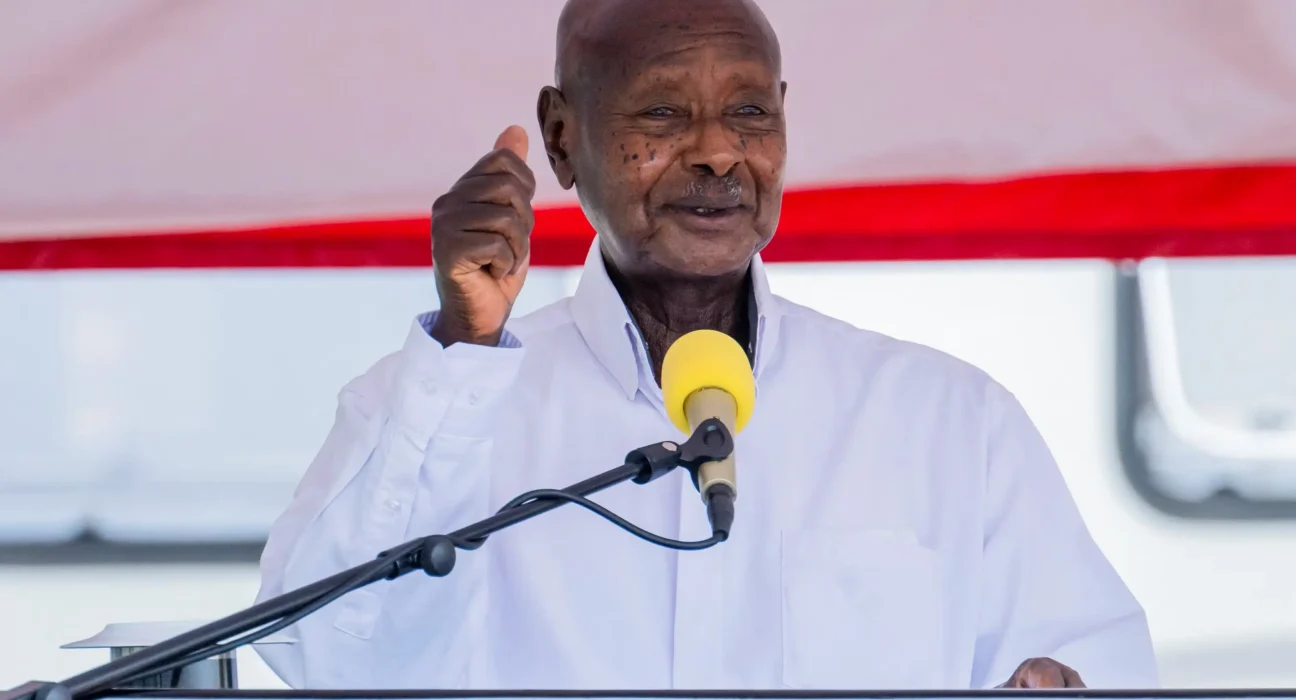
KAMPALA, Uganda – President Yoweri Museveni has reignited an old African argument about religion, identity and cultural confidence after remarks attributed to him spread across social media on Monday.
An AfricanHub social-media post circulating on Monday quoted Museveni saying, “The problem with Africans is an inferiority complex. When they are Christians, they try to become Europeans. They think being Christian is being European. When they are Muslims, they want to become Arabs.” A review of official Ugandan channels did not establish the original date or full video context. The message closely matches positions Museveni has expressed repeatedly over many years.
His argument reaches far beyond clothing, names or worship. Museveni has spent years attacking what he describes as African cultural insecurity, linking colonial education, foreign religious influence and imported social standards to a loss of confidence among Africans.
At Makerere University in 2023, Museveni criticised skin bleaching and imported beauty standards. He said colonial thinking had taught Africans to dislike blackness and described the resulting inferiority complex as dangerous. He also criticised wigs worn to imitate European hair.
His criticism of religious imitation follows the same line. In November 2025, while discussing conflict in Sudan and the Horn of Africa, Museveni accused some Muslim youth of copying ideas from the Middle East and judging other Africans through foreign cultural standards. He argued for coexistence among pagans, Christians and Muslims and said Africa belonged to Africans of every faith.
Museveni has also criticised African political movements built around religious identity. Speaking to Ugandan military officers in 2024, he blamed religious and ethnic politics for weakening states such as Sudan. State House quoted him describing competition between Arab and African identities, alongside Muslim and Christian divisions, as destructive politics.
The debate requires historical care. Christianity is not European by origin. Christianity began in the Middle East and reached parts of Africa long before modern European colonial rule. The Kingdom of Aksum, covering territory in present-day Ethiopia and Eritrea, adopted Christianity during the fourth century. Oxford research traces the faith’s establishment there to King Ezana and the Aksumite elite.
Islam also has deep African roots. Muslim tradition records an early migration of followers of Prophet Muhammad to Abyssinia during Islam’s earliest years. Islam later expanded across North Africa, the Horn, the Sahel and coastal trading societies, developing African schools, kingdoms and religious traditions over centuries. African Muslims therefore do not become Arabs through faith any more than African Christians become Europeans through Christianity.
Museveni’s stronger point concerns cultural substitution.
European colonial governments often linked education, administration and Christian mission institutions. In several colonies, social advancement rewarded Africans who adopted European languages, dress and manners. Portuguese colonial policy went even further through the assimilado system. In a March 2026 East African Community speech, Museveni recalled Portugal’s demand for Africans in its colonies to become “Black Portuguese” by abandoning their own culture.
Similar debates exist around Arabisation in parts of Africa. Sudan offers one of the clearest political examples. Successive governments promoted Arab and Islamic identity within a country containing numerous ethnic, linguistic and religious communities. Museveni has repeatedly blamed such identity politics for conflict and fragmentation. His criticism targets the conversion of religion into a racial or cultural hierarchy rather than religious belief itself.
The scale of African Christianity also weakens the idea of Christianity as a European possession. Pew Research Center projected sub-Saharan Africa’s share of the global Christian population would rise from 24 percent in 2010 to 38 percent by 2050, while Europe’s share would fall from 26 percent to about 16 percent. Under those projections, sub-Saharan Africa becomes Christianity’s largest regional population centre.
African Islam follows a similar demographic reality. Pew projected the Muslim population of sub-Saharan Africa to rise from 248 million in 2010 to about 670 million by 2050. Africa therefore sits near the demographic centre of both major faiths, rather than standing as a distant cultural extension of Europe or Arabia.
The harder question concerns African institutions.
A continent confident in its identity does not need to reject Christianity, Islam, English, Arabic, French or modern global culture. Confidence appears when societies absorb outside ideas without surrendering local languages, history, names, architecture, scholarship and economic interests.
Museveni himself has framed African self-confidence as an economic issue. In a 2026 address, he warned African political parties against weak economies and said dependence leaves states vulnerable to foreign domination. In July, he urged senior security officers toward stronger ideological grounding, science, production and regional integration.
His own record also invites scrutiny. Museveni has governed Uganda since 1986, giving his administration four decades to shape education, culture and national confidence. A leader who diagnoses an inferiority complex across Africa also faces a fair question about what governments have done to reverse such thinking in schools, universities, media and public institutions.
The question matters more than outrage over one quotation.
Africans do not need permission from Europe to practise Christianity. African Muslims do not need an Arab identity to practise Islam. Faith and ethnicity remain separate questions. Religion crosses borders. Culture evolves locally.
Museveni’s argument becomes strongest when stripped of racial simplification. Africa’s problem is not Christianity or Islam. The deeper problem appears when Africans treat foreign identity as superior and African identity as something requiring replacement.