

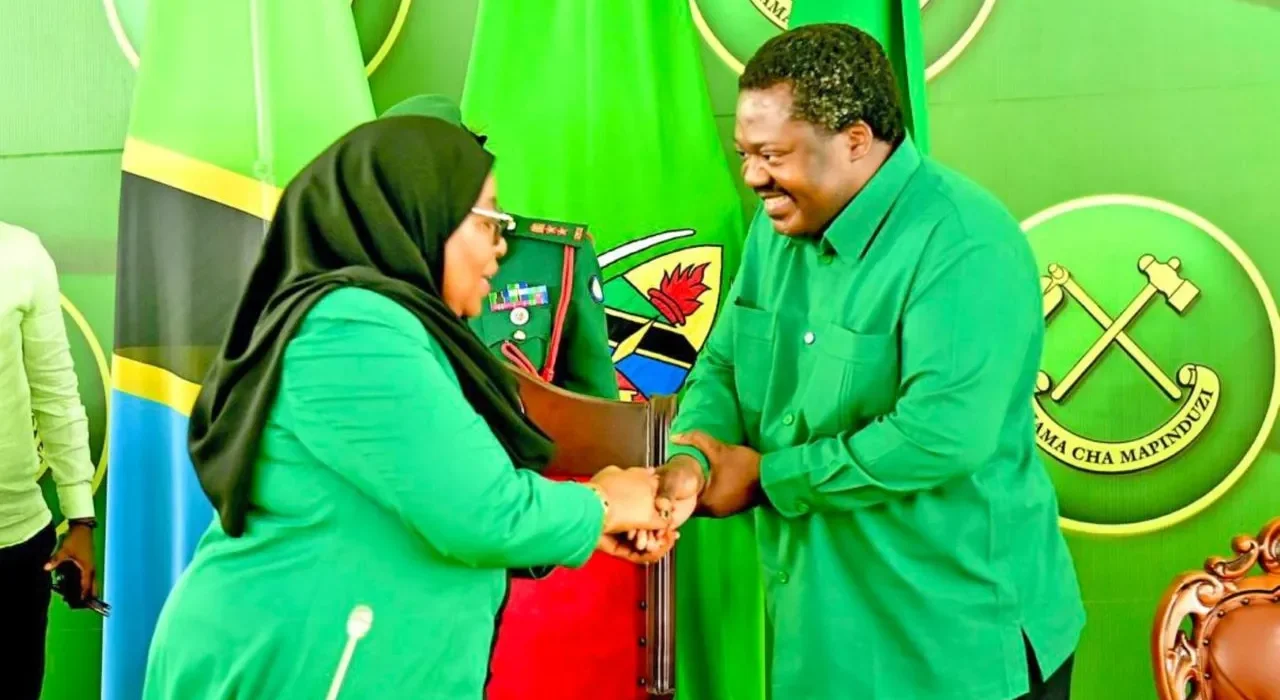
DAR ES SALAAM, Tanzania – Tanzania’s Vice President Emmanuel Nchimbi has resigned less than 10 months after taking office, triggering an extraordinary leadership change inside President Samia Suluhu Hassan’s government after weeks of reports about tension at the highest level of the ruling establishment.
Nchimbi submitted his resignation on August 25 and announced retirement from politics and public service. His departure takes effect on September 4. President Hassan accepted the request later Tuesday, according to a statement issued by Chief Secretary Moses Kusiluka. The presidency said constitutional procedures for choosing another vice president would follow.
The move ends a vice-presidential tenure lasting only 295 days. Nchimbi took office on November 3, 2025, after serving as Hassan’s running mate in the October general election. Under Tanzania’s present constitutional structure, his departure represents an unprecedented voluntary resignation from the vice presidency.
His explanation immediately raised more political questions.
Nchimbi said he had made a personal promise to Hassan on August 27, 2025, before assuming office. He pledged to serve faithfully and step aside whenever she wanted another deputy. His resignation notice stated, “I will therefore resign from the position of Vice President of the United Republic of Tanzania,” effective September 4. He also said he had become convinced the president wanted change.
Those words give the resignation an unusual character. Nchimbi did not cite health, family pressure, age or a policy dispute. He linked his exit directly to his understanding of Hassan’s wishes.
The timing adds another layer.
Only six days before the announcement, Tanzania’s Information Services Department suspended MwanaHALISI newspaper for six months after publication of a front-page story headlined “Nchimbi agoma kujiuzulu,” translated as “Nchimbi refuses to resign.” The report alleged pressure on the vice president to leave office amid internal disagreements involving government and the ruling Chama Cha Mapinduzi.
Authorities said the newspaper failed professional standards involving accuracy, balance and verification. Regulators also cited an incorrect photo caption and said editors failed to demonstrate adequate efforts to obtain responses from Nchimbi and senior CCM officials. The suspension covered print and online editions.
Media organisations criticised the severity of the punishment. Tanzania Editors Forum chairman Deodatus Balile argued against licence suspensions and said a regulator should not operate as complainant and judge in the same dispute. He also reminded journalists of their duty to verify sensitive political reporting.
Nchimbi’s resignation less than one week later does not validate every claim published by MwanaHALISI. The sequence still places new pressure on authorities to explain events leading to his departure.
Public speculation had already focused on reports of Nchimbi losing influence within government. No official statement has confirmed a personal feud between Hassan and her deputy. Nchimbi’s letter contains no accusation against the president and presents his departure as fulfilment of an earlier commitment.
Three days before announcing his resignation, Nchimbi stood beside Hassan at the inauguration of the 2,115 megawatt Julius Nyerere Hydropower Project on the Rufiji River. Reuters photographer Emmanuel Herman captured both leaders at the August 22 ceremony. Their joint appearance gave no public sign of an exit from the country’s second-highest office only days later.
Nchimbi, 54, entered the vice presidency with decades of experience inside CCM, government and diplomacy. He previously served as CCM secretary-general, Home Affairs minister, information minister, deputy minister in several portfolios, Bunda district commissioner and member of parliament for Songea Urban. He represented Tanzania as ambassador to Brazil from 2016 to 2021 and ambassador to Egypt from 2022 to 2023.
His return to the centre of Tanzanian politics started in January 2024, when CCM appointed him secretary-general. He had earlier emerged as a notable figure during the party’s 2015 succession struggle, when he opposed exclusion of Edward Lowassa from CCM’s presidential nomination process. His later rehabilitation demonstrated his ability to survive internal party battles and rebuild influence.
Hassan selected Nchimbi as her 2025 running mate partly because of his long experience and broad links inside CCM. His selection followed former Vice President Philip Mpango’s decision to step away from frontline politics. Nchimbi then became one of the most visible figures in Hassan’s second-term political team.
His resignation now forces Hassan to choose another deputy during a politically sensitive period.
Article 50(4) of Tanzania’s Constitution requires the president to nominate a replacement within 14 days after the office becomes vacant. Parliament must approve the nominee. Since Nchimbi remains formally vice president until September 4, the vacancy starts from his effective departure date.
Political discussion has already produced several names. The Citizen reported speculation involving Prime Minister Mwigulu Nchemba, Palamagamba Kabudi, Dotto Biteko and George Simbachawene. No official nomination has emerged. Hassan retains responsibility for selecting a candidate before parliamentary consideration.
The choice will carry more significance than a routine cabinet reshuffle. Tanzania’s vice presidency sits close to questions of Union balance, succession, party cohesion and relations between mainland Tanzania and Zanzibar. The next appointment will also offer clues about Hassan’s preferred political structure for the remaining years of her term.
Nchimbi’s exit comes during wider scrutiny of Tanzania’s political environment following the disputed 2025 election, restrictions affecting opposition activity and mounting concern over media freedom. The MwanaHALISI episode has now become inseparable from public discussion surrounding his resignation because the newspaper faced suspension after reporting pressure on him to leave, followed days later by his announcement of departure.
For Hassan, the immediate task involves stabilising the executive and presenting a successor capable of winning parliamentary support and maintaining CCM unity.
For Nchimbi, September 4 closes a long career spanning party leadership, parliament, cabinet, diplomacy and the vice presidency. His decision to retire from active politics altogether makes the departure even more striking.
Tanzanians now face a straightforward question. What changed between a president and a running mate chosen less than a year ago to govern together?
Until State House or Nchimbi offers a fuller account, his resignation will continue feeding debate over internal power, political trust and the real events behind one of Tanzania’s most unusual leadership departures.