

NASHVILLE, United States – Dolly Parton, the International country singer, songwriter, actress, entrepreneur and humanitarian who rose from a one-room Tennessee mountain cabin to sell more than 100 million records and become one of the most loved entertainers on earth, died Tuesday in Nashville. She was 80.
Her death immediately became a national event in the United States and a global moment of mourning.
President Donald Trump ordered American flags lowered to half-staff across the United States for one week, beginning at 6 p.m. Tuesday. Trump described Parton as one of the greatest country singers in history and said, “There has never been anyone like her, and never will.”
Amazon founder Jeff Bezos, who developed a personal relationship with Parton after awarding her US$100 million through his Courage and Civility Award in 2022, joined the tributes with his wife Lauren Sánchez.
“Dolly spent her whole life showing us what it means to lead with love,” Bezos wrote. He praised her music, generosity and joy and sent condolences to her family and millions of people touched by her work.
Miley Cyrus, Parton’s goddaughter, wrote that the world had lost “the purest soul.” Country star Reba McEntire thanked Parton for her music and enormous heart. Kacey Musgraves wrote that the world suddenly felt less sparkling. Dionne Warwick remembered her laughter and friendship. Actor Julia Roberts, Parton’s Steel Magnolias co-star, said the loss had dimmed the day.
Former President Bill Clinton remembered Parton as a songwriter who understood ordinary Americans and never forgot her East Tennessee roots. Clinton said he and Hillary Clinton first saw Parton perform in 1974 and remained lifelong admirers.
Former Vice President Kamala Harris called Parton a true American icon whose achievements stretched from Grammy Awards to the distribution of hundreds of millions of books to children.
Author J.K. Rowling described the Imagination Library as one of the greatest contributions to child literacy ever made by a celebrity. Rowling recalled meeting Parton backstage during the 1990s and becoming tongue-tied in her presence.
The U.S. Department of the Interior remembered Parton as a champion of the Great Smoky Mountains who carried the music and stories of her Tennessee home around the world.
New York joined the mourning. The Empire State Building announced plans to illuminate its tower in pink in Parton’s honour.
Parton died peacefully, according to her publicist. Her nephew Bryan Seaver announced her death through her official social media accounts. Seaver had served as her head of security for more than two decades. His father, Larry, held the position before him.
Seaver said Parton had asked him years earlier to make the announcement when her life ended. He described an aunt known inside the family as Sister, Sis, Aunt Granny and Gigi. He said Parton opened doors for relatives and generations of singers, musicians, songwriters and dreamers.
No official cause of death had been disclosed by Tuesday night.
Parton had experienced significant health problems during the final year of her life. She suffered recurring kidney stone infections, complications affecting her immune and digestive systems, dizziness and dehydration. Doctors ordered medical procedures and periods of rest. Those problems first forced postponement of a planned Las Vegas residency and later forced complete cancellation.
Her final public appearance came on June 24 at the opening of Dolly’s Tennessean Travel Stop in Cornersville, Tennessee. She cut a ribbon, addressed fans and displayed the humour which followed her throughout her career.
Only four days before her death, Parton spoke about continuing health problems while insisting she still had projects and ambitions ahead. She had been working on a Broadway production based on her life, a Nashville hotel, a museum and other ventures.
Her death followed another profound loss.
Carl Dean, her husband for almost 59 years, died in March 2025 at 82. Parton later acknowledged caring for Dean during his declining health had caused her to neglect some of her own medical needs. She released “If You Hadn’t Been There” after his death, turning private grief into another song.
The marriage had become one of entertainment’s strangest success stories.
Dolly Parton lived much of her adult life under bright lights. Carl Dean spent almost six decades avoiding them.
They met on Parton’s first day in Nashville in 1964, outside a laundromat. Parton was 18. Dean was 21. They married in Ringgold, Georgia, in 1966 because Parton’s record label worried marriage might interfere with her developing career.
Dean rarely attended industry events. He stayed away from red carpets and celebrity culture. Parton later joked that people sometimes doubted his existence.
The marriage survived fame, constant travel, tabloid rumours and decades of speculation about Parton’s friendships.
They never had children.
Parton later explained she sometimes wondered how motherhood would have changed her life. She eventually came to believe her freedom from parenting responsibilities gave her time to build a career and help millions of other children through educational work. Her nieces and nephews knew her through affectionate family names, including Aunt Granny and Gigi.
Dolly Rebecca Parton was born January 19, 1946, in Locust Ridge, Tennessee, the fourth of 12 children of Robert Lee Parton and Avie Lee Owens Parton.
The family lived in a one-room cabin in the Appalachian mountains. Electricity, indoor plumbing and running water were absent during much of her childhood. Her father worked as a sharecropper and farmer. Her mother sang and told stories.
MusicRow reported Robert Lee Parton paid the doctor who delivered Dolly with cornmeal because cash remained scarce.
Poverty later became central to her songwriting, but Parton rarely described childhood solely through deprivation.
Her family possessed music, religion, humour and close relationships.
Her mother knew old mountain songs. Relatives performed country and gospel music. Her grandfather preached. Uncle Bill Owens bought Dolly a guitar, helped her learn and introduced her to local radio and television opportunities.
Parton started writing songs before she properly understood written language. Her mother sometimes wrote down compositions for her. At 10, she performed on Cas Walker’s radio programme in Knoxville. She later appeared on television before her own family owned a television set.
At 13, Parton appeared at the Grand Ole Opry.
Country star Johnny Cash reportedly encouraged the young singer to follow her instincts rather than conform to expectations.
Her early records produced little commercial success. Failure did not send her home.
In 1964, she became the first member of her immediate family to graduate from high school. The following day, Parton boarded a bus for Nashville.
She arrived carrying songs, ambition and little money.
Early Nashville work included songwriting, singing and ordinary jobs. Her first breakthrough developed through songwriting rather than celebrity.
Bill Phillips recorded “Put It Off Until Tomorrow,” written by Parton and Uncle Bill Owens. Parton sang harmony on the recording. Other artists started recording her compositions.
Her first important solo single, “Dumb Blonde,” arrived in 1967.
The title became an early example of a recurring Parton strategy. She embraced stereotypes about her appearance while quietly demonstrating how badly people underestimated her intelligence.
Porter Wagoner then changed her life.
Wagoner hired Parton in 1967 to replace singer Norma Jean on The Porter Wagoner Show. The nationally syndicated programme introduced her to millions of country music viewers.
Audiences initially resisted the newcomer. Parton eventually won them over.
Wagoner and Parton became one of country music’s most successful duet partnerships, producing 21 hit duets according to MusicRow. They won Country Music Association honours and spent years touring together.
Parton’s solo career grew faster.
“Joshua” became her first solo number one in 1971.
Then came songs which permanently changed country music.
“Coat of Many Colors” told the true story of her mother sewing a winter coat from scraps. Parton proudly wore the coat to school. Other children laughed at her poverty.
Parton turned humiliation into a song about dignity.
The Library of Congress later placed “Coat of Many Colors” in the National Recording Registry. Scholars praised the composition for storytelling, emotional restraint and an ability to address poverty without self-pity.
“Jolene” followed.
Parton drew the title from a young fan and the emotional story from a woman who had shown interest in Carl Dean. The song rejected conventional anger. Parton’s narrator pleaded with the other woman rather than threatening her.
Four chords, a tense guitar line, a distinctive vocal performance and simple language produced one of the most recognisable country recordings in history.
Artists across genres later recorded “Jolene.” The White Stripes turned the song into rock. Beyoncé revisited the composition decades later. Generations of country performers kept returning to Parton’s original.
Then came “I Will Always Love You.”
Parton wrote the song as a farewell to Porter Wagoner when she decided to leave his programme.
The relationship had become professionally difficult. Wagoner had helped build her career. He also struggled to accept her independence.
Instead of ending the partnership through an angry confrontation, Parton wrote a goodbye.
The song reached number one on the country chart in 1974.
Parton recorded another version for The Best Little Whorehouse in Texas in 1982. The new recording reached number one again.
Whitney Houston then recorded “I Will Always Love You” for The Bodyguard in 1992. Houston’s interpretation became one of the largest-selling singles in recording history.
The financial story behind the song revealed Parton’s business intelligence.
Elvis Presley wanted to record “I Will Always Love You.” Parton initially celebrated the prospect.
Colonel Tom Parker, Presley’s manager, then demanded a share of the publishing rights.
Parton refused.
Walking away from an Elvis Presley recording opportunity represented a painful decision for a songwriter raised worshipping major stars. The choice preserved ownership.
When Houston’s version later became a global phenomenon, Parton retained the publishing income.
Her career offers countless examples of such decisions.
She understood ownership long before artist rights became a common celebrity talking point.
Parton eventually controlled publishing interests, recording ventures, production companies, property, tourism businesses and consumer brands.
Her separation from Wagoner did not end peacefully.
Wagoner filed a US$3 million lawsuit in 1979 alleging breach of contract and demanding money linked to Parton’s earnings and royalties. The case ended through an out-of-court settlement. Parton later said Wagoner received the first million dollars she ever earned.
Time repaired some of the relationship.
Parton and Wagoner reconciled. She appeared with him during later years and honoured his role in her career after his death in 2007.
Parton expanded beyond traditional country during the late 1970s.
“Here You Come Again” gave her major crossover success. The album reached broader pop audiences. Her glamorous appearance, television appearances and humour started moving Dolly Parton from country celebrity to American celebrity.
Hollywood followed.
Jane Fonda recruited Parton for 9 to 5 alongside Lily Tomlin.
Parton had never acted in a feature film.
She played Doralee Rhodes, a secretary dealing with a sexist boss. The comedy became a commercial success. Parton wrote its title song by tapping her acrylic fingernails together to imitate the rhythm of a typewriter.
“9 to 5” reached number one on both country and pop charts. The song won Grammy Awards and received an Academy Award nomination for Best Original Song.
The film also tied Parton permanently to working women and workplace equality.
Her screen career continued with The Best Little Whorehouse in Texas, Steel Magnolias, Rhinestone and Straight Talk.
Rhinestone, co-starring Sylvester Stallone, became a commercial and critical disappointment. Parton never pretended every project worked.
Her 1987 television variety series Dolly also struggled.
The failures never ended her career.
During the early and mid-1980s, a deeper crisis developed away from cameras.
Parton experienced serious health problems, hormonal changes, weight gain, depression and personal distress. She underwent a partial hysterectomy. In later interviews, she acknowledged reaching a mental state where she understood how people arrive at suicidal thoughts.
She described the period as a breakdown.
Faith, family, friends and work helped her recover. Parton repeatedly said songwriting worked as therapy throughout her life.
Her relationship with appearance also attracted endless fascination.
Big blonde wigs, rhinestones, acrylic nails, tight clothes and cosmetic surgery formed an intentionally exaggerated image.
Parton never denied surgery.
She frequently made herself the centre of the joke before anyone else had an opportunity.
The strategy disarmed critics.
Behind the image sat an entertainer who understood branding decades before social media turned personal identity into a commercial industry.
Parton said her glamorous image grew from a rural Tennessee understanding of beauty. She openly admitted using surgery and enhancements while insisting the personality underneath remained genuine.
Tabloids spent years speculating about affairs, her marriage and her lifelong friendship with Judy Ogle. Parton denied claims of a romantic relationship with Ogle.
Celebrity gossip never produced a major personal scandal comparable with many stars of her era.
The more serious controversies concerned business, race, politics and representation.
Her dinner attraction originally operated as Dixie Stampede and used Civil War imagery. Critics attacked the name and presentation for romanticising the Confederacy.
Parton removed “Dixie” from the attraction’s name in 2018.
Two years later she openly supported the principle behind Black Lives Matter and acknowledged people sometimes fail to recognise offensive traditions until someone points out the problem. Her response centred on correction rather than defensiveness.
Parton also developed an unusually broad following among LGBTQ audiences while remaining a Christian rooted in Southern religious culture.
She repeatedly rejected condemnation of gay fans and argued people should receive respect.
Her position sometimes put her outside conservative country music expectations. She also resisted becoming a partisan political campaigner.
Presidents from different parties praised her.
She declined the Presidential Medal of Freedom twice during Trump’s first administration. One refusal followed Carl Dean’s illness. Another came during the COVID-19 period. She later declined an offer during Joe Biden’s presidency because she worried accepting might appear political.
Trump’s decision Tuesday to lower flags for a week therefore carried extra significance.
Parton spent much of her public life resisting political ownership. On the day of her death, figures from both Republican and Democratic politics claimed common affection for her.
Her business career became equally important.
Dollywood opened under Parton’s name in Pigeon Forge, Tennessee, in 1986 through a partnership with the Herschend family.
Parton did not build the park in Los Angeles or New York.
She invested near home.
Dollywood grew into a major tourism destination and employer in East Tennessee. Resorts, entertainment venues and related developments followed.
Parton expanded into publishing, film production, television, fragrances, food products, clothing, books, wine and other commercial ventures.
MusicRow estimated her fortune above US$500 million, although private holdings make exact valuation difficult.
Yet philanthropy eventually became almost as central to her public reputation as music.
Parton established the Dollywood Foundation in 1988.
One early initiative, the Buddy Program, paired schoolchildren and promised US$500 to students who graduated. The foundation says dropout rates among participating classes fell from 35 percent to 6 percent.
In 1995, she created Dolly Parton’s Imagination Library.
The inspiration came from her father.
Robert Lee Parton never learned to read or write. His daughter became one of the world’s most successful songwriters. She decided to honour him by sending books to children.
The first programme covered Sevier County.
Expansion followed across the United States, Canada, Britain, Australia and Ireland.
By the end of 2025, the programme had distributed 304,539,509 books since inception. More than 40 million books went out during 2025 alone. The programme now distributes more than three million books each month.
Independent research involving more than 86,000 caregivers across five countries found participation strengthened early literacy and family reading habits.
J.K. Rowling’s tribute after Parton’s death therefore focused on books rather than music.
The programme perhaps represents the clearest explanation for why Parton became more than a celebrity.
Millions of children received something from Dolly Parton without buying an album, visiting Dollywood or knowing who she was.
Disaster relief deepened her connection to Tennessee.
Wildfires devastated Sevier County in 2016.
Parton created the My People Fund through the Dollywood Foundation. More than US$12 million eventually went to families affected by the fires. The foundation also provided scholarships for students whose homes had been destroyed.
After Hurricane Helene in 2024, Parton and her associated businesses contributed more than US$2 million toward recovery across Tennessee and North Carolina.
Health philanthropy reached national significance during COVID-19.
Parton donated US$1 million to Vanderbilt University Medical Center. The funding supported coronavirus research connected with development of Moderna’s vaccine.
She later received the vaccine herself at Vanderbilt and used humour and music to encourage vaccination.
Jeff Bezos recognised the wider pattern in 2022.
His Courage and Civility Award gave Parton US$100 million to direct toward charitable work. Parton responded by saying people with resources should help others and promised to put money where her heart led.
Bezos returned to the same theme after her death.
His tribute focused on love and generosity rather than record sales.
The honours were enormous.
Parton entered the Country Music Hall of Fame in 1999.
The Songwriters Hall of Fame followed in 2001.
She received the National Medal of Arts, Kennedy Center Honors and the Grammy Lifetime Achievement Award.
The Recording Academy records 10 competitive Grammy wins and 55 nominations, with a separate Lifetime Achievement Award presented in 2011. Reuters counts the lifetime honour among 11 Grammy Awards associated with her career.
She accumulated 25 number one singles on Billboard’s Hot Country Songs chart, tying the record for a female artist. Grammy reporting credits her with 49 Top 10 country albums and more than 100 million record sales worldwide.
Her catalogue reached far beyond one sound.
Parton recorded country, bluegrass, gospel, pop, dance music and rock.
Trio, recorded with Linda Ronstadt and Emmylou Harris, became a landmark collaboration.
“Islands in the Stream,” recorded with Kenny Rogers, became one of country pop’s most famous duets.
“Here You Come Again” took her deep into pop radio.
“9 to 5” connected country music with working-class frustration.
“Jolene” became global folklore.
“I Will Always Love You” achieved immortality twice, first through Parton and then through Whitney Houston.
“Coat of Many Colors” preserved the voice of the child from Locust Ridge.
“My Tennessee Mountain Home” documented where she came from.
“Light of a Clear Blue Morning” captured independence after her professional break with Wagoner.
Later albums returned to bluegrass and Appalachian roots before Parton took another unexpected turn.
In 2022, she initially tried to withdraw from consideration for the Rock & Roll Hall of Fame because she did not believe she had earned a rock honour.
The Hall declined to remove her from the ballot.
Parton eventually accepted induction and responded in typical fashion. She recorded Rockstar, a large rock project featuring major artists and classic songs.
Her Rock Hall induction placed her beside artists from genres far beyond Nashville.
P!nk inducted her.
The Rock Hall praised Parton for songwriting, artistic independence, business control and philanthropy.
Her international appeal had already become undeniable.
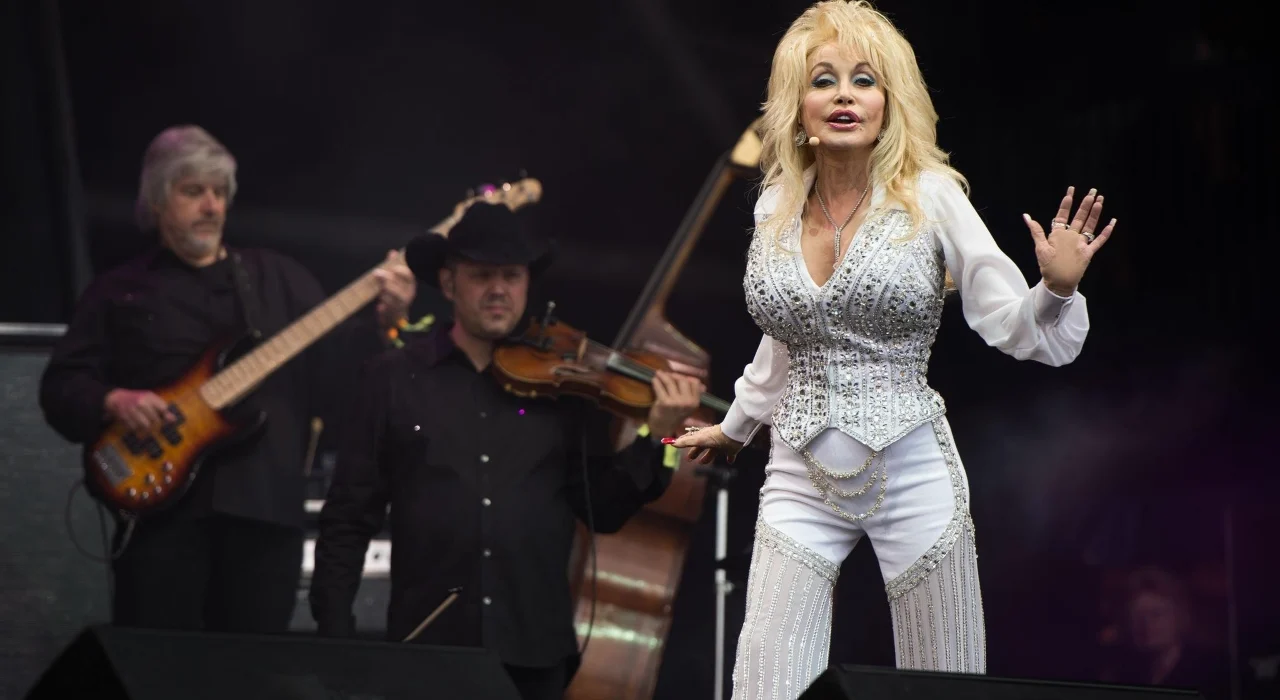
At Glastonbury Festival in England in 2014, Parton performed before an enormous crowd far outside the traditional country music market.
The performance produced one small controversy when online viewers accused her of miming. Her representatives denied the allegation and insisted she performed live.
The episode disappeared quickly.
The crowd singing along to songs written decades earlier told the more important story.
Parton had become global.
She belonged to Tennessee, but Tennessee no longer contained her.
Her family nevertheless remained central.
Her 2024 project Smoky Mountain DNA: Family, Faith and Fables brought relatives into a large musical exploration of Parton and Owens family history.
Her work kept circling home.
Country Music Hall of Fame chief executive Kyle Young captured the central contradiction in his tribute Tuesday. He said Parton’s legacy rested on humanity rather than celebrity and recalled her rise from poverty before sharing her fortune with others.
Her family has requested a small private funeral for immediate relatives.
Instead of flowers, the family asked admirers to donate to Dolly Parton’s Imagination Library. Fans around the world were also invited to leave messages through her official website and social media channels.
Such instructions fit her life.
A global superstar dies, and the family directs attention toward books for children.
Parton spent decades joking about her hair, breasts, wigs, nails and clothes.
She understood the usefulness of spectacle.
Yet underneath the spectacle sat one of American music’s strongest songwriters, one of Nashville’s most disciplined business figures and one of entertainment’s most substantial philanthropists.
Her songs will keep playing.
Her businesses will keep employing people.
Her park will keep receiving families in Tennessee.
Children who never heard “Jolene” will keep receiving books carrying her name.
Whitney Houston’s voice will keep sending publishing income through a decision Dolly Parton made when she refused Elvis Presley’s representatives.
Young singers will keep studying how she wrote.
Entrepreneurs will keep studying how she retained ownership.
Performers will keep studying how she created an image without allowing the image to control her.
Philanthropists will keep studying why her giving worked.
The mourning Tuesday stretched from country singers to presidents, billionaires, actors, writers, business leaders and ordinary families.
Trump lowered the nation’s flags.
Bezos remembered a woman who led with love.
Miley Cyrus mourned her godmother.
Bill Clinton remembered her honesty.
Kamala Harris remembered her books.
J.K. Rowling remembered her contribution to literacy.
Reba McEntire remembered her friend.
The U.S. government remembered a daughter of the Great Smoky Mountains.
The Empire State Building prepared to glow pink.
All were describing different parts of the same woman.
Dolly Parton spent 80 years proving poverty did not set the limits of ambition, femininity did not prevent commercial control, glamour did not cancel intelligence, faith did not require intolerance, country music did not need geographic borders and enormous wealth did not need to end in private luxury.
She once said songwriting stood behind every dream she achieved.
Near the end, despite illness, grief and declining physical strength, she still worked.
Parton accepted an ACM Poets Award virtually days before her death. She described songwriting as therapy, release and a gift from God.
Her last months therefore ended close to where her life began.
With songs.
A girl born in a one-room cabin wrote her way into history.
Dolly Rebecca Parton Dean, born January 19, 1946. Died August 25, 2026.
She was 80.
From Us at The African Telegraph, “We Will Always Love You Dolly.”