
ACCRA, Ghana – Your religion often reaches you before your independent judgment begins. Parents name you, elders teach you, schools reinforce doctrine, and national geography narrows the beliefs placed before you. By adulthood, inherited identity often feels like personal selection.
This truth deserves discussion across Africa. Yet the statement needs historical discipline. European colonial powers drove mass Christian expansion across much of sub-Saharan Africa, while Arab conquest spread Islam across North Africa. Trade, scholarship, marriage, migration and African political choice also spread both faiths. The continent’s religious map reflects power, contact and inheritance, not one simple invasion story.
Pew Research Center estimates show 76 percent of sub-Saharan Africans followed traditional African religions in 1900. Christians represented 14 percent and Muslims 9 percent. By 2020, Christians formed 62 percent of the region and Muslims roughly one-third. Geography still follows history. Muslim-majority societies dominate northern zones, while Christian majorities appear farther south.
Colonialism played a decisive role in Christian expansion. Mission schools controlled access to literacy, formal employment and elite advancement across many colonies. Baptism often arrived beside education, medicine and colonial administration. Families understood the material consequences. Faith entered homes through conviction, pressure, opportunity and survival.
Yet Christianity did not first enter Africa through European colonial rule. Ethiopia’s Aksumite kingdom adopted Christianity during the fourth century, more than a thousand years before the scramble for Africa. Ancient Christian communities also flourished in Egypt and Nubia. UNESCO describes Aksum as one of the earliest civilisations to embrace Christianity officially.
Islam carries an equally complex African history. Muslim armies conquered Egypt and North Africa during the seventh century. UNESCO’s General History of Africa links those conquests to Islamisation across the Maghreb and later Arabisation. South of the Sahara, merchants, scholars, rulers, marriage and trade networks spread Islam through West Africa and along the Swahili coast.
Africa also gave early Muslims protection. The Christian Aksumite kingdom sheltered refugees during the first Hijra in 615. UNESCO describes the event as an early example of asylum and interfaith tolerance. Africa therefore appears in Islamic history as sanctuary, not only territory reached through conquest.
These facts weaken every crude slogan. Christianity does not belong to white people. Islam does not belong to Arabs. Africans adopted, translated and reshaped both traditions over centuries. Ethiopian Christianity, Coptic Christianity, West African Islam and Swahili Islam developed African institutions, languages, scholarship, music and moral practice.
Still, your birthplace strongly predicts your first faith. A child born in Morocco usually enters Islam. A child born in Zambia usually enters Christianity. Neither child studies every religion before receiving a religious label. The family and surrounding society make the first choice. Adult reflection comes later, when social penalties for questioning belief often grow severe.
This inherited pattern becomes deadly when politicians, clerics and armed groups turn identity into a weapon. People begin defending labels received during childhood as though an enemy personally attacked their dignity. A dispute over land, office, cattle, elections or public money then acquires religious language.
Nigeria offers repeated warnings. Christian and Muslim identities often overlap with region, ethnicity, land disputes and political competition. Violence receives a religious name even where struggles over territory, state appointments, policing and economic exclusion drive the confrontation. Pew researchers identified elite manipulation, land disputes and international influences among the forces behind religious tension in northern Nigeria.
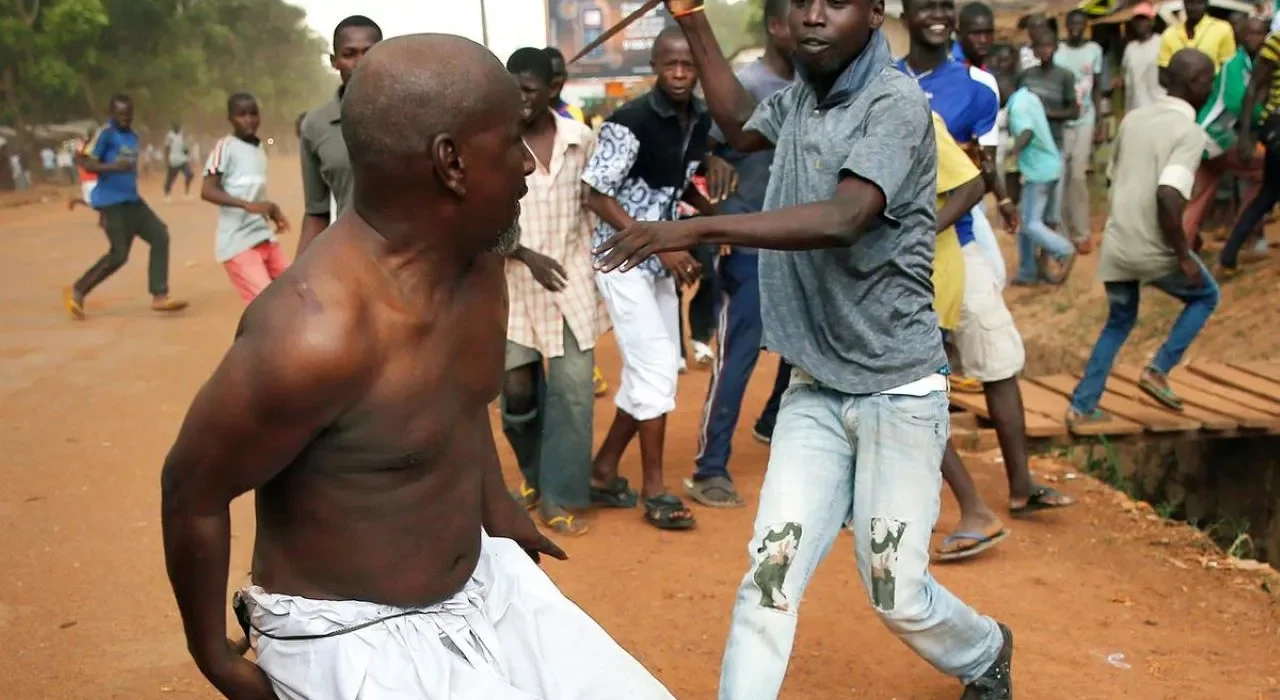
The Central African Republic gives an even clearer example. Armed factions divided communities along Muslim and Christian lines after years of weak government, exclusion and predatory violence. Former United Nations Secretary-General Ban Ki-moon stated, “The conflict in the Central African Republic is not about religion.” He said political actors manipulated religious and ethnic affiliation.
United Nations adviser Adama Dieng later condemned politicians and armed groups for using religious hatred to gain territory, recruit fighters and seize property. His warning exposed the material interests hidden beneath sacred language.
Africans should therefore ask who benefits whenever a preacher or politician presents another faith community as an enemy. Does the speaker seek votes, land, donations, recruits, protection from corruption charges or control over a district? Religious anger often protects a worldly transaction.
The deeper tragedy concerns African traditional religions. Colonial authorities and missionaries often dismissed indigenous beliefs as superstition, darkness or backwardness. Postcolonial elites repeated the insult. Many Africans now know biblical and Middle Eastern history better than the spiritual systems, ethics and rituals of their own ancestors.
Those traditions never disappeared. Pew research found many Christians and Muslims still consult traditional healers, honour ancestors or retain beliefs linked to indigenous spirituality. African practice often blends identities which public doctrine treats as separate.
Africa does not need a campaign against churches or mosques. Such a campaign would repeat the coercion critics condemn. The continent needs freedom of conscience, historical honesty and equal protection for believers, traditionalists, converts, doubters and people without religion.
You should hold your faith because your conscience accepts its teachings, not because conquest, family pressure or fear removed every alternative. You should also grant your neighbour the same freedom. A belief loses moral authority when followers need violence, state punishment or social terror to defend faith.
Schools should teach African religious history without propaganda. Students should learn about Aksum, Nubia, Islamic scholarship in Timbuktu, Swahili civilisation and indigenous African systems. They should also study colonial missionary power, Arab conquest, slavery, conversion, resistance and coexistence.
Religious leaders should publish funding sources and reject political mobilisation built on fear. Governments should punish incitement consistently, protect places of worship and refuse laws which privilege one faith over equal citizenship. Journalists should investigate the land, money and political interests behind alleged religious conflict.
Africa’s greatest danger does not come from a Christian praying, a Muslim fasting or an elder honouring ancestral tradition. Danger grows when leaders persuade citizens to kill neighbours over identities history assigned before either side understood the choice.
Your neighbour did not draw Africa’s religious map. Neither did you. Colonial administrators, conquerors, traders, missionaries, rulers and families shaped much of the inheritance. Africans now hold responsibility for what happens next.
No imported scripture, inherited label or foreign-funded institution should carry greater value than an African life. The continent must end wars fought in the name of faith while politicians divide communities and collect the rewards.