

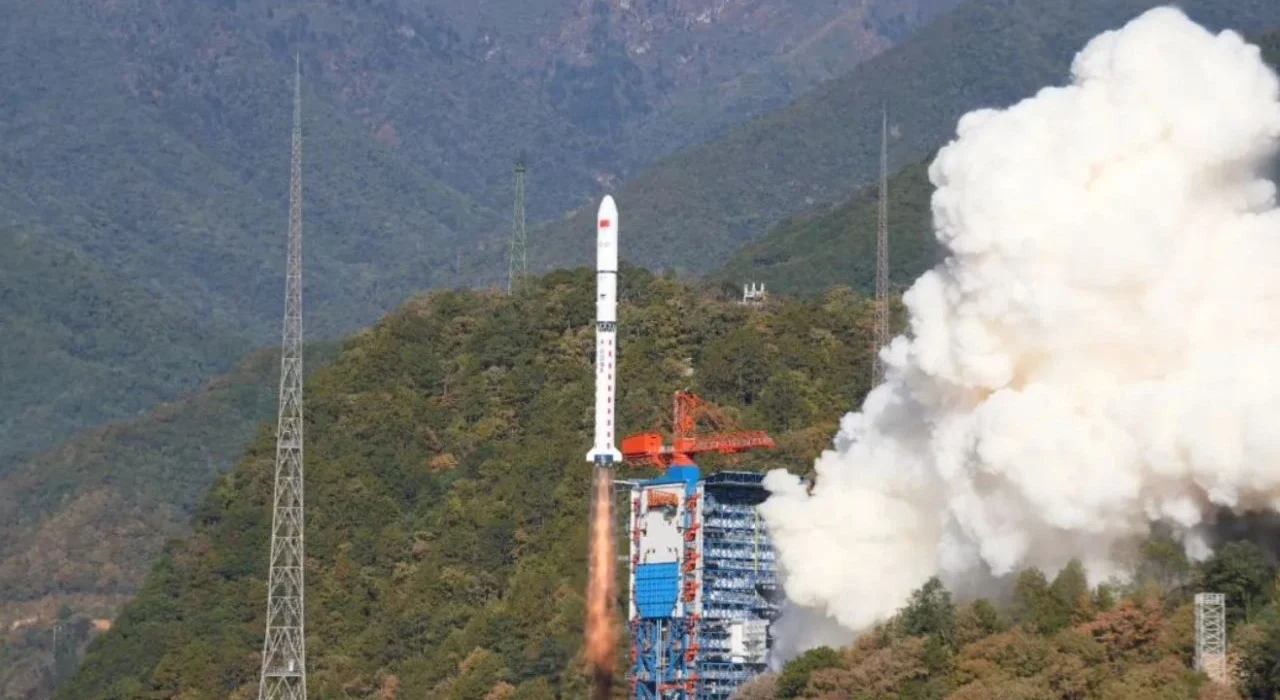
BEIJING, China – China’s rapid expansion in military space is forcing Washington to confront a strategic reality long feared by Pentagon planners. American forces still hold unmatched global reach, yet Beijing now possesses an orbital network built to find ships, follow aircraft, guide long-range weapons and threaten the satellites supporting United States operations.
The latest warning comes from American defence assessments and recent reporting by The Wall Street Journal. China’s military now has access to more than 500 intelligence, surveillance and reconnaissance satellites. The United States Department of Defense reported more than 500 ISR-capable Chinese satellites after Beijing launched 67 such spacecraft during 2024. The Wall Street Journal later placed the current figure above 510.
The military value sits in persistence. One satellite gives a brief look. A large constellation gives repeated coverage, faster updates and more chances to locate moving targets. Aircraft carriers, bomber deployments, airfields, missile batteries and logistics hubs become harder to hide when optical, radar and electronic-intelligence satellites work together.
The Pentagon warned China’s growing ISR fleet supports long-range kill chains. A kill chain starts with finding a target, then identifying, tracking, assigning a weapon and striking. Space shortens those steps.
This matters most in the western Pacific. American strategy relies heavily on carriers, submarines, long-range aircraft, bases in Japan and Guam, plus allied facilities spread across a huge maritime area. China does not need military superiority across every domain. Beijing needs enough surveillance to find valuable platforms and enough weapons to threaten them before commanders reposition.
BeiDou strengthens this structure. China built the navigation network as an alternative to the American GPS system. BeiDou supports civilian navigation, logistics and communications, while military users gain independent positioning, navigation and timing. Dependence on American-controlled GPS would expose Chinese operations during a major war. BeiDou reduces such vulnerability.
China also invests in radar imaging, infrared sensors, electronic intelligence, artificial intelligence and laser communications. Radar satellites operate through cloud and darkness. Electronic-intelligence satellites search for emissions from radars and communications equipment. AI helps analysts process vast image volumes faster than traditional human teams.
Clayton Swope of the Center for Strategic and International Studies described Beijing’s thinking directly. “Beijing sees space as an arena for geopolitical competition, where the United States is the main competitor,” he told The Wall Street Journal.
The commercial sector now adds another layer. American officials sanctioned three Chinese satellite companies in 2026, accusing them of providing imagery which supported Iranian targeting of United States forces in the Middle East. The firms included Chang Guang Satellite Technology, MizarVision and The Earth Eye.
Washington’s allegation represents an American government position. Beijing rejects accusations portraying Chinese commercial space operations as extensions of hostile military activity. Yet the episode shows how commercial imagery, AI analysis and military targeting increasingly overlap.
Chinese firms have also published analyses tracking American carriers and bombers. MizarVision publicly released assessments involving American military movements, according to The Wall Street Journal. Such work does not automatically prove formal People’s Liberation Army tasking. Military planners still face the same operational problem. Commercial sensors place more eyes over areas once monitored mainly by governments.
Counterspace weapons deepen the concern. The Pentagon says China possesses direct-ascent anti-satellite missiles for low Earth orbit targets, lasers, jammers and systems with possible on-orbit military applications.
China destroyed one of its own satellites during a 2007 anti-satellite test, creating thousands of pieces of debris. Beijing has avoided another destructive test of the same type, yet American assessments say development continued. Pentagon analysts believe China seeks systems capable of threatening satellites across wider orbital ranges.
More recent Chinese spacecraft have demonstrated rendezvous, close-approach and robotic manipulation abilities. Shijian-21 moved a defunct navigation satellite into a graveyard orbit in 2022. Such technology serves legitimate repair and debris-removal missions. The same engineering gives a spacecraft the ability to approach, move or interfere with another satellite.
Space warfare presents serious risks for both sides. Destroyed satellites produce debris threatening friendly and hostile spacecraft. Jamming spills across civilian networks. Cyberattacks against ground stations risk wider disruption. A conflict beginning over Taiwan or another flashpoint might spread into communications, navigation, weather services and commercial systems used far beyond the battlefield.
America is responding. The United States created the Space Force in 2019 and continues building more resilient constellations, anti-jam communications and distributed satellite networks. Space Systems Command announced contracts worth $437.7 million in June for initial satellites under a protected tactical communications programme designed for contested environments.
Washington also relies on a large private sector led by SpaceX, Maxar, Planet and other commercial operators. Starlink’s role in Ukraine showed how distributed commercial networks complicate attempts to shut down battlefield communications.
The strategic contest therefore involves resilience as much as dominance. Large expensive satellites once offered unmatched capability, yet a small number of critical platforms created attractive targets. Both countries now pursue larger constellations with greater redundancy.
China’s reusable-launch progress also matters. Lower launch costs would help Beijing replace damaged satellites faster, deploy larger constellations and refresh technology more frequently. China successfully demonstrated new recovery technology during a Long March-10B mission in July, marking another step toward cheaper access to orbit.
The wider lesson reaches beyond Washington and Beijing. Space has become part of conventional warfare. Satellites now support missile warning, navigation, communications, targeting, weather forecasting and intelligence at every stage of military operations.
China spent decades studying American warfare from the Gulf War onward. United States forces repeatedly showed how superior information, precision weapons and satellite support multiply combat effectiveness. Beijing appears determined to deny Washington exclusive possession of those advantages.
American naval strength still carries immense weight. United States forces retain global bases, allies, nuclear submarines, advanced aircraft and extensive space infrastructure. China has not erased those advantages.
Beijing has changed the cost of using them near China.
A carrier operating inside a dense surveillance zone faces a different risk from one moving under limited observation. A bomber launch detected early gives defenders more preparation time. A satellite network feeding missile units faster coordinates increases pressure on every American commander operating in the region.
The uncomfortable shift is simple. Washington spent years planning to see an opponent first, communicate faster and strike from distance.
China now wants the same information advantage.
The next Pacific conflict, if deterrence fails, would not begin only with ships and aircraft. The opening struggle would reach orbit, data networks and satellite ground stations. Whoever protects information while denying the opponent reliable targeting would gain a decisive early advantage.
China’s satellite surge does not prove American defeat. The development proves the old assumption of uncontested American visibility no longer belongs in serious military planning.