

BEIJING, China – China has introduced a serious reform for professional engineering doctorates. Africa should study the policy, copy its discipline, and reject the social media exaggeration surrounding the announcement.
China has not abolished doctoral research. Nor has Beijing allowed every engineering student to replace scholarship with an invention assembled in a workshop. National guidelines now permit candidates in eight professional engineering doctorate fields to seek a degree through an assessed practical achievement instead of a conventional dissertation.
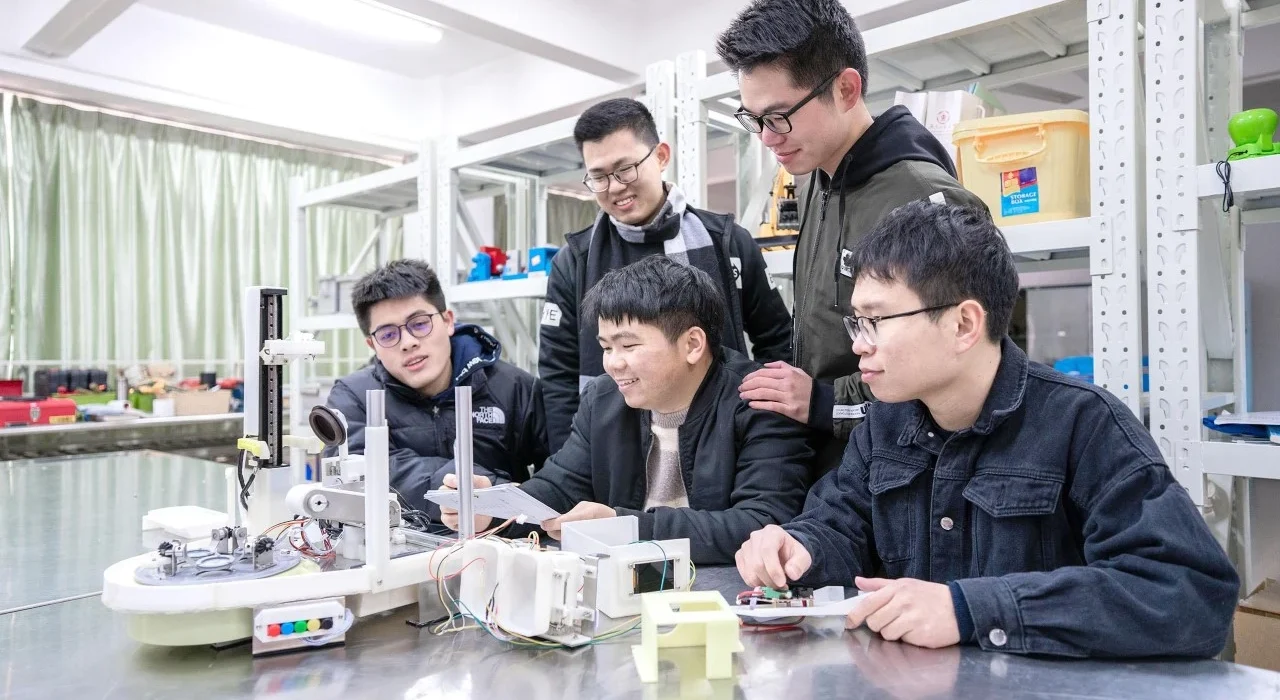
Eligible work includes major equipment, instruments, hardware, software, new materials, medicines, engineering designs, and technical standards. Each candidate must also submit a written report, prove an individual contribution, present evidence of application, face expert assessment, and defend the work.
Nature reported in July on China’s first cohort pursuing this route through products, techniques, or engineering projects rather than standard theses. The reform follows China’s 2024 academic degree law and reflects a wider effort to train engineers who solve industrial problems, rather than graduates judged mainly through page counts and journal papers.
China’s approach sits inside a wider industrial system. Factories define problems, universities supply research teams, public policy supports strategic technologies, and companies move successful work toward production.
WIPO placed China inside the Global Innovation Index top 10 in 2025 and ranked the country first for knowledge and technology outputs. China also led global patent filings and hosted 24 of the world’s top 100 innovation clusters.
A graduation reform did not create those results by itself. Long-term research funding, industrial demand, manufacturing depth, and university-company cooperation gave practical doctorates somewhere to operate.
Africa should copy the complete lesson. Reform assessment, finance laboratories, place doctoral candidates inside factories and public projects, and create routes from prototypes to procurement.
Africa needs this debate urgently.
Across the continent, universities graduate engineers who have written long dissertations on irrigation, mining, energy, transport, housing, waste, health equipment, and food processing.
Many projects end inside libraries or digital repositories. Villages still lack clean water. Factories import simple machinery. Farmers lose crops after harvest. Hospitals import basic devices. Cities drown after heavy rain.
The failure does not sit with students alone. Universities often reward writing more than implementation. Promotion systems reward paper totals. Supervisors protect familiar academic routines. Governments praise innovation while denying laboratories stable electricity, equipment, grants, and industrial partners.
The African Union says Africa holds about 15 percent of the global population, yet the continent accounts for only 1.3 percent of worldwide research investment and 0.1 percent of patents.
UNESCO reported only 88 researchers per million people in sub-Saharan Africa, compared with 4,358 in Europe and Northern America. Most sub-Saharan states spend between 0.1 percent and 0.4 percent of gross domestic product on research, far below the AU target of 1 percent.
Those figures explain why copying China requires more than changing graduation rules. A student cannot build a medical device without components, testing facilities, ethics approval, clinical partners, and money. An engineer cannot produce a commercial irrigation system where universities lack workshops and farms lack financing.
Africa should create two clear doctoral routes.
Academic engineering doctorates should retain rigorous dissertations for candidates advancing theory, methods, and scientific knowledge.
Professional engineering doctorates should permit an applied achievement supported by a concise technical report and a public defence. The achievement should solve a defined African problem and show tested results.
A candidate working on solar power should install and test a functioning system. A civil engineer should prove a drainage design under real rainfall conditions. A mining engineer should reduce waste, energy use, or worker exposure at an operating site.
A biomedical engineer should produce a safe device and complete independent testing. A software candidate should deploy a system, document security, and show measurable performance.
Universities should never award a doctorate for a clever demonstration alone. The Chinese rules demand engineering value, innovation, application, expert review, evidence, and a clear personal contribution. Africa needs equal or stronger safeguards.
Every applied doctorate should include five protections.
First, independent examiners should include senior academics, practising engineers, regulators, and users affected by the product.
Second, universities should publish conflict declarations where companies fund projects.
Third, candidates should disclose team roles and intellectual property ownership.
Fourth, assessors should inspect raw data, field tests, safety records, and user results.
Fifth, universities should revoke degrees linked to fabricated tests, purchased products, or hidden subcontracting.
Such reform would connect universities with industry. WIPO ranks the University of the Witwatersrand as sub-Saharan Africa’s strongest university for industry collaboration and international research networks.
Makerere University and the University of Rwanda also appear among notable institutions from low-income economies in global university engagement data. Africa already possesses centres able to lead serious pilots.
Governments should fund the change through competitive problem missions. Ministries should publish national engineering needs each year.
Universities would bid to solve specific problems involving water pumps, grain storage, mine safety, low-cost housing, disease testing, road materials, or electricity systems. Public procurement should reserve a transparent testing route for successful local products.
The AU already speaks in similar terms. Its education and science leadership wants systems which convert “African research into African products, African companies, and African jobs.” Universities should treat those words as an instruction, not another conference slogan.
You should also reject a false choice between books and products. Serious invention requires theory. A bridge needs mathematics. A medicine needs biology, chemistry, trials, and ethics. Software needs architecture, testing, and security.
China’s reform does not remove knowledge. The policy changes the final proof of mastery.
Africa should copy this principle with care. Stop asking every engineering doctoral candidate to prove value through length. Ask some candidates to prove value through a working solution, documented evidence, independent testing, and public defence.
A continent importing water meters, hospital devices, farm machinery, solar components, software, and mining equipment cannot afford thousands of engineering theses with no path into production.
The doctorate should remain difficult. The difficulty should produce something Africa needs.