

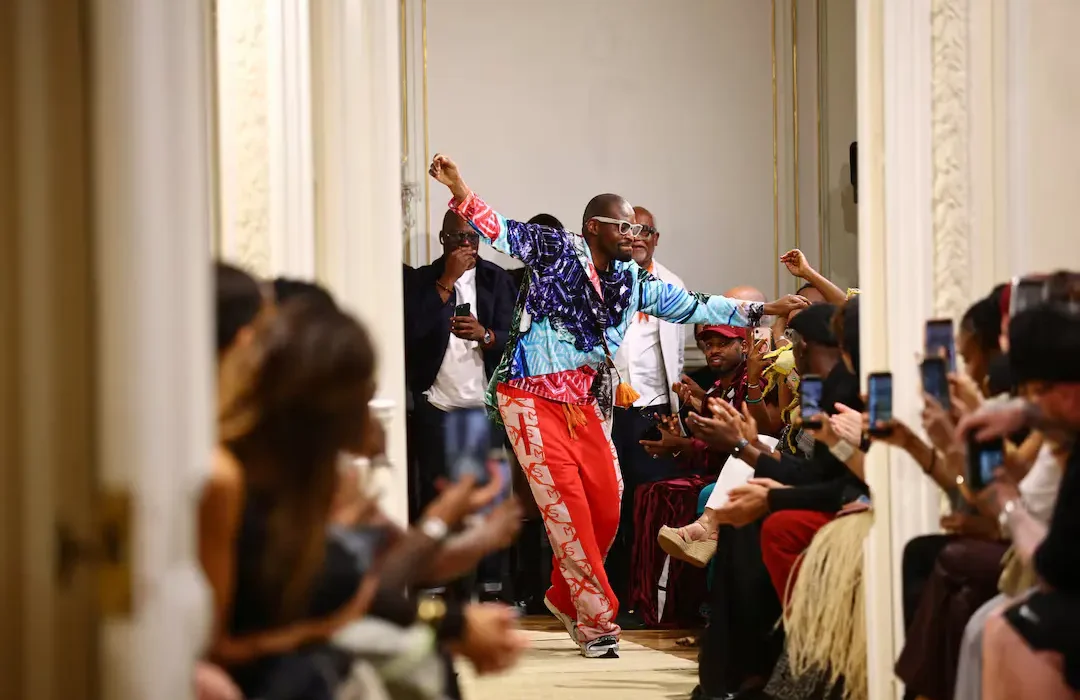
PARIS, France – South African luxury house MaXhosa Africa has placed African textile design at the centre of Paris Fashion Week after becoming the first South African brand to stage a full runway show on the official womenswear calendar. Founder and creative director Laduma Ngxokolo presented 54 Spring Summer 2027 looks on Monday, turning a long campaign for recognition into one of the opening day’s defining moments.
Ngxokolo staged the show inside the residence of South Africa’s ambassador to France. He used the setting to present a collection built around Pan-African identity, Xhosa design codes, local manufacturing and a wider argument about Africa’s place inside the global luxury industry. The garments moved between dense knitwear, pleated skirts, graphic tailoring, patterned suits and statement dresses carrying references to African countries and the continent itself.
“I feel honoured to be represented. I’ve been fighting to sit on the table for 16 years now,” Ngxokolo said after the show. His comment captured the scale of the moment. MaXhosa started in 2010 and built its reputation through knitwear inspired by Xhosa aesthetics, colour systems and geometric pattern language. Paris now gives the label access to buyers, editors, stylists and luxury decision-makers who influence global distribution.
The Spring Summer 2027 collection carried the title Izihlwele Zivumile. The fashion house translates the title as “the ancestors have co-signed.” The concept linked family roots, heritage and contemporary African ambition. Mpondo cultural references appeared alongside Cape Aloe imagery from South Africa’s Eastern Cape. Invitations resembled passports, reinforcing the journey from South Africa to Paris.
One wool dress featured tassels carrying the names of African countries. Another black and grey look placed a large outline of Africa across the front. Ngxokolo also referenced the recent rescaling of Africa on a United Nations map, using garment construction to challenge distorted visual perceptions of the continent’s size.
The collection treated African identity through fabrication, yarn, intarsia, jacquard-style graphics, tailoring and silhouette. MaXhosa’s strongest commercial signature remains knitwear, yet the Paris presentation showed a wider luxury wardrobe. Structured separates sat beside dresses, skirts and coordinated sets. The styling preserved colour and pattern while giving buyers recognisable ready-to-wear categories.
Production matters as much as runway presentation. MaXhosa owns knitting factories in Johannesburg and East London. The brand sources wool from the Eastern Cape, then converts local material into finished luxury products inside South Africa. This structure gives the company greater control over yarn development, production standards, finishing and intellectual property.
For African fashion businesses, this part of the story deserves attention. Too many African raw materials leave the continent before manufacturers convert them into higher-value finished goods. MaXhosa follows a different model. South African wool enters a South African design process, moves through South African factories and reaches luxury consumers under an African-owned label. More value stays inside the domestic production chain.
Ngxokolo has linked his work to a broader economic vision for Africa. He has argued for an Africa with stronger economies, lower crime and less corruption, while using fashion to present a continent defined by enterprise, culture and production capacity. His runway gave this argument a commercial form through South African materials, labour, design and ownership.
The business message sits beside the cultural one. Global luxury depends on provenance, workmanship, identifiable design codes and controlled brand equity. European houses have built commercial empires around those principles for decades. MaXhosa applies similar discipline to African heritage without reducing its work to souvenir design. The label sells culture through premium fabrication, repeatable signatures and recognisable house codes.
The runway also widened its creative network. Kenyan artist Cyrus Kabiru contributed eyewear produced from discarded materials. South African musician Sjava supplied the soundtrack. Those collaborations turned the presentation into a broader African creative project connecting fashion, visual art and music.
Paris Fashion Week runs from September 28 to October 6, with 68 runway shows and 34 presentations on the Spring Summer 2027 programme. Major houses include Dior, Chanel, Louis Vuitton, Saint Laurent, Balenciaga and Maison Margiela. MaXhosa entered this schedule after several seasons of Paris presentations, moving from showroom-style exposure into a full official runway slot.
You should watch this distinction. A presentation gives editors and buyers access to garments in a controlled setting. A runway show carries greater production cost, press visibility and scheduling weight. Placement on the official calendar also signals deeper recognition from the institutions governing Paris fashion. For an African house, such access influences wholesale relationships, international press coverage and long-term luxury positioning.
Ngxokolo has spent years arguing African designers should not dilute their identities to gain European acceptance. He previously said, “African culture is a universal language.” His Paris strategy now demonstrates the commercial logic behind this position. MaXhosa arrived with Xhosa-rooted patterns, South African wool, African collaborators and a manufacturing base on the continent.
The timing also matters for African luxury. Consumers across Africa and the diaspora increasingly seek products carrying cultural authorship rather than borrowed African motifs produced elsewhere. Global fashion houses have faced criticism for using African references without matching African ownership, manufacturing or economic participation. MaXhosa offers a contrasting route built around origin, control and production.
For emerging designers in Lagos, Nairobi, Accra, Harare, Dakar, Johannesburg and Cape Town, the Paris debut sets a practical benchmark. International recognition starts with a strong product identity, consistent quality, manufacturing discipline, intellectual property protection and enough commercial structure to fulfil orders after press attention arrives.
A runway moment without production capacity quickly becomes publicity with little revenue. MaXhosa’s factories give the label a stronger base for converting visibility into sales. Its physical retail presence and international expansion also support brand continuity beyond fashion week.
Paris gave MaXhosa a larger stage. Ngxokolo used the stage to keep the message African. The 54-look collection showed buyers what African luxury looks like when design, raw materials, manufacturing, cultural authorship and ownership sit under one house.