

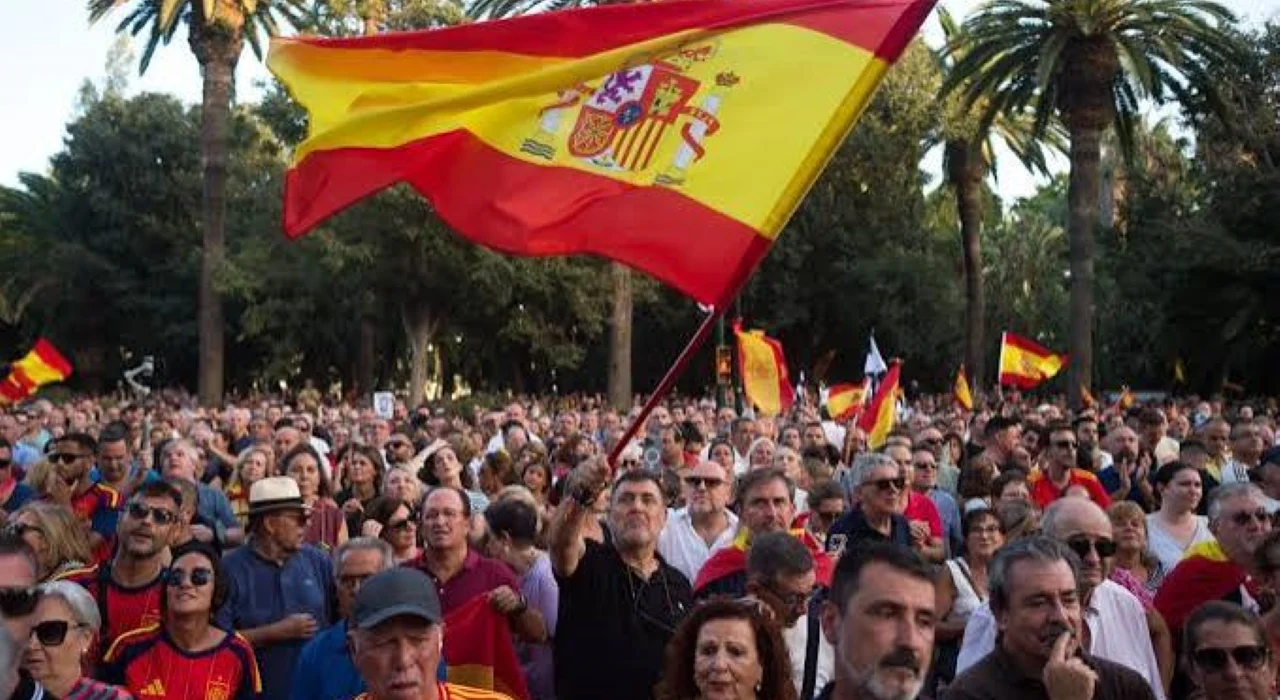
MADRID, Spain – More than 50,000 people marched through Madrid on Wednesday to protest Prime Minister Pedro Sánchez’s response to the mass arrival of migrants in Ceuta, turning the border crisis into one of Spain’s largest political demonstrations of the year.
Protests were also reported in Ceuta, Valencia and several other cities. Organisers said around 20,000 people gathered in Ceuta, while authorities estimated that roughly 25,000 attended the demonstration in Valencia.
The protests came after more than 70,000 migrants and asylum seekers crossed from Morocco into Ceuta on July 30 and 31. The Spanish-controlled territory, located on Africa’s northern coast, was quickly overwhelmed by the scale of the arrival.
Border officers, shelters and social services struggled to cope. Most of those who entered have since been returned to Morocco, but the Spanish government says about 5,000 people remain in Ceuta, including around 1,200 minors. Local officials believe the actual figure may be higher.
At least 80 people are thought to have died during the crossing, although some reports have suggested the toll could be as high as 141. Many tried to swim around the border barrier, while others crossed through openings after security controls collapsed under the pressure.
In Madrid, protesters marched towards Cibeles Square carrying Spanish and Ceuta flags. The demonstration was organised by the Spanish Federation of Municipalities and Provinces, an organisation closely associated with the conservative opposition.
“Ceuta is not for sale” and “Sánchez resign” were among the slogans shouted by demonstrators. After the official march ended, several hundred people moved towards parliament, where riot police intervened.
The crowd included people demanding stronger border controls, more emergency assistance for Ceuta and greater accountability from the government. Others used openly anti-migrant language, calling those who crossed “invaders” and demanding their immediate expulsion.
The mixture of security concerns and hostile rhetoric showed how the crisis has developed into a wider argument over immigration, Spanish identity and national sovereignty.
Alberto Núñez Feijóo, leader of Spain’s conservative People’s Party, and Santiago Abascal, leader of the far-right Vox party, attended the Madrid protest. Both accused Sánchez of misleading the public, protecting Morocco and failing to defend Spanish territory.
Feijóo called for the prime minister’s resignation, describing the government’s conduct as a combination of “incompetence and complicity.” Abascal demanded large-scale returns and accused Sánchez of representing Moroccan interests in Spain.
Pressure on the government intensified after a Spanish police report suggested that Moroccan security forces may have helped migrants reach the Ceuta border.
The report said fewer Moroccan officers than usual were stationed near the border breakwater and described the response during the surge as one of “total permissiveness.” Some migrants also told investigators that uniformed Moroccan officers had directed them towards crossing points.
The report did not, however, identify officials who organised the movement or provide independently verified evidence that Morocco’s government ordered the crossings. Rabat has denied deliberately opening the border.
Sánchez told parliament that Spain had found no evidence that Morocco planned the operation.
“I can assure you that no institution—not the diplomatic service, nor the European Commission, nor any international body—has provided the Spanish government with any solid evidence that Morocco planned or carried out the incident. None whatsoever,” he said.
The prime minister acknowledged that Moroccan forces allowed people to cross during a critical ten-hour period on July 30. Spanish authorities are investigating whether that was the result of a deliberate policy, a breakdown in operations or an inability to control the crowd.
Moroccan officials have blamed human traffickers, false information circulated on social media and confusion over a Spanish court ruling. Justice Minister Abdellatif Ouahbi said officers avoided confronting the crowd to prevent bloodshed and had acted “wisely and with sang-froid.”
The incident has also revived tensions over Ceuta and Melilla, Spain’s two territories on the African mainland. Morocco claims both cities, while Spain considers them sovereign Spanish territory and part of the European Union.
Madrid summoned Morocco’s ambassador on August 21 after Moroccan ministers made what Spanish officials called “unacceptable statements” about the territories.
For many Africans, Ceuta symbolises one of the world’s starkest economic and political divides. The territory is administered by a European power and provides access to the European Union, while nearby communities face high unemployment, poverty and limited prospects.
Income per person in Ceuta is estimated to be several times higher than in neighbouring Morocco. That disparity helps explain why people continue to risk drowning, injury and confrontation with border forces in attempts to enter the territory.
Otman Ianaya, one of the migrants who crossed, said he swam to Ceuta with his wife and two young daughters after failing to find work in Morocco.
“There is no work in Morocco,” he said. “I want to build a future in my life.”
Thousands of migrants and asylum seekers are reportedly staying in emergency shelters, makeshift camps, on streets and along beaches. The Spanish government has increased accommodation and funding for local services, but Ceuta’s authorities say the support remains insufficient.
The crisis has also been accompanied by violence. Reports have described fights, attacks on security personnel and sexual assaults. Some residents have destroyed migrant shelters, burned belongings and confronted police.
Ceuta’s regional president, Juan Jesús Vivas, described the crossings as an attack on Spain’s territorial integrity. Speaking to supporters, he thanked “all the Spaniards who are telling us we are not alone, who tell us Ceuta is not for sale, that it will be defended.”
The Sánchez government says those who crossed cannot legally be treated as one group and expelled without individual consideration. Spanish, European and international law require officials to identify asylum seekers, vulnerable people and unaccompanied children.
“You can’t just grab someone by the arm and drag them across the frontier as though they were a sack of dirt,” Sánchez told parliament.
Aina Vidal, a lawmaker from the left-wing Sumar alliance, rejected descriptions of young migrants as an invading force.
“They’re children, not invaders, not soldiers,” she said. “They didn’t come carrying bombs; they arrived wearing water wings, in tears.”
The government faces serious questions about why the border was overwhelmed, whether it ignored warnings and why Ceuta lacked sufficient preparations for a humanitarian emergency of this magnitude. Morocco must also account for the actions of its security forces during the period when the crossings peaked.
Migrants, however, should not be made scapegoats for failures by governments. Many who crossed were impoverished Africans seeking employment, safety and a better future, not soldiers attempting to seize Spanish territory.
The Madrid protest suggests that the Ceuta crisis could become a major political liability for Sánchez ahead of Spain’s next general election. It also shows how migration can be used as leverage in disputes between neighbouring governments and exploited by parties offering outrage rather than practical solutions.
Europe cannot address migration simply by paying African countries to prevent people from leaving while ignoring the poverty, conflict and unequal economic relationships that drive movement. African governments must expand opportunities at home, but Europe must also create safer legal routes and stop treating every desperate arrival as a security threat.
Ceuta is more than a border dispute. It is a warning that higher fences alone will not end dangerous crossings. Unless Spain, Morocco, the European Union and African governments address the conditions pushing people towards the border, the journeys will continue.