
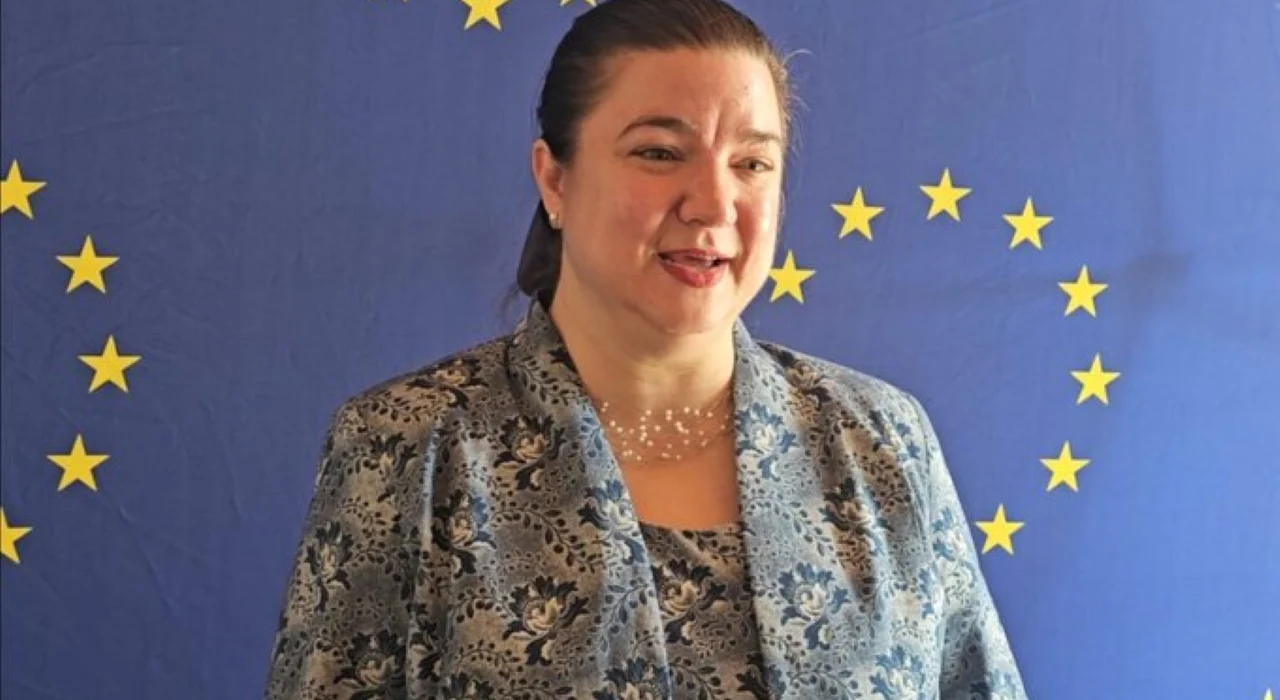
HARARE, Zimbabwe – Katrin Hagemann, the Head of the European Union Delegation to Zimbabwe, has died after reportedly becoming suddenly ill at her residence in Harare, diplomatic sources said on Thursday.
Hagemann was reportedly found unresponsive by members of staff after falling ill on Thursday morning. Further details surrounding the circumstances of her death were not immediately available.
Neither the European Union Delegation nor Zimbabwe’s Ministry of Foreign Affairs had released a detailed public statement at the time of publication. The cause of death had also not been announced.
Until medical authorities or her family provide further information, speculation about what caused her sudden illness should be avoided. There has been no official announcement about whether a post-mortem examination will be conducted.
Hagemann had served as the European Union’s ambassador to Zimbabwe for less than a year. She presented her credentials to President Emmerson Mnangagwa at State House in Harare on December 11, 2025, formally beginning her diplomatic mission.
She replaced Jobst von Kirchmann, whose term as Head of the EU Delegation had ended.
When she assumed office, Hagemann described it as an honour to represent the European Union in Zimbabwe. She committed herself to developing what she called a strong, forward-looking relationship between Harare and Brussels.
Her diplomatic priorities included trade, investment, agriculture, governance, women’s economic empowerment, environmental protection and the sustainable management of Zimbabwe’s natural resources.
Hagemann also wanted the European Union to remain involved in Zimbabwe’s Structured Dialogue on Arrears Clearance and Debt Restructuring. The process seeks to help Zimbabwe resolve its external debt crisis, rebuild international confidence and eventually regain access to affordable international financing.
During her first formal engagement with Zimbabwean journalists in February, she described the EU as a dependable partner interested in building relations based on trust rather than isolation.
“The European Union reiterates its commitment to deepening bilateral relations with Zimbabwe and to strengthening a partnership built on trust, mutual respect and shared interests,” she said.
“We look forward to the next formal Zimbabwe–EU Partnership Dialogue and to continued engagement that delivers tangible benefits for both Zimbabwe and the EU.”
Hagemann entered office during an important period in relations between Zimbabwe and Europe. The EU had removed restrictive measures against Zimbabwean individuals and companies, although its arms embargo remained in place.
Her arrival was viewed as an opportunity to move the relationship away from decades of confrontation over sanctions, elections and human rights towards greater economic and diplomatic cooperation.
However, she did not avoid difficult political questions. Hagemann raised concerns about Zimbabwe’s civic space, the treatment of opposition politicians and the ability of civil society organisations to operate freely.
She warned that some organisations had become reluctant to speak publicly because of uncertainty surrounding their registration and the implementation of the Private Voluntary Organisations Act.
At the same time, she maintained that political disagreements should not prevent Zimbabwe and the European Union from expanding trade, investment and development cooperation.
Economic relations were central to her mission. Trade between Zimbabwe and the European Union was valued at approximately US$919 million in 2024, with Zimbabwe enjoying a positive trade balance of about US$328 million.
The European Union is Zimbabwe’s fourth-largest trading partner after South Africa, the United Arab Emirates and China. It is also an important market for Zimbabwean horticultural products, including blueberries, oranges, mange-tout peas and sugar snap peas.
Zimbabwean products receive duty-free and quota-free access to the markets of the EU’s 27 member states under an Economic Partnership Agreement. Hagemann argued that local businesses were not yet taking full advantage of that access.
Only about 200 Zimbabwean companies were exporting to European markets, despite the potential for agricultural producers, manufacturers and mining companies to expand their presence.
“Fair and inclusive trade and investment can create jobs, foster innovation and open new opportunities,” she said during Europe Day commemorations in Harare.
“We remain committed to deepening the economic partnership with Zimbabwe to promote shared prosperity.”
Hagemann supported an immediate symbolic target of increasing annual trade between Zimbabwe and the European Union to at least US$1 billion. She believed stronger institutions, predictable policies and investor confidence would be essential to reaching that target.
She also promoted European support for Zimbabwe’s agriculture, renewable energy, biodiversity, healthcare, education and private sector development.
Under the EU’s Global Gateway programme, European institutions have supported major infrastructure and development initiatives, including the rehabilitation of Kariba Dam. European financial institutions have also extended credit facilities to Zimbabwean banks for lending to local businesses.
Beyond her formal diplomatic responsibilities, Hagemann sought to connect with Zimbabwean communities and cultural institutions. During Europe Day celebrations in Harare, she joined musician Mary Anibal in playing the mbira, one of Zimbabwe’s most recognisable traditional instruments.
She had said she wanted to travel beyond Harare and learn directly from communities affected by programmes supported by the European Union.
“I very much look forward to travelling across Zimbabwe—to see first-hand the impact of our joint programmes, to meet our partners and, most importantly, to connect with the people of this beautiful country,” she said in February.
“I hope to listen, to learn and to better understand the hopes and aspirations that drive Zimbabweans forward.”
A German national, Hagemann was an experienced European diplomat with assignments across Africa. She joined the European External Action Service when it was established in 2011.
Between 2015 and 2019, she headed the Political, Press and Information Section of the EU Delegation to Botswana and the Southern African Development Community. She was responsible for diplomatic relations with Botswana, SADC, the United Nations and other international partners.
In 2019, she became Deputy Head of the European Union Delegation to Kenya. She also worked on political and diplomatic matters concerning Africa’s Great Lakes region before her appointment to Zimbabwe.
Hagemann had an unusual academic background for a diplomat. She studied astronomy and physics at Wellesley College and completed a master’s degree in astronomy at Cornell University. She later obtained advanced training in international studies through the University of Vienna and the Diplomatic Academy of Vienna.
She began her diplomatic career at Germany’s Federal Foreign Office before joining the Secretariat of the Council of the European Union in 2006.
Her reported death comes only months into what was expected to be a significant diplomatic assignment. She had started establishing relationships with the Zimbabwean government, private businesses, development organisations, civil society and the diplomatic community.
The EU Delegation is expected to announce temporary leadership arrangements while Brussels considers how to fill the position permanently.
Formal condolences from Zimbabwean authorities, European diplomats and organisations that worked with Hagemann are also expected once the European Union officially communicates the circumstances of her death.
Her sudden passing cuts short a mission that had placed renewed economic cooperation, honest political dialogue and stronger connections with Zimbabwean communities at its centre.