

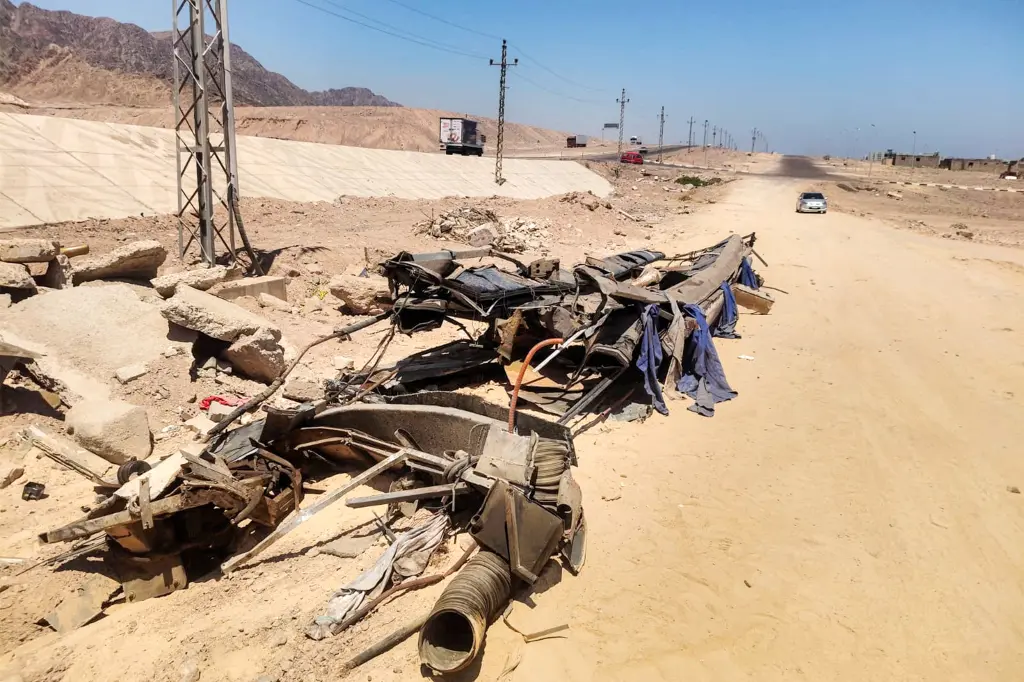
CAIRO, Egypt – The death toll from a passenger bus crash in Egypt’s South Sinai region has risen to 22, correcting initial reports that 16 people had been killed. Another 28 passengers were injured when the bus overturned on the road linking the Red Sea tourist towns of Dahab and Nuweiba on Wednesday morning.
Egypt’s Ministry of Health confirmed the revised figures after emergency teams completed further recovery operations at the scene.
“The number of injured reached 28, while the number of deaths rose to 22,” the ministry said in its latest update.
The accident occurred near the Al-Saada area as the bus travelled towards Nuweiba. The vehicle was reportedly operating between Cairo and Amman, the Jordanian capital, and was carrying both Egyptian and Jordanian passengers.
Twenty ambulances were dispatched to the scene as rescue workers struggled to remove passengers from the wreckage and transport the injured to nearby hospitals. Thirteen casualties were taken to Sharm El-Sheikh International Hospital, nine to Saint Catherine Hospital and six to Al-Fayrouz Medical Complex.
Health officials said several victims suffered serious injuries, with at least four reportedly in critical condition. Medical teams were placed on emergency alert as relatives sought information about passengers who had been travelling on the bus.
Jordan’s Foreign Ministry confirmed that Jordanian citizens were among the dead and injured but did not immediately publish its own casualty breakdown. Jordanian state broadcaster Al-Mamlaka reported that 10 Jordanians were among those killed.
The bus was reportedly carrying 43 people, including 22 Jordanians. It was travelling from Cairo towards Nuweiba, where passengers heading to Jordan commonly cross the Gulf of Aqaba by ferry before continuing to Amman.
The cause of the crash has not been officially established. Some Egyptian media outlets reported that a tyre may have burst shortly before the driver lost control, but this account has not been confirmed by investigators.
Authorities must now determine whether the disaster was caused by mechanical failure, excessive speed, driver fatigue, poor road conditions or a combination of factors. The bus operator’s maintenance records, the condition of the tyres and brakes, the driver’s working hours and any available tracking data should all form part of the investigation.
That investigation cannot be treated as a routine administrative exercise. Twenty-two people boarded a bus expecting to reach their destination. Their families deserve more than condolences and vague promises. They deserve a clear explanation of what failed, who was responsible and what will be done to prevent another tragedy.
Dahab and Nuweiba are important Red Sea destinations known for beaches, diving, mountain tourism and cross-border travel. The road connecting them carries local residents, workers, tourists and passengers travelling between Egypt and Jordan.
A serious accident on such a route raises questions not only about one bus but also about the safety standards governing Egypt’s long-distance transport industry. Vehicles covering hundreds of kilometres must undergo regular inspections, while drivers must be protected from exhausting schedules that can place passengers at risk.
Egypt has struggled with deadly road accidents for years. Speeding, poorly maintained vehicles, dangerous overtaking, weak enforcement and damaged roads are frequently identified as contributing factors. Large buses and minibuses are particularly vulnerable because a single mistake can kill or injure dozens of people at once.
In January, 21 people were killed and 16 injured in a multiple-vehicle collision near Beni Suef. Another road accident in Ismailia governorate in August reportedly killed 15 people and injured 32. These are not isolated figures. They point to a road-safety emergency requiring national attention.
The authorities should publish the findings of the South Sinai investigation rather than allowing the case to disappear after the victims are buried. If the bus was mechanically defective, the operator must be held accountable. If the driver had been forced to work excessive hours, the company’s employment practices must be examined. If the road contributed to the crash, urgent repairs and stronger safety barriers will be necessary.
There must also be proper identification of every passenger and timely communication with families in Egypt and Jordan. In cross-border disasters, confusion over passenger lists can deepen the suffering of relatives who spend hours calling hospitals, police stations and transport companies in search of information.
The tragedy carries a wider lesson for Africa, where buses remain essential for millions of people who cannot afford air travel or private vehicles. From Accra to Cairo, ordinary citizens depend on commercial transport operators to take roadworthiness seriously. Passengers should not have to gamble with their lives simply because they are travelling by road.
Governments across the continent often respond to major crashes with public mourning, investigations and promises of tougher enforcement. Attention then fades until another vehicle overturns and another group of families is thrown into grief. Breaking that cycle requires permanent enforcement, regular vehicle inspections, safer roads and real punishment for operators who ignore safety rules.
Egypt’s tourism industry also depends on the country being seen as a safe destination. South Sinai attracts visitors from across the world, and its roads are part of the tourist experience. Beautiful resorts cannot be separated from the highways that carry visitors to them.
For now, the priority remains saving the injured and supporting the bereaved. But when the funerals are over, Egypt must confront the harder question: why do so many journeys on its roads continue to end in mass death?
Twenty-two lives have been lost on the Dahab-Nuweiba road. They must not be reduced to another statistic.