

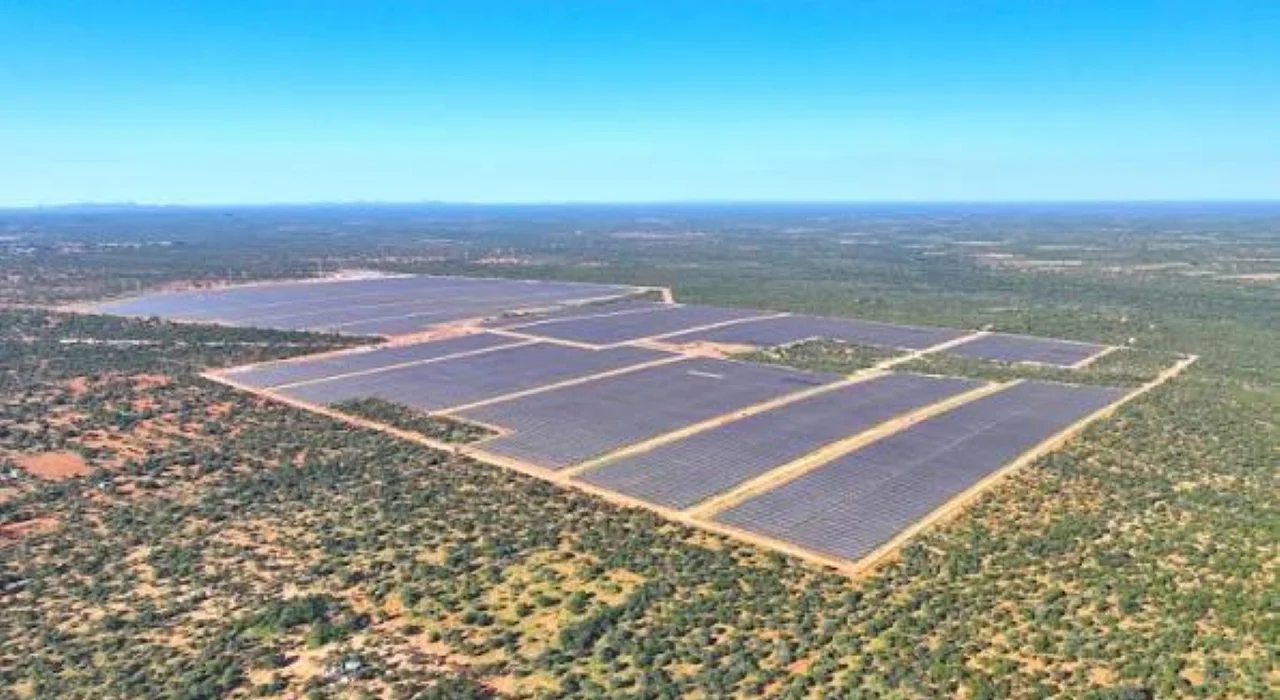
MMADINARE, Botswana – Botswana has officially commissioned the 100MW Mmadinare Solar PV Cluster, its first utility-scale, grid-connected solar power project and one of the country’s most important investments in domestic electricity generation.
Minister of Minerals and Energy Bogolo Kenewendo officially launched the plant on August 31, 2026, near Mmadinare and Selebi-Phikwe in eastern Botswana. The project was developed in two 50MW phases. The first entered commercial operation in March 2025, followed by the second in December 2025.
The solar cluster has already generated more than 243,288 megawatt-hours of electricity for the national grid. Botswana Power Corporation Chief Executive Officer David Kgoboko said the facility has maintained availability and reliability above 99 percent since operations began.
“This power has supplemented our local generation and, importantly, helped reduce our dependence on expensive electricity imports from the Southern African Power Pool,” Kgoboko said.
That statement explains the project’s economic importance. Botswana has spent heavily importing electricity whenever domestic coal stations failed to meet national demand. Statistics Botswana reported that electricity imports reached 577,466 megawatt-hours during the first quarter of 2025, an increase of 40.8 percent from the same period in 2024.
The cost of imported electricity has also risen sharply. BPC previously reported that average import costs increased from 85 thebe to P2.60 per kilowatt-hour over five years. Every unit generated at Mmadinare during daylight hours therefore reduces Botswana’s exposure to expensive regional power purchases and supply shortages beyond its borders.
“This project, along with other solar initiatives, has added over 209MW of renewable energy to the national grid,” Kenewendo said during the commissioning.
Mmadinare represents an investment of approximately P1.5 billion, or about US$108 million. Project financing included roughly P1 billion in non-recourse debt, equivalent to about US$73 million, with the balance supplied through equity from Norwegian renewable-energy company Scatec.
Rand Merchant Bank and the World Bank’s International Finance Corporation supported the financing. Their involvement demonstrates how African utilities, private investors and development institutions can work together to deliver large infrastructure without requiring the government to finance the entire construction bill directly.
Scatec developed, financed and constructed the project. The Norwegian company owns the solar portfolio and will operate and maintain the plant. BPC is the electricity buyer under a 25-year power purchase agreement.
This distinction matters. Mmadinare is not jointly owned by BPC and Scatec. BPC provides the connection to the national electricity system and purchases the generated power, while Scatec carries ownership and operational responsibilities. The long-term agreement provides Scatec with predictable revenue and gives Botswana a committed source of renewable electricity.
Some reports describe Mmadinare as a 120MW facility, while Botswana officially commissioned it as a 100MW project. Both descriptions refer to the same plant. Its export capacity is 100MW alternating current, while the installed solar panels have a combined peak capacity of about 120MW. The additional panel capacity supports stronger production when sunlight conditions are below their maximum.
The cluster is expected to produce around 280 gigawatt-hours of electricity annually. Such output will support households, mines, commercial businesses and public institutions while reducing pressure on Botswana’s ageing coal-fired generation system.
The project also created more than 1,200 construction jobs across its two phases. Scatec reported 686 workers during the first phase and 515 during the second. Communities around Mmadinare and Selebi-Phikwe also received business through security, transport, accommodation, catering and construction-material contracts.
Those construction jobs were significant but largely temporary. Botswana must now ensure that the project creates lasting value through technical training, plant maintenance, engineering careers and opportunities for citizen-owned businesses.
A solar development should not become an imported facility maintained mainly by foreign specialists. Batswana engineers, electricians and technicians should gain the skills required to manage future projects across the country. Local companies should also enter supply chains for cleaning, security, maintenance, transport, electrical equipment and environmental monitoring.
The location near Selebi-Phikwe carries added economic importance. The area has struggled since the closure of BCL Mine damaged employment and local business activity. Renewable-energy investment offers a new development route, but one solar plant will not replace thousands of lost mining jobs. Government must connect the project to wider industrial, manufacturing and training programmes.
Mmadinare also supports Botswana’s plan to increase renewable energy from around 8 percent of electricity supply to 50 percent by 2030. The government is pursuing other projects, including a planned 500MW solar development in northwestern Botswana and additional generation at Maun, Letlhakane and other locations.
For Southern Africa, the commissioning provides a practical example of how a national utility and an independent power producer can deliver large-scale solar through a long-term purchasing agreement. Countries including Zimbabwe, Zambia, Namibia and South Africa face similar pressure from ageing power stations, drought-affected hydropower and expensive electricity shortages.
Reduced Botswana demand from the Southern African Power Pool also leaves more regional electricity available for other countries during periods of limited supply. Future surplus generation could support exports, but Botswana first needs dependable domestic capacity, stronger transmission infrastructure and adequate energy storage.
Solar energy alone will not end Botswana’s electricity problems. Mmadinare produces its strongest output during daylight hours, while homes and businesses still require power after sunset. Batteries, flexible generation and improved grid management will be necessary as more solar plants enter the system.
BPC must also improve the performance of the Morupule coal stations during the transition. Renewable energy and reliable conventional generation will need to operate together until storage capacity becomes large enough to support the grid for extended periods.
Transparency will remain important throughout the 25-year agreement. BPC and government should demonstrate how the purchasing price compares with imported electricity, how savings reach consumers and how local companies benefit from operations.
The commissioning of Mmadinare is therefore more than a ceremonial launch. The plant is already generating electricity, cutting import exposure and proving that utility-scale solar is commercially possible in Botswana.
The strongest measure of success will not be the number of panels installed or speeches delivered at the launch. Success will be lower import costs, reliable electricity, skilled local workers and stronger businesses around Mmadinare.
Botswana possesses some of the strongest solar resources in Africa. Mmadinare shows what becomes possible when those resources are connected to financing, infrastructure and a long-term national energy plan. The next task is to repeat the achievement at greater scale while ensuring Batswana retain the jobs, knowledge and economic value.