

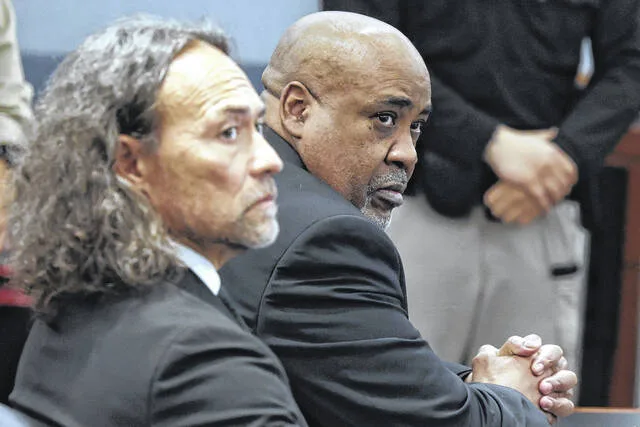
LAS VEGAS, United States – A Nevada jury has found Duane “Keffe D” Davis guilty of first-degree murder for organising the 1996 drive-by shooting which killed rapper Tupac Shakur.
The 12 jurors reached a unanimous verdict on Monday, August 31, after deliberating for fewer than three hours. Their decision produced the first murder conviction in one of hip-hop’s longest-running criminal cases, nearly 30 years after Shakur died.
Davis, 63, faced one count of murder with a deadly weapon. Clark County District Judge Carli Kierny scheduled sentencing for October 13. The conviction exposes Davis to a maximum sentence of life in prison without parole. Davis told the judge he “plans to appeal this matter.”
Shakur’s sister, Sekyiwa “Set” Shakur, cried and embraced prosecutors after court officials read the verdict. Davis’s son covered his face with one hand. Other relatives and supporters exchanged hugs inside the courtroom.
The verdict followed an 11-day trial focused on revenge, gang authority and Davis’s own recorded accounts.
On September 7, 1996, Shakur attended a Mike Tyson boxing match at the MGM Grand in Las Vegas. After the fight, hotel surveillance footage captured Shakur and members of his entourage assaulting Orlando “Baby Lane” Anderson, Davis’s nephew, near the casino floor.
Prosecutors said Davis responded by obtaining a firearm and gathering three other South Side Compton Crips members. The group searched for Shakur and Death Row Records co-founder Marion “Suge” Knight in a white Cadillac.
Hours later, Knight stopped his black BMW at a red light near the Las Vegas Strip. Shakur sat in the passenger seat. The Cadillac pulled beside the BMW and a gunman fired several rounds. Bullets wounded Knight and struck Shakur multiple times. Shakur died six days later, on September 13, aged 25.
Prosecutors never asked jurors to find Davis pulled the trigger. Nevada law holds an organiser or accomplice criminally responsible when another participant carries out a planned killing.
Chief Deputy District Attorney Binu Palal told jurors Davis acted after the assault on Anderson. “He acquired a firearm, got his group together, and went hunting for Mr. Shakur,” Palal said during closing arguments.
Davis repeatedly placed himself inside the Cadillac during interviews with investigators, documentary producers and journalists. He described passing a gun to men seated behind him. Prosecutors also presented secret recordings and sections from his 2019 memoir, Compton Street Legend.
Those statements revived an investigation which had produced no charges for 27 years. Police arrested Davis in September 2023 after searching a home linked to his wife in Henderson, Nevada.
The prosecution built an unusual murder case. Investigators presented no murder weapon. No surviving witness identified Davis as the shooter. The other three men whom prosecutors placed inside the Cadillac have died. The state relied heavily on Davis’s words, supporting timelines, gang evidence and testimony from people connected to both groups.
Palal argued Davis changed smaller details while preserving central facts. Across separate accounts, Davis placed himself in the car, described the retaliation and explained how a gun reached the back seat.
Defence lawyer Michael Sanft urged jurors to reject those accounts. He described Davis as a storyteller who exaggerated his role for money and attention. Sanft labelled the memoir “fiction and not fact.” He also attacked police handling of records, missing files and the absence of physical evidence tying Davis to the shooting scene.
Jurors rejected the defence argument.
The state called 24 witnesses. The defence called three. Witnesses described the rivalry between the South Side Compton Crips and Mob Piru, a group associated with Knight and Death Row Records. Prosecutors used the MGM Grand video to establish the immediate motive. They used Davis’s later statements to establish planning and participation.
After the conviction, prosecutors said they would dismiss the gang enhancement attached to the charge because of witness logistics. The first-degree murder conviction still stands. The dismissal does not erase the jury’s finding on Davis’s role in Shakur’s death.
The appeal will likely challenge the admission and interpretation of Davis’s statements. His lawyers previously argued some comments arose from protected discussions with federal investigators. Prosecutors relied on numerous later public statements, including television interviews and the memoir, to show repeated admissions outside those earlier talks.
For Shakur’s family, the verdict supplies a court judgment after decades without a convicted defendant. Family members said they would reserve fuller public comment until sentencing.
For listeners across Africa, Shakur’s importance reaches beyond an American criminal file. His music addressed racism, police violence, poverty, incarceration and pressure inside Black families. Those subjects helped his catalogue reach audiences far outside the United States.
Shakur was the son of Black Panther activist Afeni Shakur. He recorded five number-one albums, earned six Grammy nominations and entered the Rock and Roll Hall of Fame in 2017. His work still circulates among young rappers, political artists and listeners who examine inequality through music.
The conviction also requires careful reading. You should treat the verdict as an answer to a defined legal question. Jurors found Davis criminally responsible for organising the fatal attack. The trial did not produce an official finding naming the gunman. Prosecutors did not charge any second living suspect.
The murder of Christopher Wallace, who performed as The Notorious B.I.G., in Los Angeles six months after Shakur’s death also remains unsolved. Davis’s conviction does not establish a legal connection between the two killings.
Davis spent years discussing Shakur’s death in private sessions, televised interviews and a commercial memoir. Those statements eventually gave prosecutors much of their case. His defence called the accounts salesmanship. Jurors treated them as evidence of responsibility.
Almost 30 years after gunfire killed Shakur, a criminal court has assigned legal responsibility for the first time. Sentencing on October 13 will determine Davis’s punishment. His planned appeal will move the dispute into a new legal phase, but Monday’s unanimous verdict now forms the central judicial record of Tupac Shakur’s killing.