

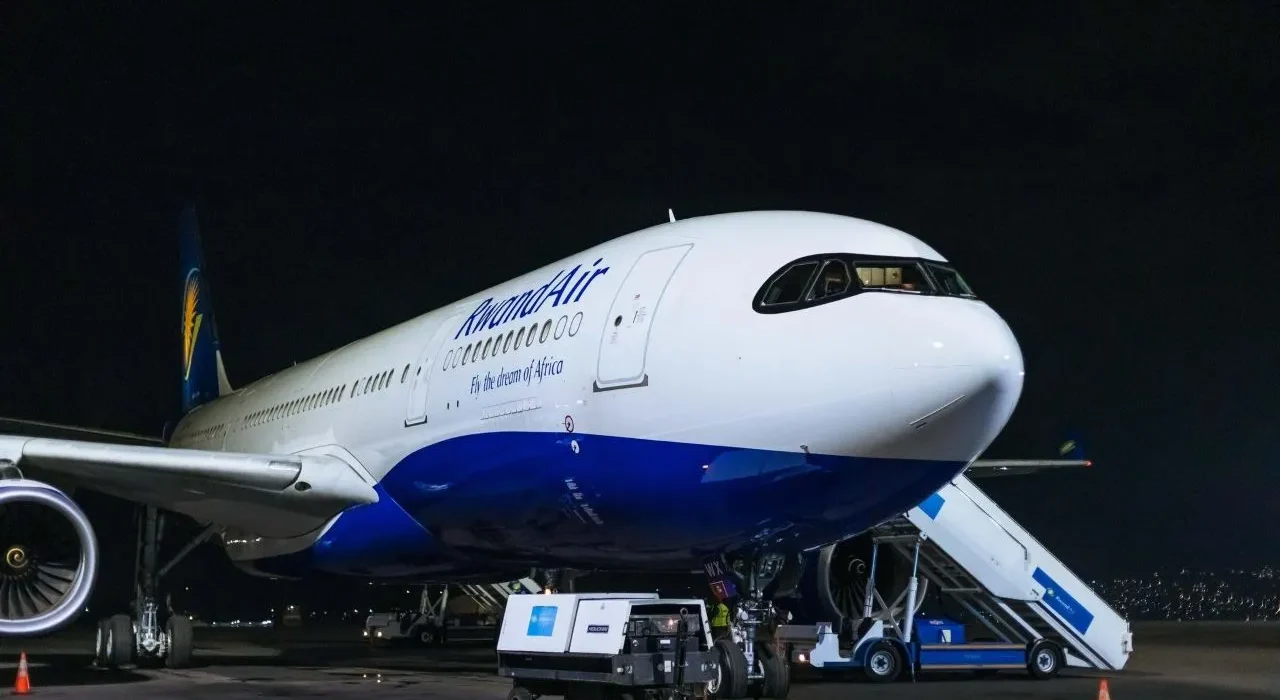
KIGALI, Rwanda – RwandAir has received a new Airbus A330-200, the first of five A330 aircraft scheduled to join the national carrier as Rwanda pushes a wider plan to turn Kigali into a stronger African aviation hub.
The airline announced the arrival on August 24. RwandAir said the wide-body aircraft will strengthen long-haul operations, improve reliability and expand onboard connectivity. “More than fleet expansion, this addition means enhanced comfort, greater reliability, and improved onboard connectivity, helping keep our passengers connected wherever their journey takes them,” the carrier said.
The aircraft arrives as RwandAir pursues one of the most ambitious growth programmes among smaller African flag carriers. The airline wants annual passenger traffic to rise from slightly above one million in 2023/24 to more than 2.1 million by 2028/29. Rwanda’s Transport Sector Strategic Plan also targets a fleet of at least 21 aircraft by 2029.
RwandAir serves a network centred on Kigali, linking Rwanda with African capitals and long-haul markets such as London, Paris, Doha and Dubai. Current schedules also connect Kigali with Johannesburg, Nairobi, Accra, Lagos, Harare, Lusaka, Entebbe, Bujumbura and several other regional destinations.
The A330-200 gives RwandAir more room for long sectors where narrow-body aircraft would limit passenger and cargo capacity. Airbus designed the A330 family for medium and long-distance operations. RwandAir first introduced the type in 2016, when Airbus described the airline as East Africa’s launch operator for the A330. The original RwandAir A330-200 carried Business, Premium Economy and Economy cabins.
The latest delivery also follows earlier fleet reinforcement. RwandAir acquired two Boeing 737-800 aircraft in 2025 after technical disruptions reduced available capacity and caused schedule changes. Chief Executive Yvonne Makolo said the added aircraft would improve reliability, strengthen schedules and provide a better passenger experience.
Rwanda wants more from aviation than an airline with a larger fleet. Kigali seeks a transport system linking air travel with tourism, conferences, trade, cargo and foreign investment.
The biggest piece of the strategy sits outside the capital at the New Kigali International Airport project. In June, Qatar Investment Authority acquired a 60 percent interest in the airport company for US$578 million and committed another US$1.1 billion toward completion. Rwanda’s state-owned Aviation Travel and Logistics Holdings retains 40 percent and has committed additional capital. QIA says the first terminal under construction has capacity for five million passengers, with space for future expansion.
For a country with a relatively small domestic population, such spending only makes commercial sense if Kigali attracts passengers travelling between other markets. Rwanda therefore needs RwandAir to feed the new airport with regional traffic while long-haul aircraft move passengers toward Europe, the Middle East and other global destinations.
This strategy resembles the hub model used elsewhere, where airlines use geography and coordinated schedules to connect travellers who never start or finish their journeys in the carrier’s home country. Rwanda’s location near the centre of Africa gives Kigali a useful position for links between East, Central, Southern and West Africa.
Competition will be intense. Ethiopian Airlines carried 20.7 million passengers and generated US$9.1 billion in revenue during 2025/26, according to its annual performance briefing. OAG ranked Ethiopian first among African airlines by scheduled seat capacity in August 2026, while Kenya Airways also remained among the continent’s ten largest carriers by seats. Rwanda therefore enters a market where established hubs already compete hard for African connecting traffic.
RwandAir’s smaller size gives management a different task. The airline does not need to match Ethiopian scale to succeed. Kigali needs reliable connections, disciplined route selection, strong partnerships and enough connecting traffic to support each aircraft. A five-aircraft A330 expansion therefore represents a major commitment for a carrier targeting 2.1 million annual passengers.
The expansion carries financial pressure as well. RwandAir still receives substantial state support. Rwanda’s Ministry of Finance recorded Frw170.2 billion in RwandAir operating subsidies during July to December 2025/26 and said officials rescheduled part of an airline loan repayment. An IMF programme document projects continued working-capital support over coming years.
Those figures make passenger growth, aircraft use and route economics central to the story. A larger fleet creates opportunity, but parked aircraft and weak load factors drain money quickly. Rwanda needs each new aircraft to support dependable schedules, competitive fares, cargo revenue and connecting traffic.
If you watch the next stage, focus on three measurements. Passenger numbers must move toward the 2.1 million target. New aircraft must improve schedule reliability. The airline must deepen commercial links between Kigali and markets where travellers generate enough demand for sustained service.
RwandAir also gains reach through its partnership with Qatar Airways. The two carriers already cooperate on connectivity beyond their own networks, while talks around a Qatar Airways investment in RwandAir have continued for years. Separate from the airline discussions, Qatar’s sovereign wealth fund now holds the majority interest in the new airport project.
The new A330 therefore represents more than another aircraft arriving at Kigali. The delivery connects fleet growth with a national aviation programme involving airport construction, tourism, trade, cargo and global partnerships.
Rwanda has placed a large financial bet on aviation as an economic connector. RwandAir now faces the harder task of turning aircraft, routes and infrastructure into sustained passenger growth and stronger commercial performance.