
LUANDA, Angola – Angola and Brazil are moving toward a major agricultural investment agreement covering up to 800,000 hectares, as Luanda searches for new sources of growth beyond crude oil and seeks foreign capital to raise domestic food production.
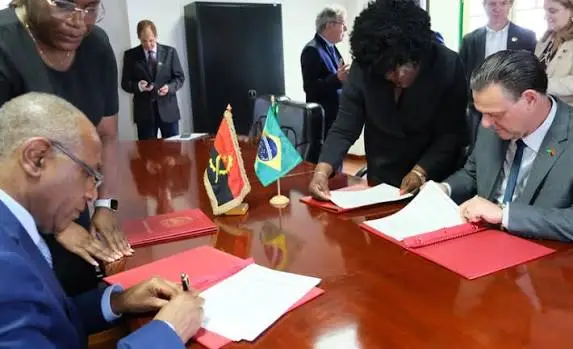
Brazilian Secretary for Trade Promotion, Science, Technology, Innovation and Culture Alex Giacomelli said in Luanda this week the Agricultural and Livestock Productive Investment Programme between both governments “should be signed shortly.” Brazilian companies would use agricultural expertise, machinery, financing and production technology inside Angola rather than rely mainly on trade between both countries.
Angola identified the 800,000-hectare area in 2025 for surveys, land planning and prospective Brazilian agribusiness operations integrated with local communities. Agriculture Minister Isaac dos Anjos presented the land offer again during the Angola-Brazil Agribusiness Forum in Luanda on August 12. His ministry said the partnership now aims at productive investment, technology transfer, research, mechanisation, skills development and agricultural value chains.
The scale is significant. Eight hundred thousand hectares equals 8,000 square kilometres, or almost two million acres. Angola holds tens of millions of hectares suitable for agriculture, yet farmers cultivate only a fraction. Brazilian government data show roughly 2.6 million farmers worked about 5.5 million hectares during the 2024-25 season.
For Luanda, the project addresses an economic weakness built over decades of oil dependence.
The World Bank says oil represents roughly 30 percent of Angola’s gross domestic product, about 65 percent of state revenue and more than 95 percent of goods exports. Oil wealth funded major public spending after the civil war, but falling production, volatile prices and limited job creation exposed the risks of dependence on one commodity.
Agriculture offers a different route. More than half of Angola’s workforce depends on farming for livelihoods, while food imports drain billions of dollars each year. The World Bank estimates Angola spends about US$3 billion annually on imported food. Its AgriConnect programme targets as many as 700,000 jobs by 2030, US$2.2 billion in annual added value and US$1.45 billion in public and private agricultural finance.
Brazil brings experience Luanda wants. Brazilian agribusiness transformed large areas of tropical savannah into major soybean, maize and livestock production zones through research, soil treatment, mechanisation, seed technology and large-scale logistics. Angola sees similarities between parts of its farming environment and Brazilian production regions.
Brazilian Agriculture Minister Carlos Fávaro travelled to Angola in 2024 with an agribusiness delegation. Work between both governments later produced proposals involving land access, infrastructure, seed rules, plant varieties and investment conditions.
A Brazilian government document in 2025 discussed concessions of up to 500,000 hectares for periods of up to 60 years, subject to Angolan law and final agreements. The new 800,000-hectare programme expands the potential scale, while final commercial terms still await agreement.
Public records do not show an outright sale of 800,000 hectares to Brazilian owners. Current government descriptions refer to land allocation for surveys, planning, development and establishment of agricultural businesses. Final agreements will determine tenure terms, financing, obligations and investor rights.
Financing has delayed progress.
Dos Anjos publicly expressed frustration with Brazilian investors earlier this month after negotiations moved slowly. “Enough is enough,” he said after warning Angola would seek other partners if Brazilian firms failed to commit.
Proposed financing includes 45 percent from Brazil’s BNDES, 23 percent through BB-Proex, 5 percent from Angola’s development bank, 17 percent from Angola’s sovereign fund and 10 percent from producers.
BNDES official André Taveira said commercial agreements still require finalisation before financing starts. Brazil’s ambassador to Angola, Eugénia Barthelmess, said negotiations are nearing completion and rejected claims of major obstacles.
Angola has already shown willingness to court alternative investors. Bloomberg reported agreements with China’s Citic Construction covering 100,000 hectares for soybean and maize development and with Sinohydro covering 30,000 hectares for grain cultivation. Those deals give Luanda leverage in talks with Brazilian groups and signal competition for Angola’s underused farmland.
Foreign investment also raises questions over land rights, community participation and who receives the economic gains.
Past investment reviews warned about weak transparency in Angolan land allocation and conflicts involving large agricultural concessions. UNCTAD previously cited more than one million hectares granted to 48 agricultural and forestry mega-projects, while productive use covered a much smaller area. Some disputes involved community land and alleged forced removals.
The government now says Brazilian operations will integrate local communities. Investors and Angolan authorities will face pressure to prove this promise through contracts, jobs, local procurement, farmer partnerships and transparent land arrangements.
If you judge the programme only by hectares allocated, you miss the real test. Angola needs production. The country needs irrigation, roads, storage, processing plants, reliable electricity, affordable finance and routes into domestic and export markets. Large concessions without those systems risk becoming unused land on official maps.
The government already pursues a broader agricultural agenda. In June, Angola and the World Bank launched AgriConnect to increase domestic food output and private investment. In Rome earlier this year, Angolan officials presented a US$551 million programme for maize, soybeans, wheat and rice linked partly to the Lobito Corridor.
The proposed Brazilian deal fits this shift from crude exports toward food, processing and regional trade.
Angola has land. Brazil has capital, technology and agribusiness experience. The opportunity lies in combining both without repeating old models where foreign investors secure huge concessions while surrounding communities see few gains.
Luanda wants farms producing food, jobs and exports, not empty promises. Dos Anjos already signalled his impatience with delays. If negotiators sign the programme soon, attention will move from diplomatic forums to tractors, irrigation systems, factories and actual harvests.