

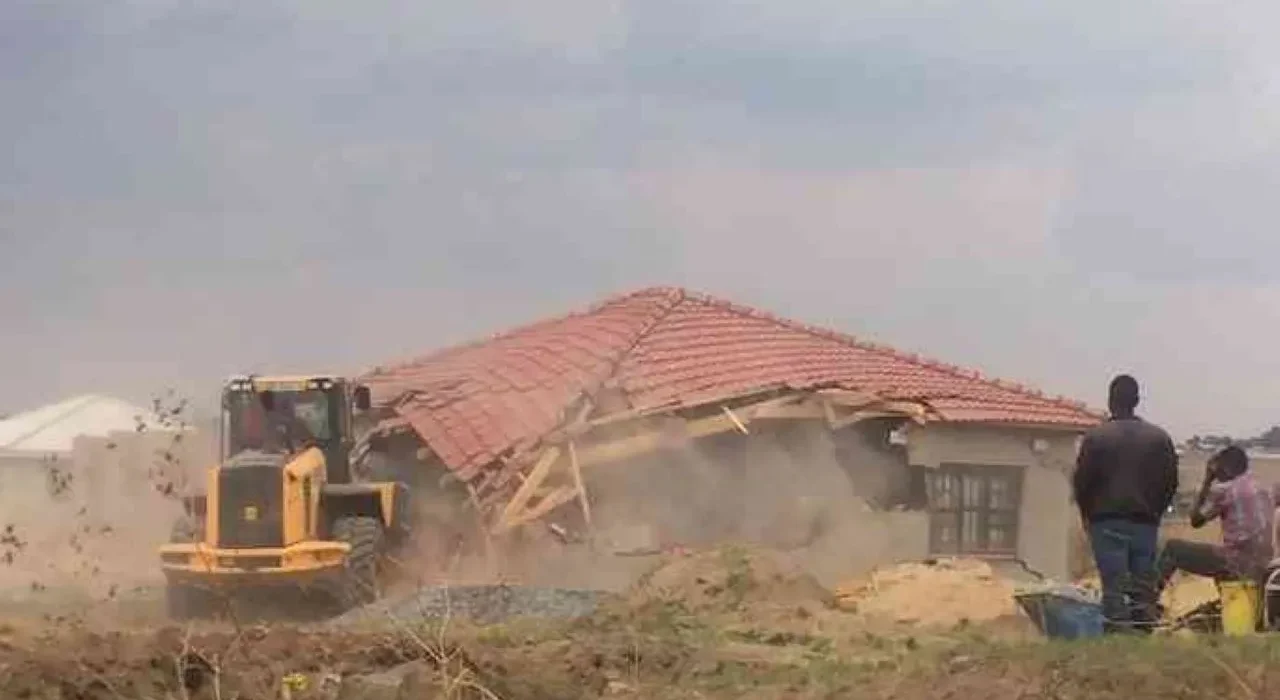
HARARE, Zimbabwe – Zimbabwe has entered another demolition season, with bulldozers flattening homes in Harare, Seke and Zvimba while thousands of other structures face removal under a government and council campaign against illegal settlements.
The official explanation is straightforward. Authorities say land barons, forged documents, unlawful subdivisions and construction on wetlands, school sites, road reserves and other protected land have created dangerous settlements. Harare City Council says more than 100 illegal settlements face enforcement, while a task force inspected 22,255 sites earlier this year. Council records list areas from Kuwadzana and Budiriro to Greendale, Belvedere, Mabvuku, Glen Lorne and Hopley.
Yet the anger surrounding the demolitions comes from a different question. Why did families build permanent houses for years, pay cooperatives, councils or intermediaries, receive documents or rate demands, connect services and live openly before authorities arrived with bulldozers?
St Martins has become the clearest example. Residents say Harare City Council sold residential stands there, including stands acquired by council employees. The Standard reported council sold 224 stands in 2018. Some residents also say they paid rates and held paperwork they believed valid. Bulldozers still destroyed homes in August. A High Court order protected some properties, forcing council to leave those houses untouched while demolishing others nearby.
Harare Mayor Jacob Mafume told residents with approved plans to produce them during enforcement.
“Those who have approved building plans need to produce them when enforcement is being done,” Mafume said.
His response left residents asking why verification did not happen before demolition crews arrived.
The same pattern appears elsewhere.
At Stoneridge in Harare South, demolitions in June left scores of families homeless on disputed private land. Residents had paid fees through Takunda Freedom Fighters Housing Cooperative Society, linked to war veterans. The Standard reported thousands of home seekers had invested savings, built houses and established businesses while ownership remained contested.
The Stoneridge dispute also fuels claims spreading across social media about land being cleared for foreigners or politically connected interests.
NewsDay initially described the owner of a disputed 20-hectare section as an unidentified foreign investor. Later reporting identified Chinese national Xinfeng Li in the ownership dispute, while another investigation identified Downberry Marketing as the company holding title to the private property.
No credible public evidence reviewed by The African Telegraph proves authorities launched the present demolition campaign to transfer residential land to white people. In the best documented current foreign-investor dispute, reporting points toward a Chinese-linked interest, rather than a white beneficiary.
Claims involving white business interests therefore need evidence before publication as fact.
Evidence of elite influence over urban land is much stronger.
Public suspicion also draws strength from earlier selective enforcement. In 2024, a NewsDay investigation into Ridgeview and Belvedere reported ordinary residents lost houses while some structures linked to wealthy or politically connected people survived. Justice Minister Ziyambi Ziyambi later told Parliament council had acted without a court order in the specific demolitions he reviewed. Such episodes make official claims of equal enforcement harder for residents to accept.
A peer-reviewed 2024 study on Harare’s peri-urban land market found political elites and land barons played a major role in informal land transactions after fast-track land reform. Researchers cited council officials who said politicians acquired large peri-urban tracts, parcelled land to home seekers and undermined municipal planning.
The researchers also linked some housing cooperatives to political patronage and election mobilisation. One council official interviewed for the study said political actors had taken significant peri-urban land before passing plots to people without secure documentation.
A separate investigation documented residents who said ZANU-PF representatives allocated plots linked to political loyalty. One woman built on land later identified for airport expansion. Bulldozers destroyed her house three years later. Party representatives later helped her secure another plot, according to the report.
Government itself now acknowledges corruption inside the land system.
Local Government Minister Daniel Garwe accused some town planners of helping illegal subdivisions. Harare City Council says land barons use forged signatures and occupy sites over weekends before moving families onto them.
Garwe has also warned village heads against so-called “sabhuku deals” and ordered provinces to report illegal allocations.
“Land barons have caused untold suffering to many people who invested their hard-earned money in illegal land deals,” Garwe said in June.
Earlier this year, authorities demolished homes at Gilstone Farm in Seke after giving settlers seven days to leave. Garwe accused ZANU-PF-linked figures of illegally parcelling state land. Party members disputed parts of his accusations. The dispute weakens any simple argument blaming only opposition-controlled councils. Land patronage crosses institutions and political structures.
The demolition campaign reached Murombedzi in Zvimba this week, where footage showed rural houses being pulled down after informal land deals involving local intermediaries. The spread from Harare into rural districts gives the crisis national significance.
Zimbabwean law places limits on demolition power.
Section 74 of the Constitution says no person should lose a home through eviction or demolition without a court order issued after consideration of relevant circumstances. Courts have repeatedly struck down attempts by councils to rely on old by-laws for mass demolition without judicial oversight.
The history makes public fear understandable.
Operation Murambatsvina in 2005 destroyed housing and informal businesses on a huge scale. United Nations reporting estimated 650,000 to 700,000 people lost homes, livelihoods or both. Two decades later, Zimbabwe still faces a national housing backlog above 1.25 million units, according to the Ministry of National Housing.
Authorities have a legitimate duty to protect wetlands, roads, sewer lines, schools and public land. Families also carry responsibility for verifying ownership before spending savings on construction.
The unanswered issue lies between those two facts.
Where officials, councillors, party activists, traditional leaders, cooperatives or developers sold illegal land, the government should prosecute sellers before treating buyers as the main offenders.
Where councils accepted payments or rates, officials should publish records.
Where homes stood openly for years, authorities should explain why enforcement waited until families completed construction.
Zimbabwe does not need another cycle where land barons collect money, politicians collect loyalty and ordinary families collect broken bricks.
The strongest allegation is not yet proof of a programme to clear land for white or elite beneficiaries. The documented scandal is already serious enough.
Political patronage, disputed titles, forged papers, weak planning, delayed enforcement and desperate demand for housing have produced a system where citizens sometimes learn the legal status of their home only when a bulldozer reaches the gate.