
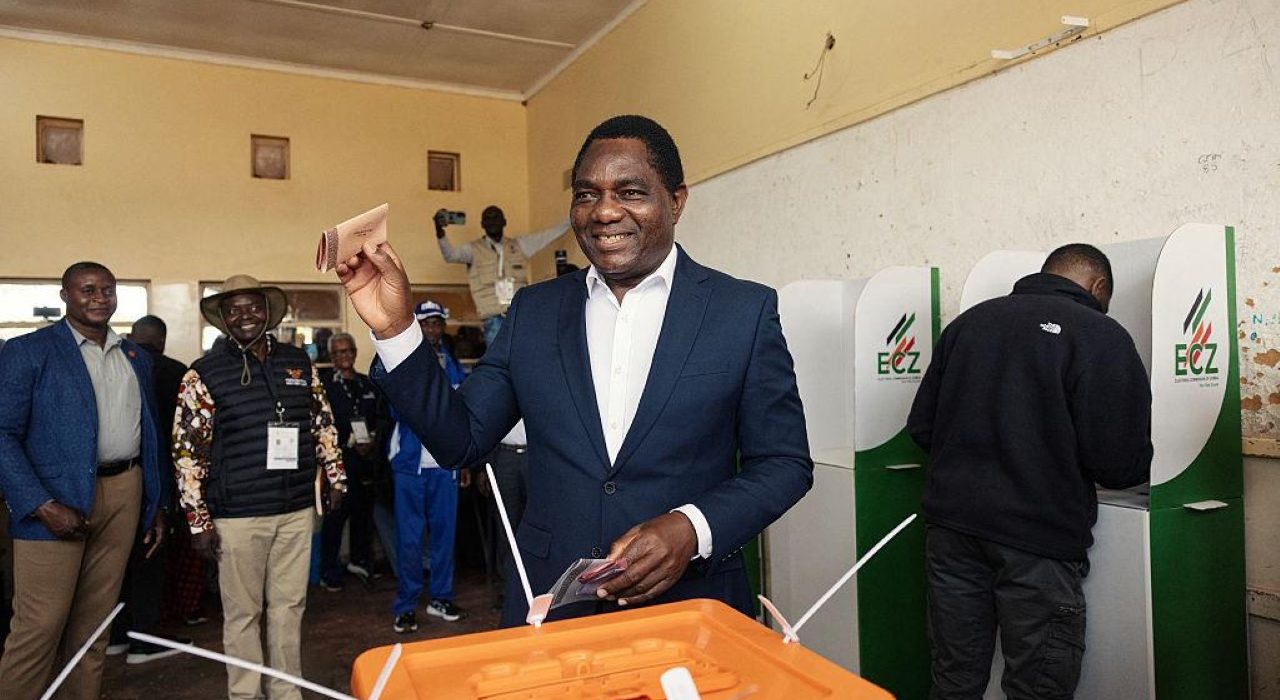
LUSAKA, Zambia – President Hakainde Hichilema secured a second five-year term after Zambia’s Electoral Commission announced a decisive victory in the August 13 presidential election, while opposition leader Brian Mundubile challenged the integrity of the process and demanded an independent investigation.
Official figures gave Hichilema 2,965,326 votes, equal to 61.4 percent of ballots cast. Mundubile received 1,856,217 votes, close to 38 percent. Electoral Commission chairperson Mwangala Zaloumis announced the final outcome early Tuesday and said, “I therefore declare, Hichilema Hakainde S, to be president-elect of the Republic of Zambia this 18th day of August, 2026.”
The result gives Hichilema another five years in State House. Debt restructuring, inflation pressures, electricity shortages and efforts to restore investor confidence shaped much of his first term. His victory also shows a large section of the electorate still backs his economic programme, even as Mundubile drew strong support from voters frustrated by living costs and household hardship.
Election day itself passed with voting across much of Zambia proceeding peacefully. Serious problems emerged during counting. On August 14, the Electoral Commission halted vote counting for several hours after attacks on election workers and reports of stolen marked ballot papers. Authorities deployed riot police and soldiers around parts of Lusaka, including the main results centre. Counting resumed after election officials and security agencies reviewed the situation.
The interruption immediately increased pressure on the commission. Zambia has built a regional reputation for competitive elections and peaceful transfers of power since the return of multiparty politics in 1991. A suspension during a presidential count therefore carried major political weight, especially in a contest where opposition leaders already accused state institutions of favouring the incumbent.
Mundubile moved quickly to question the process. “We wish to place on record our grave concern regarding the integrity of the ongoing presidential election process,” he said in a video statement. He later said his camp had received information about possible alterations to polling-station result forms and called for an urgent independent investigation.
Hichilema’s camp rejected the allegations. Mundubile’s public statements called for an investigation while raising claims about result forms. Election authorities now face pressure to publish, preserve and defend each stage of the tabulation process. Public confidence depends on verifiable records, clear explanations and lawful handling of complaints.
Security operations deepened opposition anger. Authorities arrested 11 people, including senior opposition figures, during an election-night operation involving gunfire while Mundubile was present. Police linked the arrests to threats against state security. Mundubile described a raid on his home as an attack on his life. Those competing accounts now form part of a wider argument over whether security agencies protected the vote or placed improper pressure on political opponents.
International observers gave Zambia a mixed assessment. The European Union Election Observation Mission described election day as largely peaceful, yet raised serious concerns about the wider political environment. Chief observer Michael McNamara said, “Late legal changes, legal uncertainty, and unequal campaign conditions distorted the playing field.”
The EU mission deployed observers across the country and visited 419 polling stations in 113 of Zambia’s 226 constituencies on election day. Its preliminary assessment pointed to limits on fundamental freedoms and unequal campaign conditions. Those findings matter because a peaceful polling day does not settle every question about electoral fairness. Access to media, freedom to organise, legal certainty, security conduct and transparent counting also shape credibility.
Election administrators now carry a separate responsibility from the political contest. They need to release constituency totals in forms citizens, parties and monitors inspect, retain result sheets, explain disputed polling stations and document security incidents. Transparent records help voters compare political claims against official figures. Zambia’s courts and electoral institutions also need to process any complaint within legal deadlines, without pressure from either political camp.
Zambia’s Catholic bishops also criticised the military presence during counting. “The maintenance of order during elections is constitutionally and statutorily the responsibility of the Zambia Police Service,” the bishops said. Their intervention added pressure on authorities to explain why soldiers appeared around election-related operations and what legal role they performed.
For Hichilema, the size of the victory delivers a clear electoral mandate, but the opposition’s 38 percent shows a substantial bloc of dissatisfaction. Mundubile entered his first presidential race with an argument focused on household economics. His campaign said stronger macroeconomic indicators had failed to improve daily life for many citizens. Hichilema, in contrast, asked voters to judge his record on debt restructuring, economic stabilisation and renewed investment.
Zambia’s economy gives the election significance far beyond party politics. The country sits at the centre of global demand for copper and other minerals. Hichilema’s government wants to expand copper production, attract investment and secure a new programme with the International Monetary Fund after an earlier arrangement ended in January. Investors now have continuity. Citizens will judge the second term by jobs, food prices, electricity reliability, wages and public services.
If you look only at the 61.4 percent result, the election appears straightforward. If you examine the halted count, arrests, military deployment and observer criticism, a more demanding democratic test follows. Hichilema has won the presidency. His government now faces pressure to protect institutions, answer credible complaints through lawful channels and ensure political opponents operate without intimidation.
Mundubile also faces a test. Any challenge needs evidence strong enough for public scrutiny and, if his alliance chooses court action, judicial scrutiny. Claims about altered result forms require documentation from polling stations, party agents and official tally records. Evidence, rather than suspicion, will determine the strength of any formal case. Reuters reported expectations of a possible opposition legal challenge after Mundubile demanded an independent investigation.
Zambia’s next political chapter therefore starts with two facts. Hichilema won a second term by a wide official margin. The election process still faces questions from the opposition, international observers and church leaders. The way institutions handle those questions will shape public trust long after the victory celebrations end.