
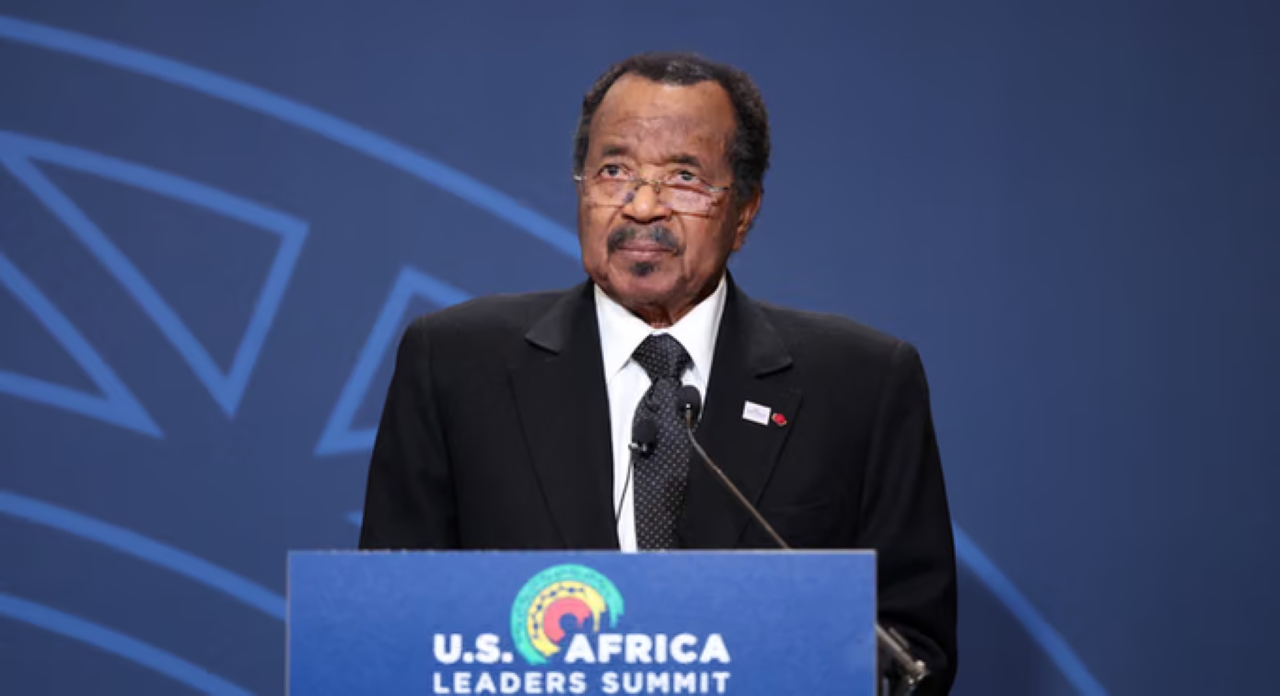
YAOUNDE, Cameroon – President Paul Biya has now spent more than two months outside Cameroon, leaving Central Africa’s largest economy confronting an uncomfortable question. Who is exercising presidential authority while the 93-year-old head of state stays in Europe?
Biya left Yaounde on June 7 with First Lady Chantal Biya for what the presidency described as a “brief private stay in Europe.” More than sixty days later, no return date has been announced. The presidency has offered no detailed public explanation for the length of the trip. Reuters reported Biya had not returned by August 4, while Associated Press confirmed on August 6 he had reached two months outside the country.
Cameroon has seen long presidential absences before. This episode carries greater political weight because Biya is now the world’s oldest serving head of state, began an eighth term after the disputed 2025 election, and governs a country facing separatist violence, jihadist attacks, fiscal pressure and deep public frustration.
The constitutional problem has become harder to ignore.
Parliament restored the office of vice president in April through a constitutional amendment. The new office was presented as protection against a sudden leadership vacancy. Yet Biya has not appointed anyone to the post. Cameroon therefore has a vice presidency on paper and no vice president in office.
Opposition leader Issa Tchiroma Bakary says the prolonged absence has reinforced public concern over Biya’s condition and legitimacy. He told Associated Press there is a widespread perception “all is not well” with the president. Other opposition figures describe governance as operating on “autopilot.”
Government officials reject claims of a vacuum. Communication Minister Rene Emmanuel Sadi told RFI on August 2 “the president is alive” and said Biya would return soon. Other senior officials say he continues reviewing state files from Geneva.
Then came a striking demonstration of remote authority.
On August 3, decrees signed in Biya’s name reshuffled senior military leadership. The changes replaced commanders in four of Cameroon’s five joint military regions, promoted the commander of the Presidential Guard from colonel to brigadier general, changed leadership inside the Rapid Intervention Brigade and elevated several senior officers. State radio announced the decrees the following day.
Military appointments during such an absence deserve scrutiny.
Cameroon faces Boko Haram-linked violence in the north and a separatist conflict in the English-speaking northwest and southwest. Control of the armed forces also matters during any disputed succession. A president absent for two months signing sweeping military changes invites questions over decision-making, consultation and chain of command.
No evidence proves the decrees were improper. No evidence reviewed by The African Telegraph establishes Biya lacked capacity to sign them. Yet transparency matters because the government has disclosed little about where executive decisions are being made, who meets the president and how major files reach him.
This is where Cameroon’s succession problem becomes an economic problem.
Investors have worried about the post-Biya transition for years. Before the 2025 election, the premium demanded on Cameroon’s dollar debt widened as investors priced political uncertainty and succession risk. Standard Chartered strategist Samir Gadio said bond spreads suggested markets were factoring uncertainty surrounding long-term succession.
Cameroon returned to international debt markets in January 2026 with a US$750 million five-year bond priced at a 10.125 percent yield. Such borrowing costs already leave little room for political disorder.
The International Monetary Fund said in April Cameroon remained at high risk of external and overall debt distress, despite debt remaining sustainable over the medium term. The Fund also identified political uncertainty, weak reform implementation, fiscal pressures and liquidity risks as major vulnerabilities.
Claims circulating online about a dramatic August collapse in Cameroon’s dollar bonds need caution. The African Telegraph found no authoritative current market source establishing a large selloff caused solely by Biya’s latest absence. Investor anxiety is well documented. A specific recent plunge requires stronger market data before presentation as fact.
The political risk remains serious without such exaggeration.
Biya has ruled since 1982. More than 70 percent of Cameroon’s population is younger than 35, according to Associated Press. Most citizens have never experienced another president. If Biya completes his current seven-year term, he will approach 100 years of age.
No modern state should depend so heavily on the physical condition of one individual.
Strong institutions should continue functioning when a president travels, becomes ill or leaves office. Succession procedures should operate without panic. Cabinet authority should remain clear. Parliament should exercise oversight. Citizens should know who holds executive responsibility.
Cameroon instead faces uncertainty around a restored but vacant vice presidency, an ageing president abroad, an unannounced return date and major military orders issued from outside the country.
The government’s defenders point toward continuity. Ministries still operate. State institutions still function. Decrees still appear. The ruling Cameroon People’s Democratic Movement held a rare senior meeting in July while Biya remained away.
Continuity is not the same as accountability.
A president receives authority from citizens. Citizens therefore deserve basic information about his ability to exercise public duties, especially after an overseas trip described by his own office as brief stretches beyond two months.
Cameroon should not need rumours about death, illness or secret succession deals. The presidency should publish a clear update, state whether Biya is performing his full constitutional duties and provide a return timetable. Authorities should also explain why the newly restored vice presidency remains vacant.
The issue reaches beyond Biya’s health.
Cameroon is testing whether a state built around one ruler for more than four decades possesses institutions strong enough to function without his physical presence.
If the answer is yes, transparency should prove the claim.
If the answer is no, two months of presidential absence have exposed a problem far larger than one ageing leader’s stay in Europe.