

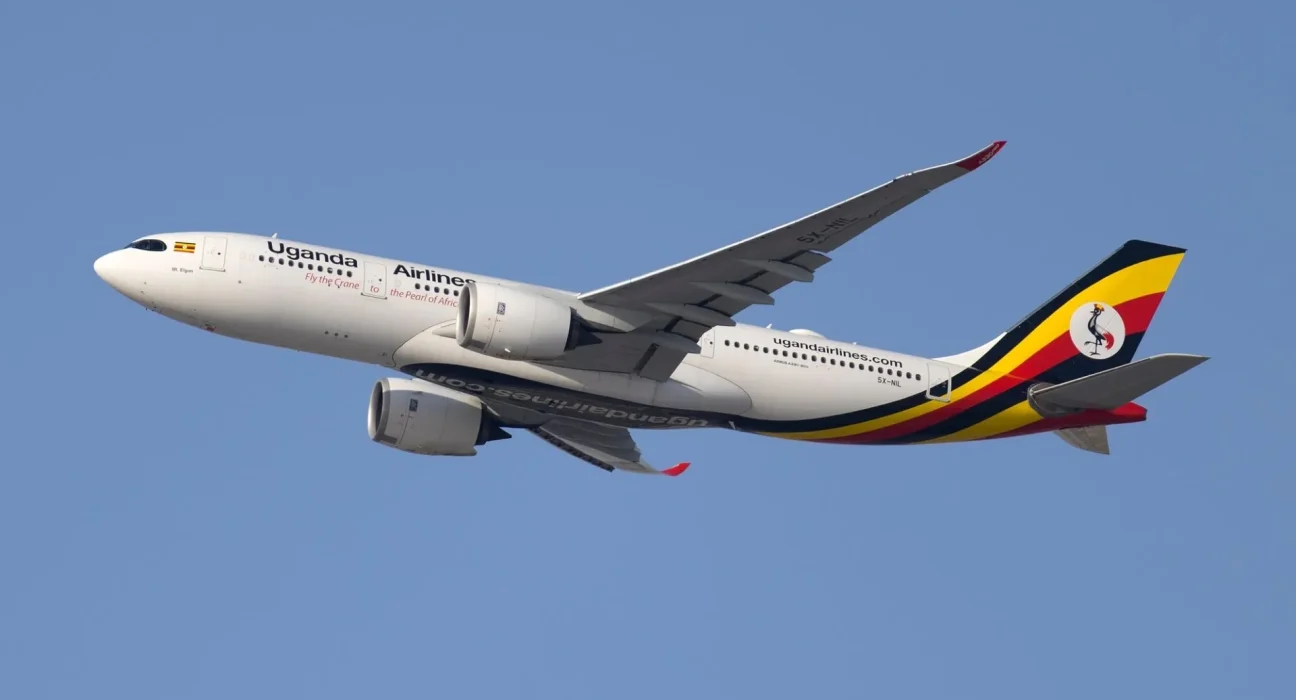
KAMPALA, Uganda – Uganda Airlines has ordered four Boeing 737-8 jets and four Boeing 787-9 Dreamliners, but the aircraft have not yet joined its fleet. Boeing and the airline announced the firm order at the Farnborough International Airshow on July 21. The agreement marks Uganda Airlines’ first direct Boeing purchase and gives the carrier eight new passenger aircraft for regional and long-haul growth.
This distinction matters. Uganda has placed an order. Uganda has not received eight aircraft overnight. Boeing gave no delivery timetable or contract price in its public announcement. Production backlogs, financing milestones, crew preparation, airport readiness, and regulatory approvals will shape the delivery programme.
The order includes four 737-8 aircraft for African routes, India, and the Middle East. Boeing says the model carries about 160 to 180 passengers in a two-class cabin and flies up to 6,480 kilometres. Four 787-9 aircraft will target Europe, Asia, and high-demand Middle Eastern routes, with a stated range of up to 15,370 kilometres.
Uganda Airlines chief executive Ato Girma Wake called the purchase “a defining step” in efforts to turn Entebbe into a regional aviation hub. He linked the fleet plan to tourism, trade, investment, passenger growth, and cargo development. Boeing says the two aircraft families use 20 to 25 percent less fuel than older aircraft they replace.
Zimbabweans should study Uganda’s decision without mocking Uganda. The dismissive phrase, “Uganda of all countries,” misses the real issue. Uganda revived its flag carrier in 2019, built a fleet, expanded routes, accepted public scrutiny, and returned to Boeing with a defined network plan. Zimbabwe once held one of Africa’s respected airlines. Years of debt, political interference, grounded aircraft, weak maintenance funding, and poor planning reduced Air Zimbabwe to dependence on hired capacity.
Air Zimbabwe’s planned London service uses a wet-leased Airbus A330-300 from Spain’s Plus Ultra under a 13-month agreement. The aircraft has 302 seats and supports three weekly services. Under a wet lease, also called ACMI, the supplier provides the aircraft, crew, maintenance, and insurance. Air Zimbabwe supplies the route, sales, airport arrangements, and commercial risk.
Wet leasing is not shameful by itself. Major airlines use ACMI contracts during peak seasons, fleet shortages, maintenance disruptions, or rapid route launches. The problem starts when emergency leasing replaces a credible fleet strategy. Air Zimbabwe’s in-house aircraft were reported grounded in July, while the airline also relied on a wet-leased ATR42 for domestic and regional work. The London arrangement also helps Air Zimbabwe operate despite restrictions linked to unresolved safety concerns in Europe and Britain.
How much does a commercial jet cost? Manufacturers rarely reveal final contract prices because airlines negotiate discounts, maintenance packages, training, spare engines, warranties, and financing terms. Boeing’s last published 2019 list price placed the 737 MAX 8 at US$121.6 million and the 787-9 at US$292.5 million. Current market appraisals place a new 737-8 near US$55 million and a new 787-9 near US$151 million. Those figures offer estimates, not Uganda’s confidential invoice.
Using those market values, four 737-8s and four 787-9s carry an indicative aircraft value near US$824 million. Training, spare engines, simulators, tools, cabins, financing charges, insurance, and initial maintenance support raise the wider programme cost. Earlier reports valued Uganda’s broader Boeing discussions, including freighter plans, near US$985 million, though Boeing’s July announcement covered only the eight passenger jets.
African governments do not need to arrive with a suitcase full of cash. Airlines usually fund aircraft through several structures. A state or airline pays deposits, then uses commercial bank debt, sovereign guarantees, export-credit support, operating leases, finance leases, or sale-and-leaseback deals.
Under an operating lease, a lessor owns the aircraft while the airline pays monthly rent. Under a finance lease, payments move the airline closer to ownership. A sale-and-leaseback deal lets an airline order or buy a jet, sell the asset to a lessor, then lease the same aircraft for operations.
IATA expects operating leases to cover roughly half of the world fleet during the next decade. Leasing gives airlines flexibility and avoids full ownership risk, yet contracts impose strict maintenance, insurance, record-keeping, deposit, and return conditions. Poorly negotiated return clauses create huge bills at lease end.
A new 737-8 carried an indicative monthly lease rate near US$400,000 in 2025. A 787-9 ranged from about US$695,000 for an older aircraft to roughly US$1.075 million for a new example. Monthly rent excludes fuel, crews, maintenance reserves, airport charges, insurance, navigation fees, catering, and route losses. Buying or leasing a jet represents only the first cost. Filling seats at profitable fares decides survival.
Uganda’s order still carries serious risk. Parliament reported government investment of Shs1.87 trillion since the airline’s revival, accumulated losses of Shs1.02 trillion, and a Shs237.9 billion loss for the 2023 to 2024 financial year. Passenger revenue still rose 58 percent, while cargo revenue rose 55 percent. Parliament demanded better contracts, tighter financial discipline, stronger partnerships, and modern fleet management.
Uganda therefore has no automatic victory. Eight expensive jets will deepen losses when routes lack passengers, cargo, connections, disciplined pricing, or professional management. Widebody aircraft punish weak planning because each empty seat carries fuel, crew, airport, maintenance, and financing costs across long distances.
Zimbabwe needs a transparent national aviation plan rather than patriotic speeches. Government should publish route studies, fleet requirements, debt capacity, safety reforms, maintenance plans, pilot training targets, and partnership options. Harare should decide whether Air Zimbabwe needs ownership, dry leases, finance leases, or a strategic equity partner. The answer should follow traffic data, not political pride.
African states also need regional cooperation. Several small carriers compete on thin routes with duplicated management, offices, training, and maintenance costs. Joint procurement, shared engineering centres, common simulator facilities, code-sharing, and regional leasing platforms would reduce costs.
Governments should also implement the Cape Town aircraft-finance framework. UNIDROIT says the agreement strengthens creditor protection, broadens financing options, and reduces aircraft borrowing costs for participating states.
Uganda has shown ambition. Zimbabwe has shown survival through wet leasing. Both approaches still need strict commercial discipline. Ownership alone does not create a successful airline, while leasing alone does not prove failure.
The real humiliation for Zimbabwe is not a Spanish aircraft operating a London route. The humiliation lies in decades without a funded fleet plan, dependable maintenance system, clean balance sheet, or trusted safety record.
Uganda ordered eight Boeing jets because leaders built a financing and route argument strong enough for Boeing, lenders, and state authorities to proceed. Zimbabwe must build the same institutional credibility. Flags painted on aircraft inspire pride. Profitable routes, safe operations, trained citizens, and accountable management build an airline.