

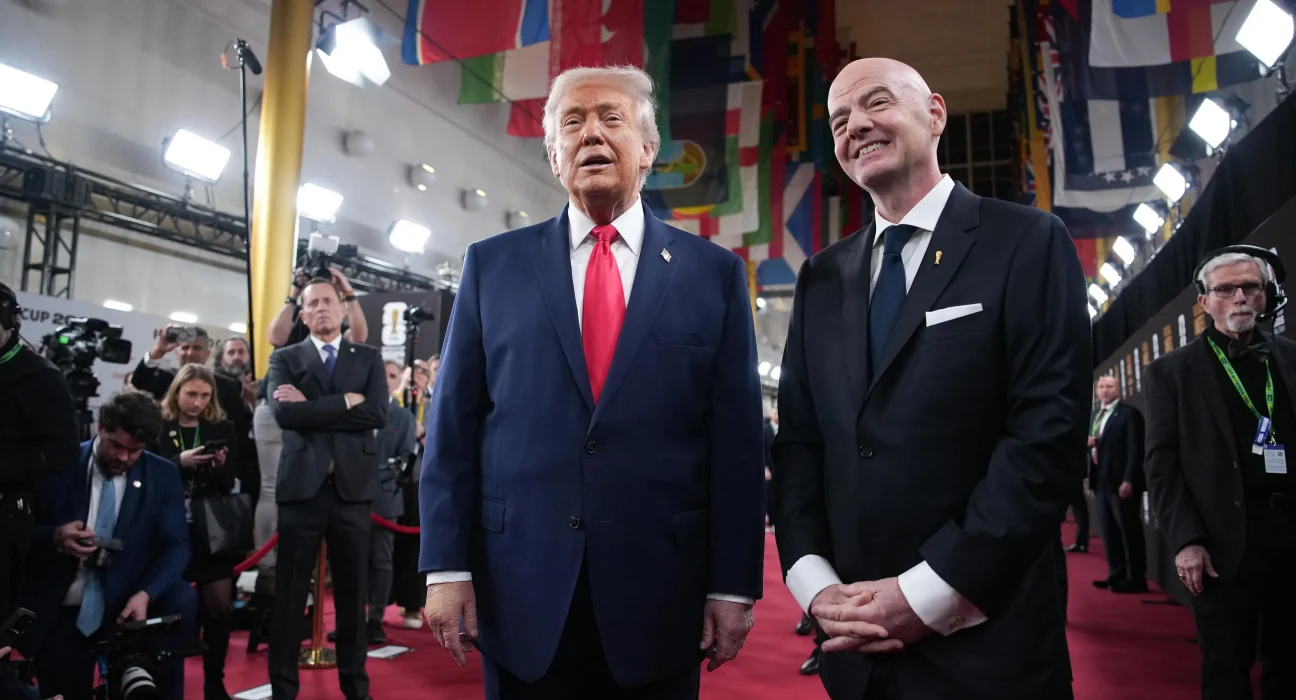
NEW YORK, United States – FIFA President Gianni Infantino has praised the 2026 World Cup as the greatest human, social, and cultural event in history, while thanking United States President Donald Trump for helping deliver the tournament.
His tribute came at a reception inside Trump Tower in New York before Sunday’s final between Argentina and Spain. Infantino said the tournament had exceeded every expectation and credited Trump for its success. FIFA reported attendance of 6,665,825 across 102 matches, an average crowd of 65,351, and stadium occupancy of 99.7 percent. Those figures give Infantino a strong commercial case. They do not answer the harder question now facing world football. Did FIFA protect sporting independence while drawing closer to the host nation’s president?
Infantino told Trump, “This World Cup would not have been such an incredible success without you.” He also described the competition as the “greatest human, social and cultural event” humanity had ever witnessed. Trump called the tournament one of history’s greatest sporting events and praised Infantino in return.
Praise between a host president and a football leader does not prove corruption. Governments provide security, visas, transport, stadium coordination, and diplomatic support for major tournaments. FIFA must work with political leaders. Yet cooperation crosses a dangerous line when a political figure appears to influence disciplinary decisions inside the competition.
The Folarin Balogun case created this crisis.
Balogun received a direct red card during the United States’ Round of 32 victory over Bosnia and Herzegovina on July 1. FIFA rules imposed an automatic one-match suspension. Trump then called Infantino and urged a review. FIFA later suspended implementation of the ban for a one-year probationary period under Article 27 of its disciplinary code. Balogun played against Belgium, although Belgium beat the United States 4-1.
Trump publicly described his intervention as a recommendation and a complaint. Standing beside Infantino on Friday, he praised the reversal and said Infantino had made another good decision. Infantino acknowledged receiving Trump’s call but denied interfering with FIFA’s judicial process. He said FIFA’s committees act independently and called such independence essential for football’s credibility.
This sequence fuels public suspicion because red-card suspensions normally carry firm consequences. Reuters reported a red card or suspension does not permit an appeal, while FIFA gave little public explanation beyond its reference to Article 27. Critics saw a host president call FIFA’s leader, then saw FIFA produce an exceptional result favouring the host team. Even without proof of direct orders, the appearance of influence damages trust.
FairSquare has asked the International Olympic Committee to investigate Infantino for alleged breaches of political neutrality. The complaint cites the Balogun episode, Infantino’s public support for Trump, his attendance at events linked to Trump’s inauguration, his endorsement of Trump for a Nobel Peace Prize, and FIFA’s decision to present Trump with its first Peace Prize. FairSquare argues Infantino acted too closely with one political leader while holding duties under FIFA and the Olympic movement.
Infantino faces no finding of wrongdoing from the IOC at this stage. FIFA also denies political interference in the Balogun decision. Those facts matter. Allegations require evidence, due process, and an independent judgment. Public anger must not replace proof.
Claims of a fully scripted World Cup go much further than the verified record. Social media users have accused FIFA of planning results, protecting Argentina, favouring selected stars, and directing referees toward a preferred final. No credible evidence proves FIFA prearranged match outcomes or ordered officials to deliver Argentina versus Spain.
Controversial decisions still deserve scrutiny. Argentina’s route to the final drew complaints after disputed VAR calls against Egypt and Switzerland. Swiss coach Murat Yakin criticised the decision which led to Breel Embolo’s dismissal. FIFA refereeing chief Pierluigi Collina rejected claims of bias and defended the independence of match officials. Reuters also reported growing fan distrust around FIFA’s new VAR protocol.
Poor or disputed refereeing does not equal a script. A fixed tournament would require evidence of coordinated instructions, compromised officials, financial trails, communications, or testimony. None has emerged publicly. Treating every controversial whistle as proof weakens serious criticism because conspiracy claims distract from documented governance failures.
The Balogun case presents a stronger concern than online scripting theories. A president admitted contacting FIFA’s leader about a live disciplinary matter. FIFA then changed the practical effect of an automatic suspension. Trump later celebrated the outcome beside Infantino. This record requires a transparent explanation from FIFA, including who reviewed the case, who attended discussions, which precedent supported the ruling, and whether Infantino communicated with disciplinary officials.
FIFA should publish the full decision and legal reasoning. An outside ethics panel should review all contacts between Trump, Infantino, United States Soccer, and FIFA officials. FIFA should also adopt a rule barring presidents, ministers, royal families, sponsors, and host committees from lobbying over disciplinary cases.
Infantino’s praise also risks erasing Canada and Mexico, co-hosts whose cities, workers, governments, and supporters helped run the tournament. His repeated focus on Trump turns a three-country event into a stage for one political relationship. Football unity should not depend on personal loyalty to the strongest leader in the room.
The 2026 World Cup has delivered huge crowds, global attention, dramatic matches, and historic participation from 48 teams. Those achievements deserve recognition. Record attendance still does not grant FIFA immunity from questions about fairness.
Infantino wants the world to remember a festival of football. Many supporters will also remember a president calling FIFA over a red card and later receiving public thanks from the same football leader.
There is no proven script for the World Cup. There is a proven crisis of perception. FIFA created much of this crisis through secrecy, personal politics, and weak explanations. Football does not survive on spectacle alone. Football survives when supporters trust the rules, even when their team loses.