

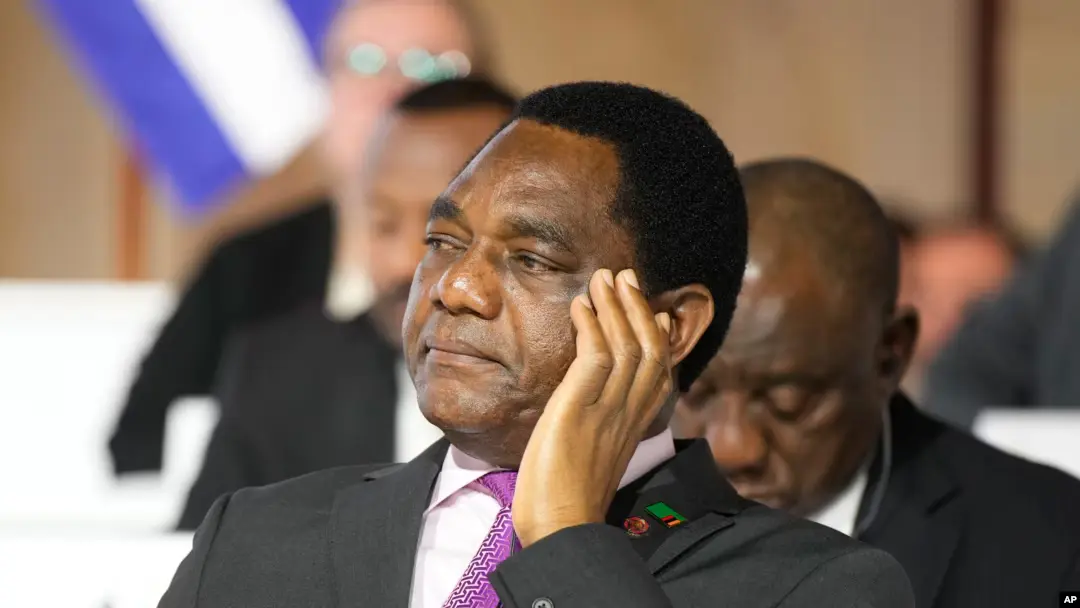
LUSAKA, Zambia – Zambia's post-election crisis deepened on Monday after authorities closed major court premises across the country on the final day available for opposition leader Brian Mundubile to lodge a presidential election petition.
Reuters confirmed the closure of Zambia's top courts, including the Supreme Court complex in Lusaka housing the Constitutional Court. Police officers stood inside closed gates. A Judiciary memorandum instructed staff to stay home. Chief Administrator Nalishebo Imataa wrote, “For security reasons, all members of staff are advised not to report for work today.” Police spokesman Godfrey Chilabi said security assessments were under way but gave no details.
The timing has triggered an immediate constitutional storm.
Article 103 of Zambia's Constitution gives any person seven days after declaration of a President-elect to petition the Constitutional Court. President Hakainde Hichilema secured a second term after the Electoral Commission announced 2,965,326 votes for him against 1,856,217 for Mundubile. The declaration came early on August 18, placing the filing deadline in the early hours of Tuesday, August 25.
Civil society groups reacted with rare force. A joint statement supplied to The African Telegraph described the shutdown as “without precedent” and said the timing was “impossible to ignore.” The organisations argued closure of court services during the filing window threatened access to justice and placed the electoral dispute beyond judicial scrutiny.
Linda Kasonde, executive director of the LCK Freedom Foundation and former Law Association of Zambia president, signed the statement. ActionAid Zambia, Chapter One Foundation, Caritas Zambia, the Non-Governmental Gender Organisations' Coordinating Council, Advocates for Democratic Governance Foundation and the Zambia Free Press Initiative joined the declaration.
Kasonde also warned of severe consequences for Zambia's democracy if citizens lose access to courts during the constitutional filing period.
The Law Association of Zambia demanded urgent restoration of access. LAZ president Arnold Kaluba expressed concern over heavily armed personnel near court premises, including reports of yellow tape marked “Crime Scene.” The lawyers' body said authorities had offered no adequate public explanation covering the geographical scope, duration or arrangements for urgent filings. LAZ began engagements with the Chief Justice and Attorney General.
Reports from Ndola, Chipata and Livingstone said police restricted access to High Court premises. Local courts also suspended proceedings in some areas. Lusaka Times reported similar restrictions across several judicial facilities.
This is where the political question becomes unavoidable. Did President Hichilema order the shutdown to stop Mundubile?
No public evidence currently proves such an order from State House. The Judiciary memorandum cites security reasons, not a presidential instruction. Police say security assessments continue. Government has not published details of the alleged threat. Hichilema's UPND has said Mundubile remains free to pursue legal routes.
Those facts do not remove suspicion. They increase the need for evidence and explanation.
A democratic government facing an election petition gains little from locked court gates on filing day. Hichilema won by more than one million votes under official results. If his victory withstands scrutiny, an open Constitutional Court offers the strongest institutional answer to fraud allegations. Closing access at the decisive moment creates the opposite image.
Mundubile announced last week he would challenge the election, alleging irregularities in counting, transmission and declaration of results. His position gained fresh attention after independent observers questioned parts of the official tally.
The Christian Churches Monitoring Group deployed 1,500 observers and produced a parallel vote estimate from 1,491 sampled polling stations. CCMG estimated Hichilema at 56.0 percent, plus or minus 1.7 points, and Mundubile at 42.3 percent, plus or minus 1.7 points. Official figures placed Hichilema near 60.5 percent and Mundubile near 37.9 percent. CCMG still found Hichilema above the 50 percent threshold required for victory, yet its numbers raised questions over discrepancies between sampled results and the official totals.
The European Union Election Observation Mission also reported serious problems during tabulation. Its August 19 update said observers saw a significant deterioration after the Electoral Commission temporarily suspended counting and announcements on August 14. The EU later said serious incidents and procedural irregularities affected transparency and credibility.
Those findings do not prove Mundubile won. They provide reasons for judicial examination.
Zambia now faces a test larger than Hichilema or Mundubile. A presidential petition exists precisely for moments when one candidate disputes a declared result. Courts resolve evidence. Police do not resolve election arithmetic. Political parties do not deliver final constitutional judgments.
You should also separate allegation from proof. Critics accuse Hichilema's administration of engineering the closure because leaders fear a petition. No verified evidence currently establishes presidential involvement. Equally, authorities have not explained the security threat with enough detail to answer why courts across several cities needed closure during a constitutionally fixed deadline.
Such silence carries a price.
Hichilema spent years in opposition and once faced imprisonment under a rival government. His rise to power in 2021 strengthened Zambia's reputation for peaceful democratic transfers. His second-term legitimacy now depends partly on protecting the same institutional routes opposition politicians need when challenging state power.
The simplest answer lies with the authorities. Publish the threat assessment. Identify who authorised each closure. Explain why police sealed court facilities. Provide an alternative filing channel. Preserve every constitutional deadline despite the shutdown. Then allow judges to hear every valid petition.
If security officials possess credible evidence of a threat, Zambia deserves enough information to understand the extraordinary response. If no threat existed, responsibility for closing the courts demands immediate investigation.
Civil society groups are right about one core principle. Access to a court during a fixed election deadline is not an administrative convenience. Such access forms part of constitutional government.
Mundubile still carries the burden of proving his election claims. Hichilema carries no obligation to accept unproven accusations. Yet Zambia's institutions carry a separate duty. They must leave the courtroom door open.