

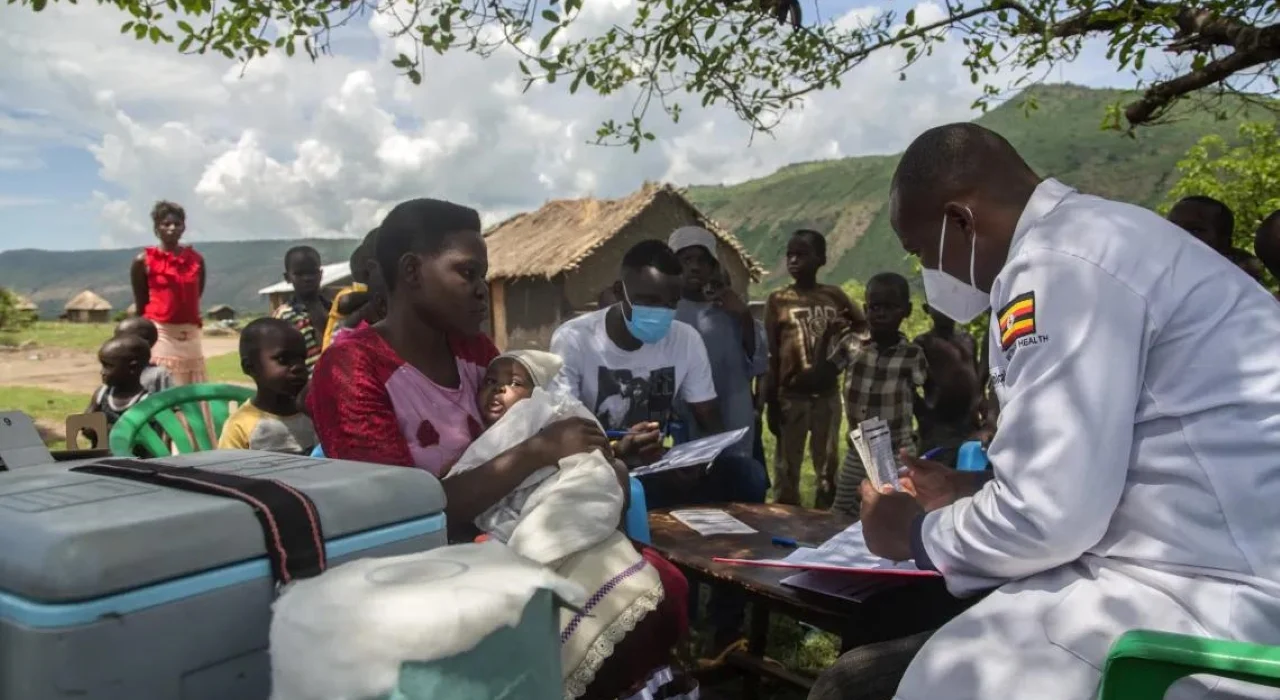
KAABONG, Uganda – Uganda’s measles-rubella vaccination drive reached one of its hardest frontiers on Monday as health worker Akol Anna Grace carried vaccine supplies into Pire, a remote community near the South Sudan border, during the final day of the national campaign.
Grace, who leads Usake Health Centre III, joined teams working across Karamoja to reach children far from fixed clinics. Her team used portable cold boxes and temporary vaccination points to protect the temperature-sensitive doses while moving through dry, sparsely connected terrain.
The latest outreach gives Uganda’s campaign a clear public health test. National coverage figures matter, but elimination efforts depend on whether teams reach children in pastoralist settlements, border communities, refugee populations and villages with limited access to routine primary care.
Ministry figures reported during the final push showed more than 5.5 million children had received measles-rubella vaccination. The campaign targets children aged nine to 59 months, including children who received earlier routine doses.
Dr Michael Baganizi, Uganda’s Immunisation Programme Manager, said, “By this morning we had vaccinated 5.5 million out of the target of 7.6 million children, representing 72 percent.”
The campaign ran from October 1 through October 5 across health facilities, temporary posts and community outreach sites. Health teams also moved into underserved areas where distance, weak road networks and population movement reduce routine immunisation coverage.
Uganda launched the drive after repeated measles outbreaks exposed immunity gaps. Health authorities recorded 66 separate outbreaks during 2025. Surveillance during 2026 also identified infections in several districts, including parts of Karamoja.
Measles spreads through respiratory droplets and aerosols. The virus moves quickly through communities with low immunity. Severe disease often brings pneumonia, dehydration, encephalitis and other complications. Young children face greater clinical risk, especially where malnutrition or weak access to treatment delays care.
Rubella usually causes milder illness in children, but infection during pregnancy creates another danger. Maternal infection early in pregnancy raises the risk of congenital rubella syndrome, which links to hearing impairment, eye disease and congenital heart defects in newborns.
Vaccination therefore protects more than the child receiving a dose. High population immunity interrupts transmission and reduces exposure for infants, pregnant women and people who face medical barriers to vaccination.
Uganda’s routine programme gives children measles-rubella doses at scheduled ages. Health officials reported first-dose coverage above 90 percent during 2025, while second-dose coverage remained far lower. The gap leaves clusters of susceptible children even when national first-dose figures appear strong.
Dr Rita Atungonza, Deputy Manager of the Immunisation Programme, linked recurrent outbreaks to weak second-dose uptake. She said persistent coverage below the 95 percent threshold leaves enough susceptible children for outbreaks to continue.
This final-day push therefore focuses on missed children rather than simple headline totals.
Kaabong shows why last-mile delivery matters. Families in some border areas travel long distances for routine services. Seasonal movement also complicates follow-up. Pastoralist households often move with livestock, while cross-border communities maintain social and economic links across Uganda and South Sudan.
A fixed clinic model does not reach every child under those conditions.
Mobile teams solve part of the access problem. Health workers carry vaccines in validated cold-chain containers, establish temporary posts and vaccinate eligible children close to homes or gathering points. Such work requires micro-planning, transport, vaccine stock control, temperature monitoring, community mobilisation and accurate recording.
Any break in those systems creates missed opportunities.
The fresh outreach in Pire shows how national immunisation policy reaches household level. A campaign succeeds only when doses leave central stores, reach district depots, move through health facilities and arrive in communities while maintaining required storage temperatures.
Cold-chain performance matters because vaccines lose potency after exposure to unsuitable temperatures. Health workers therefore monitor storage, transport time and handling throughout each outreach session.
For caregivers, the message stays practical. If your child falls within the eligible age group and local teams still operate in your area, take the child to the nearest vaccination point. Keep the vaccination record after the dose. Continue with routine immunisation appointments after the campaign because a mass drive does not replace the national childhood schedule.
Health officials also need to prepare for the period after Monday.
Campaign numbers alone will not end recurrent measles transmission. District teams need to identify missed settlements, compare doses delivered against target populations, review zero-dose clusters and strengthen routine second-dose coverage. Surveillance teams also need rapid laboratory confirmation when suspected measles cases appear.
Community trust forms another part of the response.
Ritah Atukunda, a Ugandan mother who brought two children for vaccination during the campaign launch, said, “I brought both my children because I want them to grow up healthy and protected.”
Her decision reflects the behaviour health authorities need across districts with vaccination gaps. High coverage depends on reliable services and parents who know where and when teams operate.
Uganda’s campaign also carries lessons for other African countries. Measles outbreaks often return when routine coverage slips, health systems miss mobile populations or conflict disrupts primary care. Border districts need cross-border surveillance because viruses move with people.
A country might report strong national coverage while individual districts retain large immunity gaps. Epidemiologists therefore study subnational coverage, zero-dose children, outbreak location and age distribution rather than relying on one national percentage.
The Pire outreach puts those principles into practice.
Grace and her team moved vaccine supplies toward children instead of waiting for every family to reach a clinic. Such last-mile delivery costs more in staff time and logistics, yet public health programmes lose effectiveness when geography excludes the hardest-to-reach households.
Uganda now needs a precise post-campaign review. Officials should publish final coverage by district, identify settlements with low uptake and direct routine services toward remaining gaps. The strongest result will come when emergency-style campaigns become less necessary because routine immunisation reaches children on time.
For families in Kaabong, Monday’s outreach carried a simpler meaning. A vaccine travelled across difficult terrain to reach children who live far from Uganda’s main health infrastructure.
The final mile often decides whether an outbreak grows or stops.