
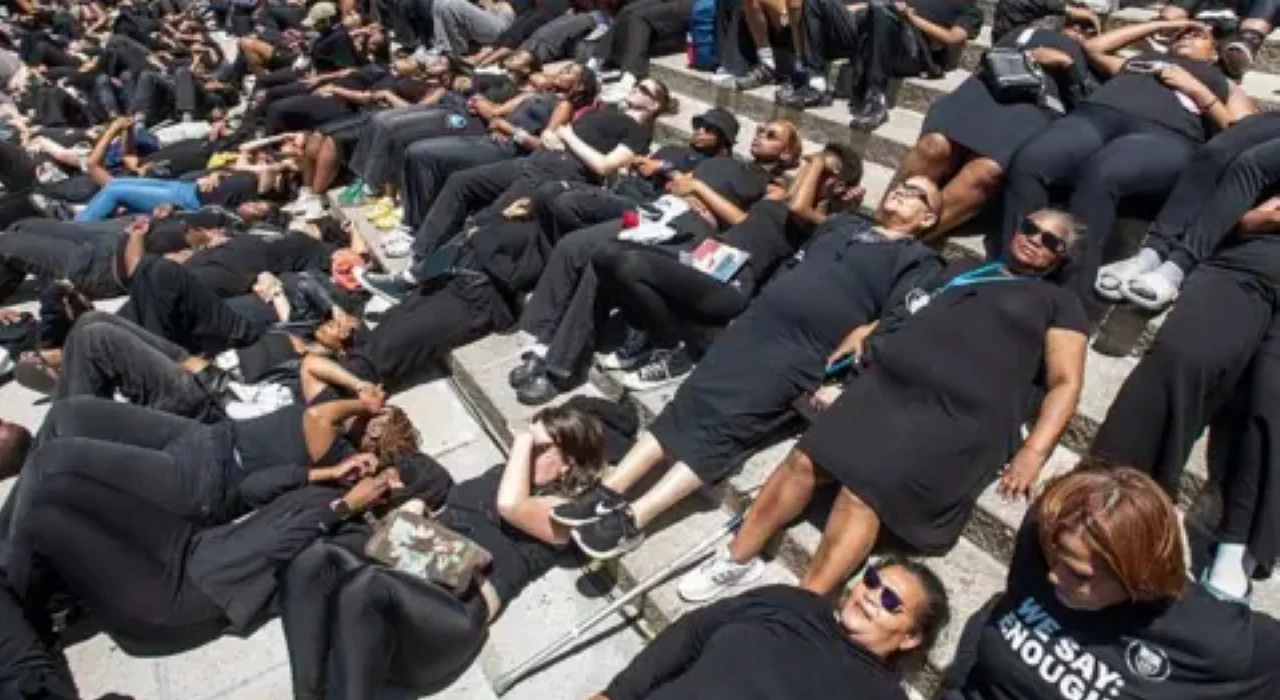
PRETORIA, South Africa – Six women are murdered every day in South Africa, according to the country’s latest police figures, exposing a national emergency that has survived government promises, public protests and repeated campaigns against gender-based violence.
The South African Police Service recorded 569 murdered women between April and June 2026. That is an average of more than six women every day. If killings continued at the same rate for a full year, the death toll would exceed 2,200.
Another 1,052 women survived attempted murders during the same three-month period. Women and children also accounted for 8,814 of the 9,201 rape victims recorded by police, representing almost 96 per cent of all reported rape victims.
However, the figures require careful explanation. The 569 victims were women murdered during the quarter, but not every case has officially been classified as femicide. Femicide generally refers to the gender-related killing of women, often by husbands, boyfriends, former partners or other men known to them.
The distinction does not make the crisis less horrifying. It shows that South Africa still struggles to identify, investigate and record gender-related killings consistently. Police also presented an unverified figure of 892 murdered women, considerably higher than the crime registrar’s verified count of 569.
The question is not whether nobody is bothered. Families, activists, community organisations and millions of ordinary South Africans are deeply disturbed. The harder question is why years of outrage have failed to produce safety—and why warning signs are repeatedly ignored until another woman is dead.
Amanda Kosani, 37, was reportedly seen with a split lip and a black eye before she was killed in August. Friends knew that she was being abused. According to police, her boyfriend later approached people at a drinking place and asked them to call an ambulance because he had injured her.
Nobody immediately checked on her.
Police spokesperson Captain Marius McCarthy said witnesses did not take the request seriously because of the couple’s history of domestic disputes and the fact that people had been drinking. Kosani was found dead the following morning in an outside room at the Newrest informal settlement in Port Alfred. Her boyfriend was arrested and charged with murder.
Her death illustrates one of the most dangerous attitudes surrounding domestic violence: the belief that abuse between partners is a private matter. Bruises become relationship problems. Screaming becomes an ordinary domestic dispute. Threats are dismissed as anger. By the time society recognises the danger, a woman may already be dead.
Kosani was not the only woman killed during South Africa’s Women’s Month. Taymin Platt, a 24-year-old traffic warden, was stabbed to death in Pretoria on August 1. Her boyfriend was arrested. A previous gender-based violence case involving Platt had reportedly been opened but was never finalised.
Josephine Tshabalala, 37, was found dead in her Soweto room with a stab wound and multiple bruises. Fifteen-year-old Amogelang Motshwaedi was killed in North West, allegedly by her boyfriend. A 17-year-old suspect was arrested.
These cases point to a terrifying reality: many South African women are not primarily endangered by strangers hiding in dark streets. The danger frequently comes from men they know, trust, love or once loved.
Development economist Nthabiseng Moleko explained that the violence often occurs inside relationships and households. But she also warned against condemning all South African men.
“This is not the majority of men,” Moleko said. “There are many men that reject violence against women and children, and it’s not a narrative where the majority of men are like this.”
South Africans are not naturally violent or murderous. Such a claim would unfairly condemn an entire population, including the women facing the violence and the men working to stop it. But South Africa is undeniably suffering from a deeply rooted culture of violence that its institutions have repeatedly failed to contain.
Researchers point to several connected factors: the country’s history of political and social violence, extreme inequality, unemployment, alcohol abuse, illegal firearms, criminal impunity and patriarchal beliefs that teach some men to treat women as possessions.
Financial hardship can increase tension, but poverty does not force a man to kill his partner. Alcohol may remove restraint, but it does not excuse brutality. The central problem is a combination of learned violence, male entitlement and a justice system that too often intervenes late.
When protection orders are poorly enforced, domestic violence cases remain unfinished and police stations turn frightened women away, abusers learn that threats have few consequences. A law that exists only on paper cannot protect a woman inside a violent home.
The South African Medical Research Council has studied femicide for more than two decades. Its research found that three women were being killed every day by intimate partners as far back as 2009, with that level remaining largely unchanged in 2017. Its later study placed South Africa’s overall femicide rate at 10.6 per 100,000 women.
In November 2025, gender-based violence and femicide were classified as a national disaster. The declaration recognised that violence against women was not merely a collection of individual crimes but a national emergency requiring coordinated government action and dedicated resources.
Yet declaring a disaster does not automatically make women safer. A declaration must be followed by properly staffed police stations, trained investigators, functioning forensic laboratories, specialised prosecutors, safe shelters, emergency accommodation and courts capable of handling cases quickly.
Acting Police Minister Firoz Cachalia acknowledged the scale of the challenge when releasing the latest crime statistics.
“Gender-based violence and femicide continues to demand urgent attention from every sector of society,” he said.
Urgent attention cannot mean another march, speech or annual campaign followed by silence. It must mean treating every threat seriously, completing investigations, prosecuting offenders and protecting women before violence becomes murder.
Communities also carry responsibility. Friends and relatives must stop advising abused women to remain in dangerous relationships merely to preserve marriages. Religious leaders must stop sending victims back to violent homes without protection. Neighbours must stop treating screams and bruises as private family business.
South Africa’s crisis should concern the entire African continent. Many countries face the same combination of domestic abuse, weak enforcement, victim-blaming and silence. South Africa’s figures are exceptionally severe, but the attitudes that feed the violence exist far beyond its borders.
Six women killed every day is not normal. It is not culture, passion, discipline or a private dispute. It is a public emergency sustained by violent offenders, institutional weakness and a society that sometimes recognises danger but responds too late.
The victims do not need another month of ceremonial praise. They need a country in which reporting abuse brings protection, breaking up with a man does not become a death sentence and a woman can enter her own home without fearing the person waiting inside.