

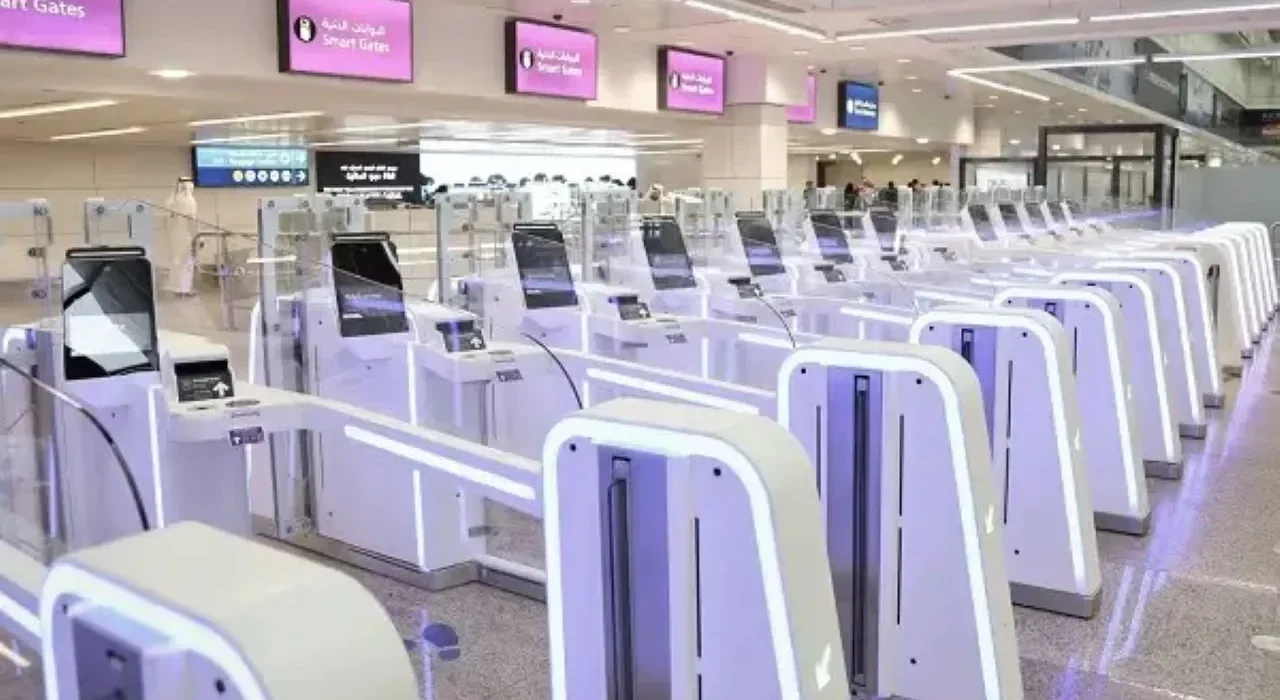
DUBAI, United Arab Emirates – Dubai is pushing airport automation into a new phase where registered travellers walk through immigration without presenting a passport, stopping at a counter or entering a conventional electronic gate.
Dubai International Airport has been testing and expanding an artificial intelligence-powered biometric corridor known as the Red Carpet. Cameras identify travellers while they walk, match facial and biometric information against immigration records and flight information, then complete border procedures within seconds.
The General Directorate of Identity and Foreigners Affairs in Dubai developed the system with Dubai Airports. Officials describe the project as part of a wider goal to remove physical barriers from passenger processing.
The experience looks radically different from conventional immigration.
Passengers enter an open corridor. Cameras and sensors capture biometric information without requiring a traveller to stop. Artificial intelligence compares the information with records already held by immigration authorities. Cleared travellers continue walking. A person flagged by the system receives additional inspection from an immigration officer.
Khaleej Times tested an early version at Terminal 3 and recorded an immigration process lasting about six seconds. Officials later reported processing times falling further as the system expanded.
Nearly 800,000 passengers used the Red Carpet service during its first year, according to figures released by Dubai authorities in May. The technology processes up to 10 travellers simultaneously instead of handling passengers individually.
Dubai already operates extensive biometric Smart Gates. Registered passengers normally approach a gate, look toward a camera and complete immigration after facial or iris verification. The Red Carpet goes further by removing the gate itself.
Dubai Airports says eligible Smart Gate passengers often pass without scanning a document, although travellers should still carry passports and boarding passes in case additional inspection becomes necessary.
The distinction matters.
Dubai has not abolished passports.
International travellers still require valid travel documents, appropriate visas and immigration eligibility. The system changes how authorities verify those documents at the airport. Passport data and biometric information already stored in official databases allow cameras to identify a registered traveller without asking for the physical booklet at every checkpoint.
First-time users still face registration requirements. Immigration authorities link passport information with photographs and biometric identifiers before repeated passport-free processing becomes possible.
Dubai sees enormous commercial value in the technology.
Dubai International ranks as the world's busiest airport for international passengers. Large passenger volumes create queues, demand for immigration officers and pressure on terminal space.
Removing physical counters allows airports to move more travellers through the same area. Faster processing also improves connection times for passengers transferring between flights.
Dubai Airports chief executive Paul Griffiths has described a wider airport strategy built around removing unnecessary stopping points. Artificial intelligence baggage scanners, biometric check-in, automated immigration and digital navigation form part of the same programme.
The efficiency argument is strong.
The privacy questions are equally serious.
A passport reveals information when a traveller chooses or receives an instruction to present it. Facial recognition operates differently. Cameras identify people at a distance, sometimes before travellers fully understand where scanning starts.
Border authorities therefore need clear rules governing collection, storage, access and deletion of biometric information.
Who holds the face template?
How long does government retain the information?
Which agencies receive access?
Do airlines receive the same biometric record?
Does law enforcement search the database for purposes unrelated to airport immigration?
What happens after a breach?
These questions grow more important because a password changes after compromise. A human face does not.
Accuracy presents another concern.
Facial recognition systems occasionally produce false matches or fail to recognise legitimate travellers. Lighting, age, facial changes and technical failures affect results. Systems trained on uneven datasets also face criticism over differing error rates across demographic groups.
Dubai says its systems automatically send suspicious or unresolved cases for human review. Such safeguards need strong independent testing.
A passenger wrongly flagged should receive a rapid route to human inspection. Immigration authorities should never treat an algorithmic mismatch as proof of deception.
Airports also need procedures for children, elderly travellers, people with disabilities and passengers whose medical or religious circumstances complicate biometric capture.
Dubai's existing Smart Gate rules already exclude some passengers from automated processing and keep conventional immigration counters available.
Employment forms another part of the debate.
Airport automation reduces repetitive document checking. Border officers once required for every lane increasingly move toward exception handling, intelligence work, security assessments and passenger assistance.
The transition will reduce demand for some traditional airport roles over time.
Governments therefore need workforce plans before automation eliminates positions faster than workers gain new skills. Immigration officers should receive training in biometric systems, cybersecurity, fraud detection, data protection and complex case assessment.
Technology should remove repetitive work rather than remove human judgment from border control.
Dubai's experiment also carries lessons for Africa.
Many African airports still rely on manual passport stamps, paper arrival forms and slow immigration queues. Travellers often spend long periods waiting after international flights despite comparatively modest passenger volumes.
African governments should study biometric processing, though copying Dubai requires more than buying cameras.
Reliable national identity databases, secure passport systems, stable electricity, strong cybersecurity and enforceable privacy laws must come first.
A weak government database connected to facial recognition creates a surveillance risk rather than a modern border.
African states also need to retain control over biometric information when foreign technology companies supply airport systems. Contracts should define data ownership, storage location, foreign access and independent security audits.
No foreign supplier should quietly gain permanent access to the biometric records of millions of African citizens.
Dubai has spent years moving toward this model. GDRFA introduced facial and iris recognition at more than 100 Smart Gates before expanding toward open corridors. Officials therefore built passport-free processing through successive stages rather than one sudden technological change.
The direction now appears clear.
Airport borders are moving away from documents passengers repeatedly present toward digital identities authorities recognise automatically.
For travellers, the result promises speed.
For governments, the result promises stronger automation and larger volumes of biometric intelligence.
For workers, the result changes airport employment.
For citizens, the central issue becomes control.
A future where your face serves as your passport sounds convenient. The same future gives border authorities an identification system operating before you reach a desk.
Dubai is showing how quickly such a system works.
The harder question concerns how societies govern the information once the camera recognises you.