
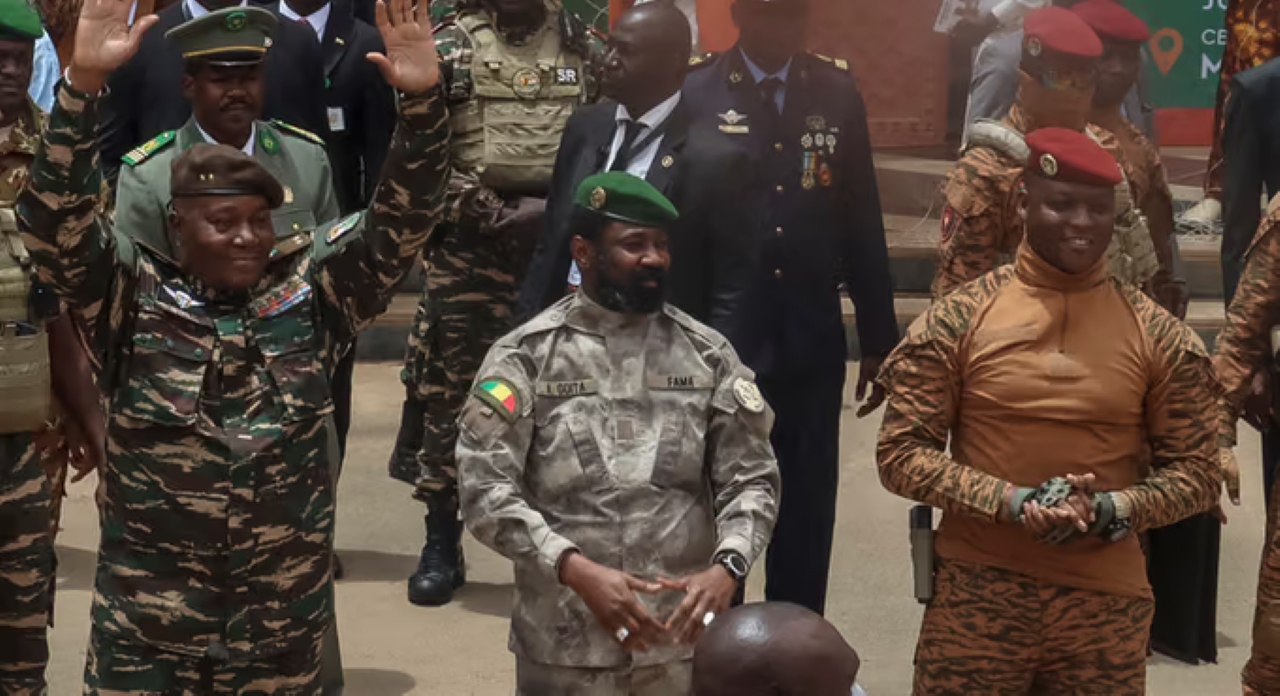
ABUJA, Nigeria – A fresh diplomatic dispute between Nigeria and the military-led Alliance of Sahel States threatens to deepen West Africa’s political fracture at the exact moment jihadist groups are exploiting porous borders, weak state control and declining regional security cooperation.
Reports circulating across West Africa say Burkina Faso, Mali and Niger protested remarks attributed to Nigerian President Bola Ahmed Tinubu which linked Nigeria’s worsening security pressures to instability across the central Sahel. The reports say the three AES governments summoned Nigeria’s diplomatic representatives and rejected any suggestion their countries should carry responsibility for Abuja’s domestic security failures.
The African Telegraph had not found an official AES communiqué confirming every detail of the reported joint summons at publication time. The wider dispute described in the reports fits an already documented pattern of increasingly tense security diplomacy between Abuja and the three Sahel governments.
Nigeria argues militant violence across Burkina Faso, Mali and Niger increasingly threatens coastal West Africa. German Foreign Minister Johann Wadephul made a similar argument during a July visit to Abuja, warning instability in the three countries increasingly affects neighbouring coastal states. Nigerian defence officials have also identified infiltration from the wider Sahel as an expanding threat.
The AES governments reject narratives which portray them primarily as exporters of instability.
Their argument deserves examination.
Burkina Faso, Mali, Niger and Nigeria face interconnected militant networks crossing borders which colonial administrations drew long before current states existed. Armed groups move weapons, fighters, fuel and intelligence across vast areas where governments struggle to maintain permanent security coverage.
Nigeria therefore has legitimate reasons to worry about developments north of its borders.
Blaming neighbours would still oversimplify Nigeria’s crisis.
Nigeria has fought Boko Haram since 2009, years before military governments seized power in Mali, Burkina Faso and Niger. Islamic State West Africa Province grew from Nigeria’s own insurgency. Bandit groups developed across northwestern Nigeria through local criminal economies, cattle rustling, kidnapping, weapons trafficking and unresolved disputes over land.
Kidnapping has also become an enormous domestic industry. Nigerian security forces rescued more than 300 abducted people in one operation last week, including victims held after attacks inside Nigeria.
Tinubu therefore faces a difficult argument.
Sahel instability creates additional danger for Nigeria.
Sahel instability did not create every Nigerian security failure.
The AES states face the same distinction.
Military governments in Bamako, Ouagadougou and Niamey regularly blame outside powers, neighbouring governments and foreign interference for insecurity. Some accusations carry evidence. Others remain unsupported.
At an April security forum in Senegal, senior officials from Mali and Niger accused neighbouring countries and foreign interests of assisting terrorist groups. Niger again accused France of supporting terrorism, while Mali alleged foreign support for militant organisations. Reuters reported those allegations while noting major claims lacked independently presented evidence.
Every government therefore needs to resist a convenient political habit.
When terrorists attack, blame someone across the border.
When soldiers die, blame foreign intelligence.
When villages fall, blame regional rivals.
Citizens deserve better explanations.
The conflict also exposes damage caused by the political separation between ECOWAS and the AES.
Burkina Faso, Mali and Niger formally left ECOWAS in January 2025 after military coups triggered sanctions and diplomatic confrontation. Their governments accused ECOWAS of abandoning regional sovereignty and serving foreign interests. They established the Alliance of Sahel States and strengthened security relations with Russia.
Those ties continue growing.
Russia and the AES agreed in July to deepen military cooperation as jihadist attacks persisted across the region. The three states also accelerated work on a unified AES military force designed for collective operations. Burkina Faso’s presidency said in July the force should serve as the main instrument in their shared fight against terrorism.
Nigeria stayed with ECOWAS.
Politics then created a security wall where geography demands cooperation.
Nigeria shares a long frontier with Niger. Militant networks operating around the Lake Chad basin do not recognise membership in ECOWAS or the AES. Smugglers do not stop at political disagreements. Armed groups benefit when neighbouring intelligence agencies stop speaking.
Abuja appears to understand the danger.
Nigeria announced plans in July for deeper security cooperation involving Benin and Niger. Defence Minister Christopher Musa said political disagreements exist, but military cooperation needs to move beyond them.
“Politically, there is always that issue, but militarily, we have been able to go beyond that,” Musa said when discussing relations with Niger.
Nigeria and Mali also agreed in July to revive a joint commission covering security, trade, migration, energy and other bilateral issues. Foreign Minister Bianca Odumegwu-Ojukwu said Mali’s departure from ECOWAS should not destroy relations between both countries.
Such diplomacy offers the sensible route forward.
Tinubu should avoid language which allows Sahel governments to claim Nigeria wants to make them responsible for problems Abuja needs to solve at home.
AES leaders should equally avoid pretending regional militant expansion has no consequences for Nigeria, Benin, Togo, Ghana and Côte d’Ivoire.
Both positions fail the geography test.
The Sahel conflict is moving south.
Nigeria’s crisis is moving across internal regions.
Militant organisations learn from each other, exploit ungoverned spaces and search for weak border zones. Political fragmentation gives them additional room.
The region therefore faces a choice.
ECOWAS and AES governments either establish practical counterterrorism cooperation despite disagreements over coups, Russia, democracy and Western partnerships, or armed groups will continue exploiting their divisions.
Nigeria’s own February statement at a regional security conference acknowledged the threat crosses borders. Abuja called for an “all-inclusive” counterterrorism strategy and said insecurity across West Africa required collective action.
That principle should guide Tinubu now.
Security cooperation does not require political friendship.
Nigeria does not need to endorse military rule in Burkina Faso, Mali or Niger.
The AES governments do not need to rejoin ECOWAS before intelligence officers exchange information about terrorists crossing shared borders.
Presidents and generals should argue about politics in conference rooms.
Security services should exchange coordinates, names, weapons routes and militant movements.
West Africa has already spent too much time deciding who deserves blame.
Nigeria needs to defeat threats inside Nigeria.
Burkina Faso needs to regain territory from armed groups.
Mali needs to protect civilians and restore state authority.
Niger needs to secure its borders.
Each country also needs its neighbours.
Tinubu and the AES leaders therefore face a larger responsibility than winning the latest diplomatic argument.
Terrorists gain nothing from ECOWAS unity.
They gain everything from the West African division.