

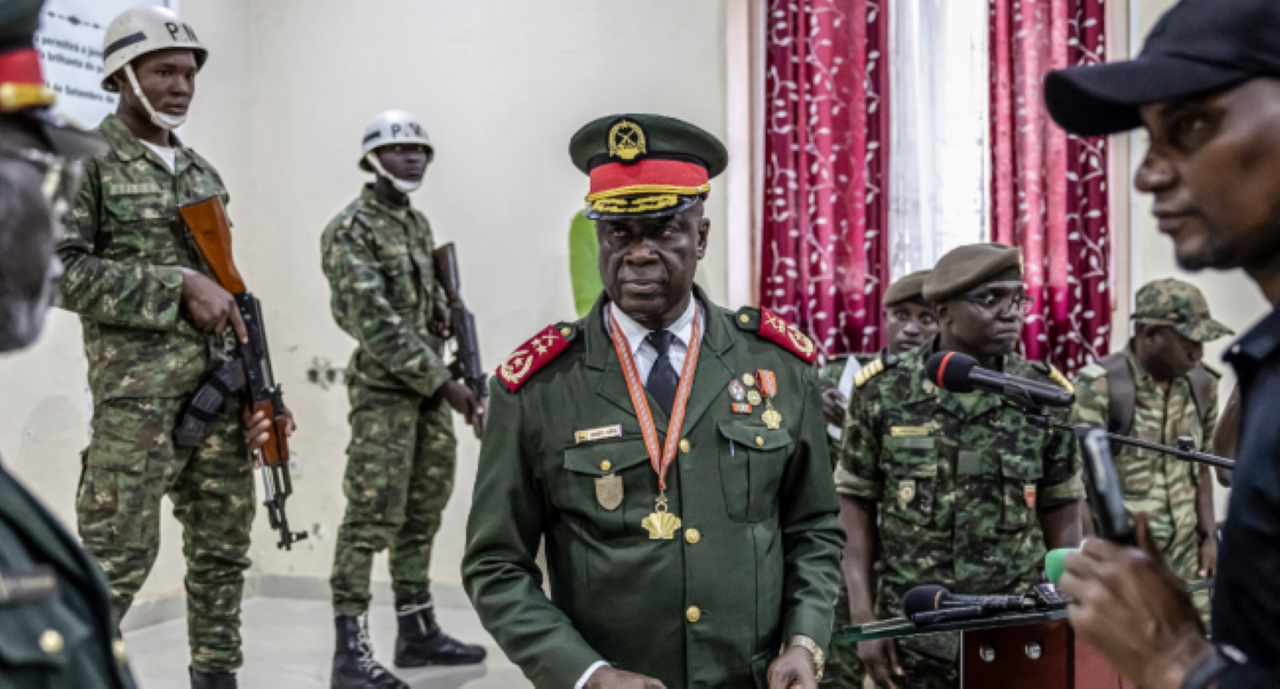
BISSAU, Guinea-Bissau – Guinea-Bissau’s military leadership has barred former President Umaro Sissoco Embaló from returning home, raising fresh questions over political participation before presidential and legislative elections scheduled for December 6.
The decision emerged Friday, less than 48 hours before Embaló’s planned arrival from exile in Morocco. Military authorities cited national security, public order and risks to social stability. Reuters published confirmation at 10:12 UTC on Friday, placing the development inside today’s political news cycle.
Embaló governed the Portuguese-speaking West African country from 2020 until military officers removed him from power in November 2025. He announced earlier this week that he intended to return on October 4 and seek the presidency in December.
Military leaders rejected those plans after reviewing the political and security situation. The High Command said conditions required for his safe return did not exist at present. Authorities also kept restrictions on political demonstrations and gatherings in place.
The confrontation creates a direct test for Guinea-Bissau’s promised transition back to civilian rule.
Senior officers seized power on November 26, 2025, one day before electoral officials were expected to announce results from presidential and legislative voting. Both Embaló and opposition candidate Fernando Dias da Costa had claimed victory. The military suspended the electoral process and later installed Major-General Horta Inta-a, also reported as Horta N’Tam, as transitional president.
The transitional authorities later set December 6, 2026, for presidential and legislative elections.
Embaló insists he wants to participate.
“I hope the judicial authorities will review our candidacy with impartiality and independence, and in accordance with the principles of justice,” Embaló said after military leaders announced the restriction.
His statement places part of the dispute before judicial institutions rather than military authorities alone. Electoral officials and courts now face scrutiny over eligibility rules introduced during the transition.
Guinea-Bissau approved a new constitution through an August referendum. The revised charter expanded presidential authority and changed electoral rules. One provision requires presidential candidates to have lived continuously inside Guinea-Bissau during the five years preceding an election. Embaló has lived abroad since his removal from office, creating an immediate legal question around his eligibility. Reuters reported uncertainty over how officials would apply the residency requirement to his proposed candidacy.
The restriction also contrasts with comments transitional President Horta N’Tam made last week.
“Every Guinean is free to return to their country if they have nothing to be ashamed of,” N’Tam told a radio journalist.
Military authorities now argue current security conditions require a different approach. Supporters of Embaló had discussed plans for a reception on Sunday, while restrictions on demonstrations remain active.
The government faces two separate questions.
The first concerns security. Authorities carry responsibility for public order, protection of political figures and prevention of violence. Guinea-Bissau has experienced repeated military interventions since independence from Portugal in 1974. Political competition has often intersected with disputes inside the armed forces.
The second concerns electoral access. An election designed to restore civilian government requires clear eligibility rules, transparent judicial review and consistent treatment of political competitors. Embaló’s previous office does not automatically settle his eligibility. Equally, a security restriction does not by itself determine whether electoral authorities should accept or reject his nomination.
Those distinctions matter as December approaches.
The military transitional charter adopted after the 2025 takeover bars the transitional president and prime minister from contesting the next elections. Authorities presented the provision as a safeguard against transitional leaders converting military control into electoral advantage. The wider credibility of the process now depends on how officials handle candidates outside the transitional administration.
Regional institutions have already followed Guinea-Bissau’s political transition closely.
ECOWAS has pressed authorities over political detentions, inclusion and constitutional governance. In July, the regional bloc called for the unconditional release of detained political figures, including opposition leader Domingos Simões Pereira. ECOWAS also urged political dialogue around restoration of constitutional government.
Guinea-Bissau’s political history adds weight to those concerns.
Military interventions have repeatedly interrupted civilian rule. State institutions have also faced pressure from organised crime networks using the country’s Atlantic coastline and islands as transit points for cocaine shipments toward Europe. Weak institutions, political instability and security-sector influence have complicated governance across successive administrations.
The December vote therefore carries significance beyond a contest between individual politicians.
Voters need clarity on who qualifies to stand, which constitutional provisions govern eligibility, how campaign activity will operate and what security restrictions apply to political gatherings. Political parties also need predictable rules before candidate registration reaches its final stages.
Embaló’s proposed return creates an immediate deadline.
He planned to arrive Sunday. Military authorities now say he should stay outside the country because security conditions do not support his return. His supporters still expect judicial institutions to examine his political rights and proposed candidacy.
The new residency requirement adds another layer. A court or electoral authority will need to interpret the provision if Embaló formally seeks registration. Such a ruling would carry consequences for other politicians who spent extended periods abroad during the transition.
Authorities also face public-order concerns surrounding any attempted return. Supporters organising a reception risk colliding with restrictions on demonstrations and gatherings. Security forces therefore face pressure to enforce existing orders without turning a political dispute into violence.
For African regional bodies, Guinea-Bissau presents another test of post-coup transition policy.
The central question concerns whether the December 6 elections produce a credible transfer from military administration to civilian institutions. Election dates alone do not settle such a transition. Candidate access, independent administration, judicial review, media freedom, campaigning conditions and acceptance of verified results all shape electoral legitimacy.
Friday’s decision places Embaló at the centre of those questions.
The military says security concerns justify blocking his immediate return. Embaló says judicial authorities should assess his candidacy through impartial legal procedures. Those positions now move toward a confrontation involving security authority, constitutional interpretation and electoral administration.
Guinea-Bissau has two months before the planned vote.
The handling of Embaló’s return, his proposed candidacy and political activity around the election will provide an early measure of how the transition authorities intend to manage competition before December 6.