
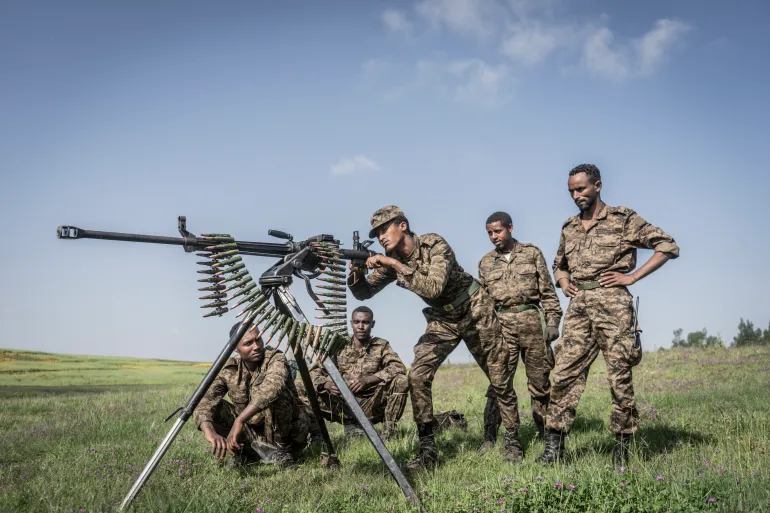
MEKELLE, Ethiopia – Ethiopian federal forces advanced to within striking distance of Mekelle on Friday as renewed fighting in Tigray pushed the country deeper into its most serious security crisis since the end of the 2020 to 2022 civil war.
Residents reported federal troops and allied militia within about 30 kilometres of the Tigrayan capital. Banks and shops shut across Mekelle as residents prepared for further fighting. Government-aligned forces have moved north after retaking territory from a rebel alliance led by the Tigray People’s Liberation Front.
The fresh advance marks a rapid change in battlefield control. Federal forces and allied units captured territory around 75 kilometres south of Mekelle before pushing closer toward the regional capital. Tigrayan forces had earlier made gains across parts of Tigray, Afar and Amhara after launching a new offensive last week.
TPLF chairman Debretsion Gebremichael acknowledged federal gains but vowed to respond.
“We should ensure that Tigray is their graveyard, not their playground,” Debretsion said in a statement on Thursday.
His language signals a hardening military position as both sides prepare for the next phase of fighting. A separate statement attributed to Debretsion described plans for mobile warfare rather than fixed defensive positions.
“Our war will not be one in which we sit in one place and fight. It will be a mobile war,” he said.
The fighting now threatens far more than Mekelle.
Ethiopia and Eritrea have severed diplomatic relations after Addis Ababa accused Eritrea of supporting the TPLF-led alliance. Eritrea denies supporting the rebels. Ethiopia closed its embassy in Asmara and ordered 10 Eritrean diplomats to leave within 48 hours. Eritrea responded by ending diplomatic relations with Ethiopia.
The break represents a dramatic reversal between two governments which fought on the same side during the previous Tigray war.
Eritrean troops supported Ethiopian federal forces against the TPLF between 2020 and 2022. Relations deteriorated after the Pretoria peace agreement ended large-scale fighting without Eritrean participation in the settlement.
Tensions later grew around Ethiopia’s push for secure access to the Red Sea. Prime Minister Abiy Ahmed has repeatedly described sea access as important for Ethiopia’s economy and national security. Eritrean officials have expressed concern over possible Ethiopian ambitions toward Assab, a Red Sea port inside Eritrea. Abiy has said Ethiopia seeks maritime access through peaceful negotiations.
The crisis also involves Egypt.
Ethiopia expelled an Egyptian diplomat on Thursday. Cairo responded by expelling an Ethiopian embassy counsellor. Ethiopia has accused Egypt, Eritrea and Sudan of backing the rebel alliance. All three governments deny the allegation.
Relations between Egypt and Ethiopia have remained strained over the Grand Ethiopian Renaissance Dam on the Blue Nile. Egypt views Nile water security as a national priority. Ethiopia argues the dam supports electricity generation and development.
Those disputes now sit beside an active war in northern Ethiopia.
The African Union urged Ethiopia, Eritrea and Egypt to exercise “maximum restraint” and avoid actions or statements which would intensify regional tensions. The AU also called for diplomatic engagement and peaceful dialogue.
AU Commission Chairperson Mahmoud Ali Youssouf had earlier called for direct talks between Ethiopia and Tigrayan leaders under the Pretoria framework. He also asked neighbouring states to avoid actions likely to deepen the conflict.
The military situation carries additional risk after explosions shook Addis Ababa this week.
A source linked to the opposition alliance described the blasts as drone attacks targeting Ethiopian National Defence Force facilities and other locations. Independent verification has not established the cause of the explosions. Ethiopian authorities also restricted drone flights around the capital.
Any confirmed rebel drone strike on Addis Ababa would mark a major expansion of the battlefield. Mekelle lies hundreds of kilometres north of the federal capital. Long-range strike capability would force Ethiopian security planners to defend strategic installations far beyond the northern front.
Civilian pressure has already grown.
Restricted transport, closed businesses, fuel shortages and disrupted banking services have affected daily life in Tigray. Humanitarian groups have reported rising casualties and displacement since fighting resumed. Hospitals in the region have received wounded civilians as artillery and other weapons hit contested areas.
The security crisis revives memories of Ethiopia’s previous war.
Federal forces and the TPLF fought from November 2020 until November 2022. The conflict killed hundreds of thousands of people through combat, hunger and disease, according to widely cited estimates. Millions faced displacement and humanitarian shortages.
The African Union brokered the Pretoria agreement in November 2022. The deal halted the main war and created a framework for disarmament, restoration of federal authority, humanitarian access and political negotiations.
Several provisions later faced delays or disputes.
Questions around territorial control, displaced communities, security arrangements and political authority continued after the agreement. Tigrayan leaders accused federal authorities of failing to complete parts of the deal. Federal officials accused TPLF leaders of breaching security commitments.
The present fighting now places those unresolved disputes under military pressure.
For Ethiopia’s economy, another prolonged war would carry serious costs. The country needs foreign investment, export growth, foreign currency inflows and infrastructure financing. Armed conflict raises insurance costs, disrupts domestic trade and damages investor confidence.
Northern Ethiopia also sits close to strategic transport routes connecting the Horn of Africa with the Red Sea.
Regional escalation involving Eritrea would widen military demands on both governments. Sudan already faces a prolonged internal war. Egypt and Ethiopia continue their diplomatic dispute over Nile waters. Armed confrontation across several borders would place more pressure on humanitarian agencies and regional institutions.
Mekelle now represents the immediate military focus.
Residents face the prospect of federal forces approaching the city while Tigrayan commanders promise resistance. The next battlefield movements will determine whether combat reaches the regional capital or whether diplomacy creates space for de-escalation.
For civilians, the priority remains straightforward. They need functioning hospitals, food supplies, fuel, banking services, communications and safe transport.
For leaders in Addis Ababa, Mekelle, Asmara and neighbouring capitals, the decisions taken during the coming days will shape whether northern Ethiopia enters another prolonged war or returns to negotiation.