
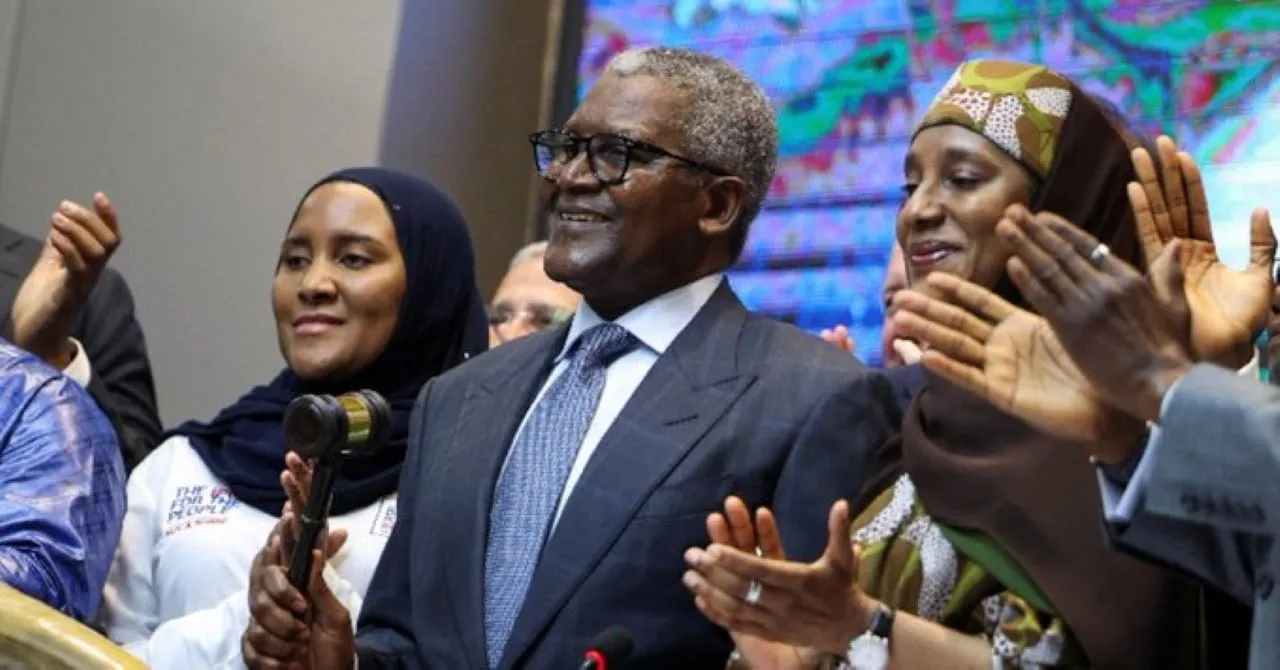
LAGOS, Nigeria – Africa’s richest man, Aliko Dangote, has launched the continent’s largest initial public offering, placing part of his giant Nigerian oil refinery before public investors in a deal worth 2.15 trillion naira, about US$1.6 billion. The offer puts one of Africa’s largest industrial assets onto the Nigerian Exchange and gives ordinary investors direct exposure to a refinery which has changed Nigeria’s fuel trade since production started in 2024. The sale covers 4.1 billion shares priced at 525 naira each. Subscription opened on September 14 and closes on October 13. If demand exceeds the base offer and regulators approve extra shares, proceeds might rise toward US$2.1 billion.
Dangote called the offering “for the people” and said he wants wider ownership of the refinery. Retail participation starts at only 10 shares, costing 5,250 naira. Digital investment platforms and mobile channels give Nigerian residents and members of the diaspora a low entry point into a business once controlled almost entirely through Dangote’s private corporate structure. The approach carries significance across Africa, where many citizens watch major mines, banks, telecom companies and energy projects generate wealth without direct public ownership. Dangote still retains overwhelming control after the offer, yet the IPO creates a public market price for an industrial asset valued near US$47 billion.
The numbers behind the refinery explain the attention. Dangote Group spent about US$20 billion building the complex near Lagos over roughly a decade. The plant processes around 700,000 barrels of crude each day and now supplies most gasoline produced inside Nigeria. Management plans to double processing capacity to 1.4 million barrels daily by 2029. Such an expansion would place the Lagos complex among the largest refining operations globally. The company also wants more petrochemical production, larger storage networks across Africa and further industrial investment, including a proposed refinery in Kenya. IPO proceeds form one part of a broader financing programme for those ambitions.
The refinery has also moved from heavy start-up costs into strong earnings. According to offer documents reviewed by Reuters, the business recorded first-half 2026 revenue above US$13 billion and net profit of US$1.82 billion. The figure marks a major reversal from a US$476 million loss for the whole of 2025. Middle East supply disruption has helped refining margins and increased demand for Dangote jet fuel in African and European markets. A July private placement raised US$2.5 billion and drew demand several times above the available allocation, giving management confidence before the retail offer.
Nigeria’s stock market now faces a transformation of its own. Before the IPO, Nigerian listed equities carried a combined market value around 157 trillion naira after recent trading losses. Analysts estimate the refinery’s eventual listing value near 65 trillion naira. On an enlarged exchange, one company would therefore represent close to three tenths of total equity value. Such concentration brings prestige and risk. The listing raises the global profile of Lagos as a capital market centre, yet major price swings in Dangote Refinery shares would also carry heavy influence over Nigerian market indices and investment portfolios.
The rush has already affected trading behaviour. Nigerian market reports linked part of a recent sell-off to investors raising cash before the refinery offer. Market capitalisation lost trillions of naira across several sessions ahead of the subscription opening. Retail enthusiasm also pressured some digital investment platforms when the offer started. Such demand shows the strength of the Dangote name, but a famous founder does not remove investment risk. Investors still need to study valuation, debt, crude costs, margins, expansion spending and governance before committing savings.
Valuation sits at the centre of the debate. The offer price places the refinery near US$47 billion, more than twice its approximate construction cost. Some Nigerian research houses have produced even higher estimates, while other investors question whether future earnings support the offer price. One Lagos investor told Reuters he regarded the company as overvalued if expansion faces delays. Refining profits also move with crude prices, product demand and global supply conditions. Strong earnings during a period of Middle East disruption offer no permanent guarantee. Public ownership now forces Dangote management to defend performance quarter after quarter before outside shareholders.
Crude supply presents another test. Nigeria ranks among Africa’s largest oil producers, yet Dangote has imported part of its feedstock because local crude pricing and supply arrangements created commercial difficulties. Reuters reported imported crude accounted for roughly 30 to 40 percent of refinery supply during parts of the year. Domestic crude carries international benchmark pricing, while Nigerian producers also have export commitments and oil-backed obligations. Expansion toward 1.4 million barrels daily will require far greater feedstock volumes. Cheap, reliable crude supply therefore matters as much as engineering capacity.
For Africa, the deeper story reaches beyond one billionaire. The continent exports huge quantities of crude oil, copper, cobalt, lithium, cocoa and other raw products, then spends foreign currency importing fuel, machinery, chemicals and finished goods. Dangote has built his fortune around a different model. His businesses target import substitution, local production and regional exports across cement, sugar, fertiliser and energy. Nigeria once imported large volumes of cement. Dangote Cement later helped turn the country into a major producer and exporter. The refinery applies the same industrial logic to petroleum.
African governments should study the financing model as closely as the refinery. Pension funds, households, institutions and diaspora investors hold enormous pools of African capital. Too much money leaves the continent or sits in short-term assets while governments seek expensive foreign loans for infrastructure. Deep local capital markets offer another route. A successful Dangote listing would show how large industrial projects might attract domestic ownership, spread investment returns and reduce dependence on overseas financiers.
Success still requires strong regulation. Nigeria’s Securities and Exchange Commission and the Nigerian Exchange now carry responsibility for disclosure, minority shareholder protection, governance standards and fair trading. Retail investors deserve full financial information, not patriotic marketing. A refinery of national importance must face the same scrutiny expected from any listed company. Public participation should mean real shareholder rights, transparent accounts and disciplined management. Dangote’s official IPO information also warns investors about share-price risk and directs prospective buyers toward the prospectus and approved subscription channels.
Dangote’s IPO therefore marks more than a record share sale. Africa has spent decades asking who will finance industrialisation at the scale required for hundreds of millions of people seeking jobs and higher incomes. Lagos now offers one answer. Build large productive assets, prove commercial demand, then bring African investors into ownership.
The refinery still faces crude supply risk, expansion risk, valuation pressure and volatile energy markets. Yet Monday’s offer places a serious African industrial company before the public at a scale the continent has never seen. If the listing succeeds and management delivers on expansion, Africa’s biggest IPO would become a reference point for how African capital finances African industry.