

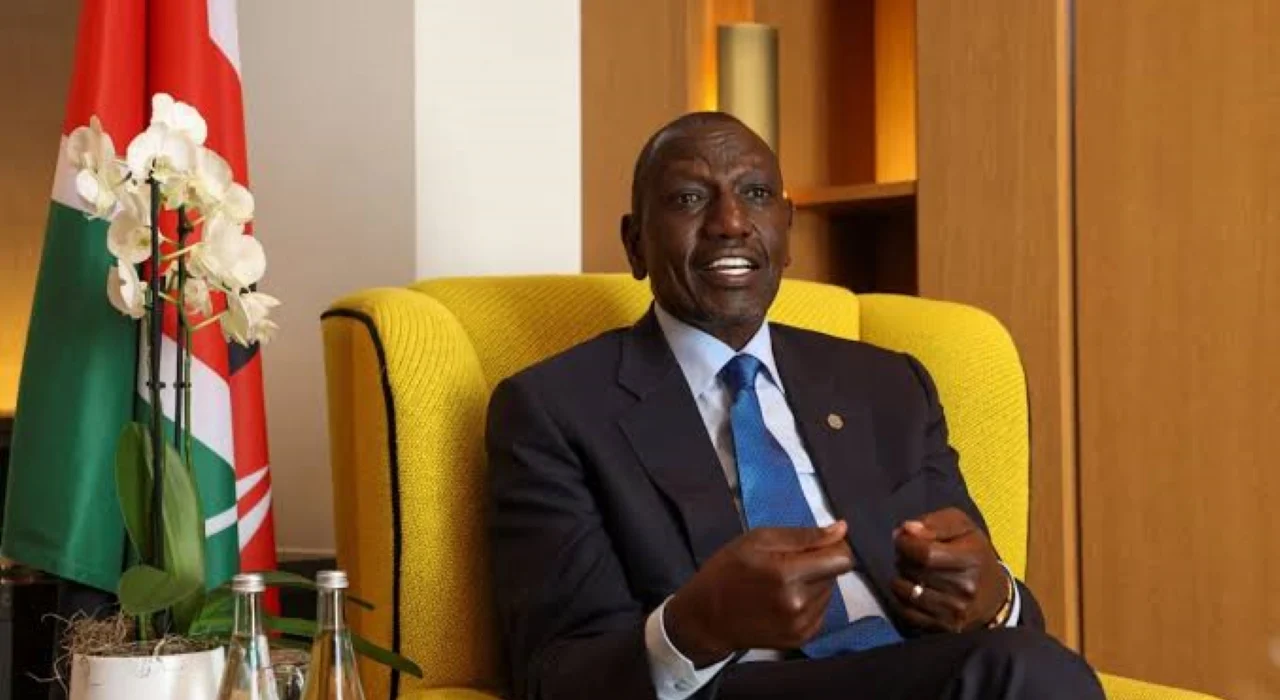
NAIROBI, Kenya – President William Ruto has ordered a nationwide crackdown on foreigners operating small retail shops and hawking businesses, opening a politically sensitive debate over unemployment, immigration and Kenya’s commitment to African integration.
Speaking during a meeting with micro, small and medium-sized enterprise traders at State House on Wednesday, Ruto directed government authorities to begin closing affected businesses from Monday, September 7.
The President said foreign investors should bring capital, technology and employment into Kenya instead of competing directly with citizens in small-scale retail activities.
“We have a Bill in Parliament on Trade. In that bill, the Local Content Bill, 2025, we have proposed that there should be businesses that foreigners should not do here in Kenya, by law,” Ruto said.
“It cannot be that a person comes from China or elsewhere to be a hawker or open a small shop.”
He then directed government officials to move against the businesses before Parliament completes its consideration of the proposed legislation.
“From next week, all traders doing those small businesses should close them,” Ruto declared.
The directive follows complaints from Kenyan traders who argue that foreign nationals are increasingly operating businesses traditionally dominated by citizens. Concerns have particularly focused on foreign traders importing goods and then selling them directly to consumers instead of supplying Kenyan wholesalers and retailers.
Ruto specifically referred to Chinese nationals selling products such as duvets and other merchandise. However, the order applies broadly to foreigners, creating the possibility that traders from neighbouring African countries could also be affected.
Kenya hosts businesspeople and workers from Uganda, Tanzania, Rwanda, Burundi, Ethiopia, Somalia, South Sudan and the Democratic Republic of Congo. Many operate small shops, restaurants, salons, repair businesses and market stalls.
The political danger is that a campaign presented as protection for Kenyan traders could quickly develop into a wider anti-foreigner operation targeting vulnerable Africans who have little political influence or access to legal representation.
The timing of the directive gives it a clear political dimension. Only days earlier, hundreds of Kenyan traders closed their businesses and protested against an increase in customs charges on consolidated imported cargo.
Police used tear gas to disperse demonstrators in Nairobi as traders complained that the revised customs system would increase their costs and threaten small businesses. The Kenya Revenue Authority had raised the minimum reference value for a consolidated 40-foot container from KSh2.5 million to KSh3.2 million.
During Wednesday’s meeting, Ruto directed that containers carrying ordinary goods should be assessed at a lower benchmark of KSh2 million, while consignments containing high-value merchandise would be assessed separately.
The foreign-trader crackdown therefore appears to be part of a broader political effort to calm an increasingly frustrated small-business constituency. Traders are struggling with taxes, import costs, expensive credit, weak consumer spending and rising operating expenses.
However, foreign hawkers and small shopkeepers did not create those economic conditions.
Closing their businesses may provide a visible demonstration that the government is responding to Kenyan traders, but it will not resolve the structural causes of unemployment or the difficulties confronting the informal economy.
Kenya’s government must still address expensive electricity, limited access to affordable financing, unpredictable tax policies, weak manufacturing growth, corruption and the shortage of formal employment opportunities.
The directive also raises legal questions because the Local Content Bill, 2025, cited by the President remains before Parliament. Its provisions have not yet completed the legislative process or become enforceable law.
Administrative action taken before Parliament approves the restrictions could face challenges over due process, permit conditions and the lawful rights of foreign nationals already registered to conduct business in Kenya.
Government authorities have the power to enforce immigration, licensing, taxation, health and competition laws. Foreign nationals operating without valid documentation can lawfully be required to regularise their status or face established legal procedures.
But a political order cannot replace individual verification.
Officials will need to determine whether each trader possesses a valid immigration status, work or investor permit, county licence and tax registration. Enforcement based merely on nationality, appearance, language or accent would expose lawful residents to harassment and arbitrary detention.
The decision may also create diplomatic tension within the East African Community. The regional bloc’s Common Market is built around the movement of people, labour, goods, services and capital between partner states.
Regional integration does not give every citizen an unrestricted right to operate any business without permits. Nevertheless, member countries are expected to reduce discriminatory barriers and create predictable conditions for East Africans living and working across borders.
In May, Ruto and Tanzanian leaders pledged to eliminate barriers to cross-border business while targeting KSh130 billion in additional trade and KSh65 billion in new investment over three years.
A broad crackdown on foreign traders could undermine that commitment and invite retaliatory restrictions against Kenyans operating businesses elsewhere in East Africa.
Kenya has previously objected when its citizens faced restrictions in neighbouring countries. Its government will therefore need to distinguish carefully between large foreign companies bypassing local supply chains, undocumented traders violating immigration rules and East African citizens operating lawful businesses.
Treating all three groups as one political problem would damage Kenya’s position as a regional commercial centre.
The directive also carries a warning for the wider continent. South Africa has repeatedly experienced anti-immigrant mobilisation in which unemployment, inequality and poor public services were blamed on African migrants.
Political hostility was followed by forced business closures, intimidation, looting and deadly attacks. Migrants from Zimbabwe, Mozambique, Nigeria, Malawi, Somalia, Ethiopia and other African countries became targets of anger rooted in much deeper economic failures.
Kenya now faces a choice over how it manages similar frustrations.
A lawful response would involve registration, documentation and dialogue. The government could provide foreign traders with a defined period to confirm their immigration status, obtain the required business permits and register with county and tax authorities.
Those found operating illegally could then be handled through established legal procedures, including written notices, hearings and rights of appeal. East African governments could also negotiate common rules for small cross-border traders instead of repeatedly imposing retaliatory restrictions.
At the same time, Kenyan traders require meaningful government assistance. Affordable credit, serviced market spaces, fair customs procedures, reliable electricity and stronger action against counterfeit goods would offer greater protection than simply removing foreign competitors.
Ruto’s intervention may win political approval from sections of the small-business community, but it could also encourage the belief that foreigners are responsible for Kenya’s economic problems.
That message would be dangerous in a country that presents itself as a diplomatic, financial and commercial gateway to Africa.
Kenya can protect local enterprises while enforcing immigration and business laws. What it must avoid is allowing economic frustration to become a political campaign against fellow Africans.