
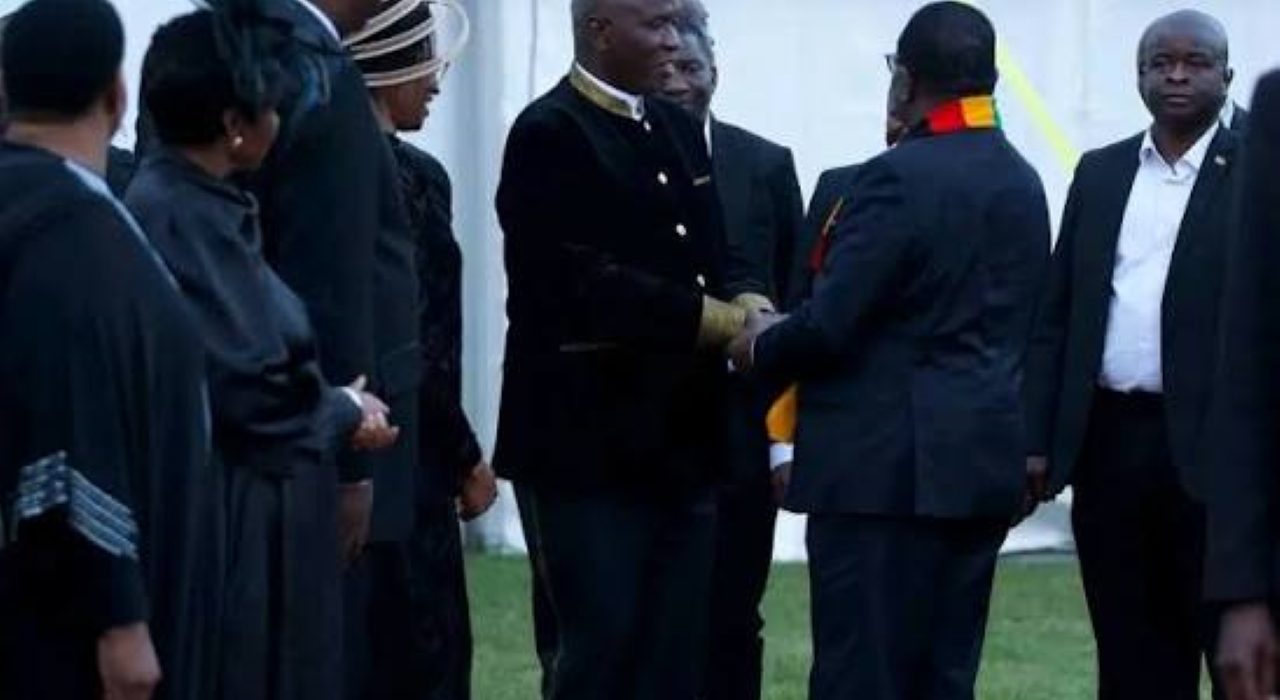
HARARE, Zimbabwe – For more than four decades, liberation credentials carried immense political weight inside Zimbabwe’s ruling system. Senior veterans, former commanders and figures shaped by the independence struggle dominated ZANU-PF, the security establishment and presidential succession. A lavish wedding at Harare’s Polo Club during the final week of 05/2026 offered a different picture of power.
The marriage of Taonanyasha John Tagwirei, son of businessman Kudakwashe Tagwirei, and Poneso Tinomuda Janda drew President Emmerson Mnangagwa, senior officials, politically connected entrepreneurs and religious figures. American R&B group Boyz II Men performed. Local reports placed the value of announced gifts at more than US$20 million, although several individual valuations came from social media and remain independently unverified.
The guest list mattered more than the entertainment.
Vice President Constantino Chiwenga, former army commander and leading figure in the 2017 military operation which removed Robert Mugabe, was absent. Local reports linked his absence to deepening succession tensions involving Tagwirei. Neither Chiwenga nor Tagwirei publicly confirmed those accounts.
The contrast captured a wider transition inside Zimbabwean politics. Liberation history once worked as the main currency of authority. Money, state contracts, private capital and proximity to the presidency now carry growing political weight.
Tagwirei represents the shift. ZANU-PF formally confirmed him as a Central Committee member after months of internal resistance. Party spokesman Christopher Mutsvangwa later praised the admission of Tagwirei and presidential adviser Paul Tungwarara as an “injection of new blood” involving younger business figures.
Such language would have sounded unusual during earlier ZANU-PF eras. Seniority once flowed through liberation history, party service, military rank and revolutionary credentials. Today, wealthy businessmen enter the same structures after building fortunes around sectors heavily shaped by state policy.
Tagwirei has interests across fuel, mining, agriculture and other sectors. The United States Treasury keeps him under Global Magnitsky sanctions. Treasury accuses him of using relationships with senior officials to obtain state contracts, preferred access to foreign currency and economic advantages. Tagwirei and Zimbabwean authorities have rejected Western sanctions and related political pressure.
US Treasury officials wrote in 2020: “Tagwirei and other Zimbabwean elites have derailed economic development and harmed the Zimbabwean people through corruption.”
The political significance reaches beyond one businessman.
Zimbabwe’s old power structure relied heavily on men who fought, organised or commanded during the liberation struggle. Mugabe led the country from independence in 1980 until the military removed him in 2017. Mnangagwa came from the same liberation generation. Chiwenga rose through the armed forces and led the operation which installed Mnangagwa. War veterans repeatedly served as an organised political constituency able to pressure presidents.
Their influence has weakened.
In 2025, war veterans openly challenged Mnangagwa over corruption, governance and efforts to prolong his presidency. Planned demonstrations triggered heavy police deployment. In 2026, six veterans also challenged constitutional changes in court.
Retired generals later met Mnangagwa over Constitutional Amendment Bill Number 3. Reuters reported the veterans and former officials opposed the proposal. Mnangagwa reportedly told the group, “whoever wins, wins.” Parliament approved the changes, and Mnangagwa signed them into law on July 7, extending his tenure from 2028 to 2030.
The outcome sends a hard message.
Liberation credentials still command respect inside ZANU-PF, yet they no longer guarantee veto power. War veterans opposed the extension. Retired military figures objected. The constitutional project still passed.
At the same time, business figures close to Mnangagwa have moved deeper into party structures, presidential programmes and public political activity. ZANU-PF itself describes the arrival of Tagwirei and Tungwarara as part of an effort to introduce younger business leadership into senior party structures.
The wedding therefore became politically useful evidence, even without proving any succession arrangement.
Around the tables sat people whose influence comes from money, contracts, mining, fuel, construction, farming, finance and access. The event displayed a ruling network increasingly defined by wealth alongside party membership.
Former opposition leader Nelson Chamisa attacked the guest list as “a roll call of the few who continue to plunder the nation’s wealth and resources for their own benefit.” His accusation reflects an opposition position rather than a judicial finding against every guest.
Zimbabweans should focus on the structural question instead of wedding gossip.
What happens when political power produces business fortunes, then those fortunes return to finance political influence?
A healthy market economy rewards risk, innovation, productivity and investment. A patronage economy rewards access. The difference matters because companies dependent on political relationships face incentives to protect the political system producing their wealth.
Such a system also changes succession.
Chiwenga represents an older claim to authority based on liberation history, military service, seniority and the 2017 transition. Tagwirei represents another route, economic influence translated into formal party status. Other wealthy figures, including Tungwarara and Wicknell Chivayo, have also become highly visible around presidential programmes and ruling-party politics. Africa Confidential describes a succession contest between traditional ZANU-PF contenders and a newer group of Mnangagwa-aligned business figures.
None of this proves Tagwirei will become president.
ZANU-PF succession rarely follows a public timetable. Chiwenga still holds the vice presidency and retains deep liberation and security credentials. Other senior figures also possess institutional networks. Mnangagwa has publicly avoided naming a successor.
The deeper change concerns who now qualifies for serious consideration.
Zimbabwe once asked which liberation veteran would inherit power.
The country increasingly asks which network controls enough money, party structures, state access and presidential favour to shape the transition.
The Polo Club wedding supplied a visual answer to part of the question.
The old guard has not disappeared. Mnangagwa still leads. Chiwenga still serves as vice president. Veterans still organise, litigate and speak.
Their monopoly over political legitimacy is fading.
If money becomes the fastest route into ruling-party authority, Zimbabwe faces a transition from liberation politics toward oligarchic politics rather than democratic renewal.
For ordinary citizens, such a change offers little comfort.
Replacing men with war credentials with businessmen carrying huge balance sheets does not automatically produce accountable government. The central issue stays unchanged. Who controls state resources, who writes the rules, who receives contracts, and who answers when public wealth becomes private fortune?
The Polo Club celebration did not settle Zimbabwe’s succession battle.
The gathering showed who had arrived at the table.