

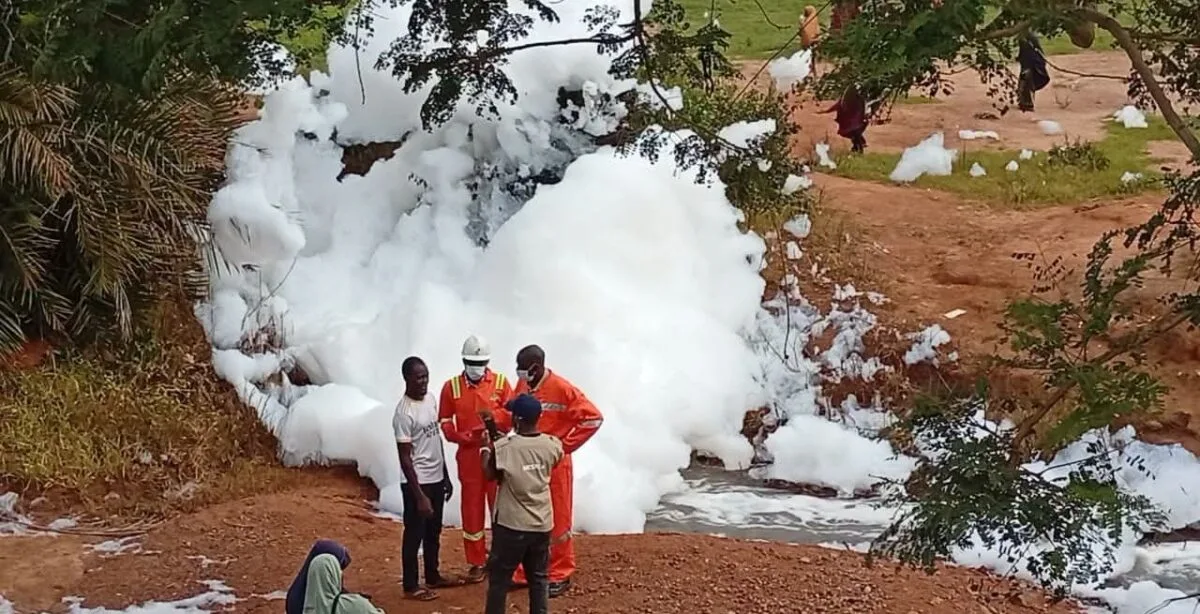
JERE, Nigeria – A thick mass of white foam beside the Kaduna-Abuja Expressway has turned a suspected chemical spill into a roadside attraction, drawing motorists toward an unknown substance while environmental officers collect samples and warn everyone to stay away.
Videos from the Jere area showed large banks of foam covering vegetation, soil, and water near one of northern Nigeria’s busiest roads. Hundreds of travellers reportedly stopped for photographs after social media users described the substance as fallen cloud, snow, detergent, or supernatural activity. None of those claims has scientific confirmation.
The National Environmental Standards and Regulations Enforcement Agency, known as NESREA, opened an investigation after preliminary findings linked the foam to a heavy-duty truck accident. Officials believe the vehicle spilled its cargo beside the highway, though investigators had not identified the material publicly by Wednesday.
NESREA’s Kaduna State Field Office sent a team led by State Coordinator Hena Dangari Emmanuel. The officers met Jere Police Commander Sani Zubairu, local Federal Road Safety Corps personnel, community representatives, and residents. Investigators collected foam, soil, and water from a nearby stream for laboratory analysis.
NESREA told motorists and residents to avoid the foam, nearby water, and surrounding soil until laboratory work ends. The agency cited possible exposure to hazardous materials and urged the public to give investigators room to work.
Many motorists ignored the danger. Isah Aminu, a regular driver on the route, told the BBC another driver first claimed “clouds had fallen from the sky.” Aminu stopped as well, though he avoided touching the foam. He said the mass “looked like snow” and watched other people approach closely.
This public reaction deserves scrutiny. Nigerians live in an age where a strange sight becomes online entertainment before trained officers establish basic safety facts. Phones come out before emergency barriers arrive. Crowds gather before responders identify fumes, runoff, skin hazards, fire risks, or contamination pathways.
White colour does not prove safety. Foam forms when liquids trap gas, often through surfactants which reduce surface tension. Industrial detergents, cleaning agents, firefighting products, agricultural chemicals, and many other mixtures produce foam. Appearance alone offers no reliable guide to toxicity, acidity, inhalation risk, or environmental damage.
Scientists have not identified the Jere material, so naming a specific chemical would amount to speculation. The correct public response stays simple. Keep away. Avoid the stream. Do not touch nearby soil. Do not collect samples. Do not let children or animals enter the area. Anyone who made contact should follow instructions from Nigerian health and environmental authorities.
The World Health Organization defines a chemical incident as an uncontrolled release of a toxic substance with potential harm to human health and the environment. Exposure effects often depend on the chemical, dose, route, and duration. Skin, eyes, lungs, soil, groundwater, crops, and aquatic life all face different risks.
International emergency guidance urges people to move away from suspected releases, avoid contaminated surfaces, follow official alerts, and seek medical attention after symptoms or direct exposure. Such guidance supports NESREA’s warning while laboratory work continues.
Nigeria’s response now needs speed and openness. Authorities should identify the truck, owner, operator, cargo consignor, cargo receiver, transport permit, safety documentation, and accident circumstances. Officials should explain why the substance stayed accessible long enough for crowds to approach.
A proper emergency scene needs visible barriers, traffic control, trained responders, protective equipment, drainage containment, public notices, and medical support. Photographs show NESREA personnel wearing protective clothing near the foam. Similar protection should reinforce one clear message for motorists. Unknown chemicals belong to specialists, not spectators.
The nearby stream creates another concern. Rainfall or natural drainage might spread dissolved material beyond the crash site. Farmers, livestock owners, and households downstream need quick information about water use. Authorities should test water at several points, not only beside the foam, then publish results in language local communities understand.
NESREA holds legal responsibility for enforcing standards on hazardous chemical production, distribution, storage, handling, transport, and disposal outside the oil and gas sector. Nigeria also has national regulations aimed at protecting human health and the environment from hazardous chemicals.
Enforcement must follow evidence. Once laboratory results identify the substance, regulators should publish the name, concentration, health risks, environmental findings, cleanup method, and responsible company. Silence would leave room for rumours. Delay would deepen public distrust. Vague assurances would protect commercial interests ahead of affected communities.
The polluter should also pay for containment, testing, cleanup, restoration, medical screening, and long-term monitoring where evidence supports such measures. Public agencies should not carry the entire cost after a private transporter or cargo owner creates an environmental hazard.
Nigeria’s roads carry fuel, chemicals, food products, gases, industrial inputs, and waste through towns and rural communities every day. A single crash involving poorly labelled cargo places drivers, police officers, firefighters, road workers, residents, and emergency crews at risk. Transport regulators should use the Jere incident to review vehicle condition, driver training, cargo declarations, hazard labels, route planning, insurance, and spill-response duties.
The strange foam also exposes a communication failure. Authorities reached the site, yet viral stories about fallen clouds travelled faster than official facts. Emergency agencies need rapid social-media notices, local-language radio messages, roadside warnings, and regular updates. Speed does not require guesswork. Officials should state known facts, unknown facts, public precautions, and the next update time.
Newsrooms and online creators share responsibility. A dramatic image attracts clicks, but reckless captions send people toward danger. Calling the substance snow or fallen cloud without evidence turns misinformation into a public-health risk. Responsible reporting should resist spectacle and repeat safety guidance.
The Jere foam might prove less dangerous than feared. Laboratory results might also reveal serious contamination. Neither outcome changes the lesson. Unknown substances demand distance, disciplined investigation, and public honesty.
Nigeria now needs more than an explanation for a viral roadside scene. Citizens need proof of a functioning chemical-response system. Authorities must identify the cargo, secure the location, protect nearby water, name responsible parties, and publish laboratory findings.
Curiosity brought crowds to the foam. Government competence must stop curiosity from producing injuries, poisoned water, or another preventable environmental scandal.